
A Santorini sunset tour times a boat trip or a cliff-top walk for the moment the sun sinks behind the caldera islands. It is one of the Greece tours on Santorini.
What is a Santorini sunset tour?
A Santorini sunset tour is an evening outing timed for the sun sinking over the Santorini caldera. Visitors reach the viewing spot either by boat across the water or by road on land. The whole trip is built around watching the light fade.
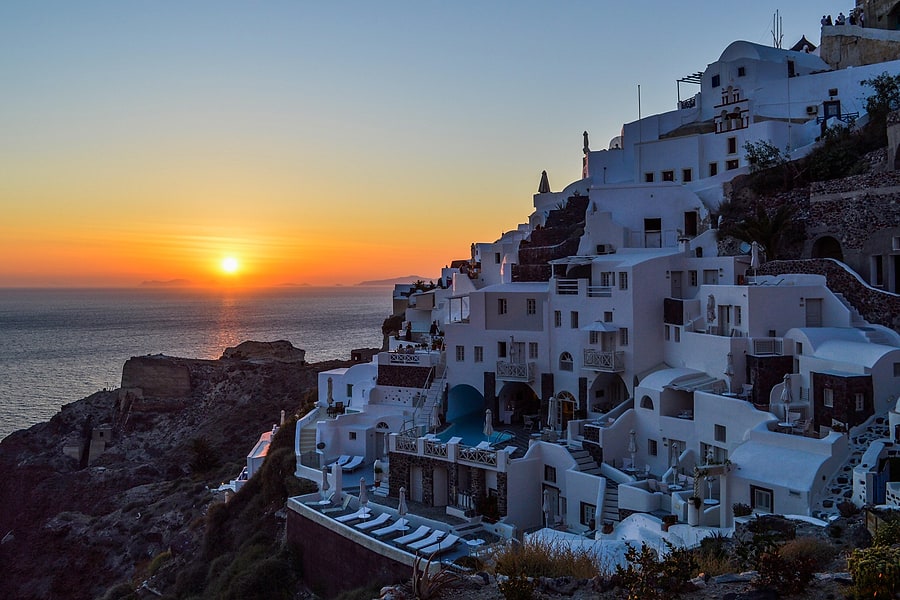
A Santorini sunset tour centres on an island with more than one name. Its official name is Thira, also written Thera. Its waters belong to the southern Aegean. Within a small, ring-shaped group of islands, Santorini is the biggest. That ring of islands was formed by the Santorini caldera.
The caldera behind the view is a large volcanic basin. The basin is largely submerged beneath the sea. An enormous eruption roughly 3,600 years ago gave it this shape. That blast left a large caldera filled with water. Deep ash deposits ring the edge of that flooded basin.
A sunset, or sundown, is the Sun disappearing below the horizon as the Earth rotates. Astronomers mark sunset at the moment the Sun’s upper rim slips below the horizon. Except near the poles, it happens about once every 24 hours. That daily event sets the clock for each Santorini sunset tour.
- Inhabited islands: Santorini and Therasia are the two inhabited islands inside the municipality of Santorini.
- Uninhabited islands: Nobody lives on its other islands: Nea Kameni, Aspronisi, Christiana, Palaia Kameni and Anydros.
- Land area: Together, the islands of the municipality cover 90 square kilometres of land.
High caldera walls and whitewashed villages define the island. A sunny climate adds to that appeal. These three features make Santorini a highlight of Aegean tourism. They give visitors a clear reason to book a Santorini sunset tour.
Why does the sun set over the sea on a Santorini sunset tour?
A Santorini sunset tour works because the island’s towns sit on the western cliffs of the caldera. These cliffs face open water to the west. From the clifftops and from boats in the bay, visitors watch the evening sun sink toward the sea.
Fira shows this layout clearly. Its whitewashed houses stand right on the caldera edge. The town lies on the western side of Thera, a semi-circular island. Because the town faces west, its terraces look out over the caldera water. The sun goes down on that side each evening.
Height adds to the view. Steep cliffs 300 metres high wall in the caldera on three sides. The inner coast drops as one sheer cliff to the sea. The main towns sit on its crest. A Santorini sunset tour therefore offers views from high ground and from sea level.
On a Santorini sunset tour, the sea hides part of the old volcano. The outer edge of the caldera lies under the water. It links the islet of Aspronisi to Therasia and Santorini. Before the Minoan eruption, the only sea entrance to the caldera lay between Thera and Aspronisi.
- Equinox light: At the spring and autumn equinoxes, the sun goes down due west of the island.
- Oia’s position: Oia sits in a spot that gives it wide views of the sunset over the caldera.
- Aspronisi’s size: This small islet is 650 metres in length and 200 metres in width.
From 100 metres above sea level, the sea horizon lies about 36 kilometres away. A viewer on raised ground therefore sees a long stretch of open water before the sun disappears. A Santorini sunset tour builds the evening around that wide outlook.
What does a Santorini sunset tour show in Oia?
A Santorini sunset tour shows Oia as the evening light fades over the caldera. Sunset watching is a special event here every evening. Crowds collect at the Sunset Serenade point as the sun sinks into the sea.
Locals call Oia the “Eagle’s Nest”, a name that suits the view from its cliffs. Visitors look across the caldera toward the Palia Kameni and Nea Kameni volcanoes. Both volcanoes stand out on a Santorini sunset tour as the sky turns orange. Their dark shapes rise from the evening water.
On the walk to the viewpoint, the route passes grand neo-classical mansions. Wealthy ship captains built these homes in the late 19th century. Their wealth came from the sea. Back in 1890, about 2,500 people lived in Oia, and the village had about 130 sailing ships to its name. That history adds depth to the evening walk.
The 1956 earthquake also features on a Santorini sunset tour. Its worst damage hit the western caldera edge, especially Oia. There, parts of the ground collapsed into the sea. In 1979, the Greek National Tourism Organisation earned a Europa Nostra Prize for its Oia work.
- Windmill: An old windmill is one of Oia’s best-known buildings and appears on postcards.
- Castle: Fort Londsa is another name for the ruined castle crowning Oia.
- Cliff houses: Air-filled pumice in Oia’s cliff houses holds warmth in winter and keeps rooms cool in summer.
Oia runs for almost two kilometres on the caldera’s northern rim. After sunset, the walk back follows the cliff path through the village. A Santorini sunset tour ends there, with the caldera fading into darkness below.
What does Ammoudi Bay add to a Santorini sunset tour?
A Santorini sunset tour that includes Ammoudi Bay adds a seaside stop to the evening. The bay is cited as an excellent place for watching the sunset. Its harbour also offers tavernas and a pebble beach, so guests can wait for dusk by the water.
Reaching the bay is part of the experience. By land, the route down starts below the castle of Oia. Walkers take 214 steps to reach the water, while others arrive by road. A Santorini sunset tour that walks down turns the descent into the start of the evening.
Ammoudi also has a trading past. It once served as a harbour for sailing merchant ships. Those ships carried goods from the whole island. Ormos Armeni, below Oia, served as the old port of Oia before Ammoudi Bay. A host can share this story before the sun goes down.
The bay is also a small port for boats. From here, trips head out to Nea Kameni and to Agios Nikolaos islet. A Santorini sunset tour can pair a boat trip with an evening by the harbour. Guests then step ashore at the same port as daylight starts to fade.
- Diving: Ammoudi suits scuba diving, and dive centres are based at the bay.
- Chapel walk: From the Ammoudi settlement, visitors can reach the small chapel of Ai Nikolas tou Peramatari.
- Armeni Bay: Armeni Bay keeps one wharf, where boats get small repairs today.
Six buildings at Ammoudi were restored by the Greek National Tourism Organisation between 1978 and 1980. That work links the harbour today with its working past. For guests, the result is a Santorini sunset tour with sea views and local history.
What does Imerovigli add to a Santorini sunset tour?
A Santorini sunset tour that stops in Imerovigli adds a village with a long history to the evening. Imerovigli lies north of Fira, the island capital. The old rock of Skaros juts out from the cliffs nearby.
The first Skaros fortress carried the name La Roka, which means “Upper Castle”. Work on it was completed in 1207. On a Santorini sunset tour, visitors can picture those early walls in the evening light. From the village path, the rock stands out against the sea like a lookout.
Life on the rock did not stay small. By the Venetian takeover in 1336, the Skaros settlement held over 200 homes. Being the island’s biggest settlement, the fortress acted as the working capital of Venetian Santorini. Seen on a Santorini sunset tour, the rock hints at its busy past.
Nature changed that story. Eighteenth-century eruptions pushed the people of Skaros to leave. They moved to Fira or to nearby Imerovigli, so the village keeps a link to the old town. By the early 19th century, the Venetian fortress stood as weathered ruins. That past gives the stop real depth.
- Village church: The church of Ai-Stratis stands right in the centre of Imerovigli village.
- Local community: Imerovigli counted 469 permanent residents in 2021, so it stays a small community.
- Cliff chapel: The Chapel of Panagia Theoskepasti remains in use on the cliffs below Skaros rock.
Skaros ruins draw hikers and photographers alike. They reach the promontory through nearby Imerovigli, which makes the village a natural gateway. A Santorini sunset tour with this stop joins history, a walk and golden light in one evening.
What does the Akrotiri lighthouse add to a Santorini sunset tour?
A Santorini sunset tour that stops at Akrotiri Lighthouse reaches the island’s south-western end, at Cape Akrotiri. The lighthouse ranks as one of the oldest in Greece. This stop adds real history to the evening, so the trip offers more than a sea view.
The French Lighthouse Company built this lighthouse at Cape Akrotiri on Santorini. The tower itself stands just 10 m tall. That modest height keeps the whole structure in one easy photo frame. On a Santorini sunset tour, a tour leader can share the builder’s story as the light fades.
The light shines from a focal height of 100 m above the sea. Its beam has a range of 24 nautical miles, or about 44 km. Sailors far out at sea can spot the signal after dark. Guests on an evening visit see a working light, not just an old monument.
At first the lighthouse burned oil to produce its beam. That early beam reached about 23 nautical miles, or 43 km. Akrotiri Lighthouse stopped working during World War II. These turns in its story give a Santorini sunset tour a deeper layer than a simple viewpoint.
- Restart: The Greek Navy brought the lighthouse back into service in 1945.
- Electric power: The lighthouse began to run on electric power in 1983.
- Automation: Since 1988, machines have run the light, which is now fully automated.
The Akrotiri area is also known simply as the Cape. A stop there pairs open sea views with a working piece of Greek history. That mix gives any Santorini sunset tour a clear purpose beyond the colours in the sky.
What makes the sky colours on a Santorini sunset tour?
A Santorini sunset tour shows the sky shifting colour as the Sun goes down. Near sunset, sunlight takes a longer path through the air. That longer path removes blue and green light, leaving warm orange and red hues in view.
On a Santorini sunset tour, the colour show starts with how light moves through air. As sunlight crosses the air, blue light is scattered much more strongly than red light. Red light meets far less scattering. This gap between blue and red drives the colour change.
Evening and morning skies do not glow alike. Sunset colours are, as a rule, brighter than sunrise colours. The reason lies in the air itself. By evening, the air carries more particles than it does at dawn. That extra load lifts the brightness of evening colour.
Sky watchers talk of the green flash. In the right conditions, a distinct green spot shows briefly above the Sun’s upper edge. The air scatters blue light out of view, so the last gleam looks green. Green flashes appear at an unobstructed horizon, such as over the ocean. No trip can promise one.
- Golden hour: This is the time before sunset when the sunlight reaching Earth is strongest in red.
- Civil twilight: In this stretch, the Sun’s centre sits between the horizon and 6° below it.
- Afterglow: A broad arch of whitish or pinkish sunlight shows in the twilight sky after sunset.
Red skies also have a place in history. After the Krakatoa eruption of 1883, a striking series of red sunsets appeared around the world. On a Santorini sunset tour, the same rules of light shape each shade before dark.
What does Thirassia show on a Santorini sunset tour?
A Santorini sunset tour that passes Thirassia shows the biggest island of the group after Thera. Thirassia and Therasia are two names for one and the same island. Boats sail past the island or can stop at its harbours.
Seen on a map, Therasia sits north-west of Nea Kameni, the young volcanic islet at the group’s centre. On a Santorini sunset tour, this layout helps passengers make sense of the islands. From the deck, the middle islet catches the eye first. The gaze then moves past it to Therasia.
Manolas serves as the main village and capital of Therasia, a small island facing Santorini. It stands in the east of the island, high above the steep caldera cliff. From the boat, passengers look up at houses on the rim. The drop to the sea looks sharp from the deck.
Therasia also has a surprising link to the Suez Canal. In 1866, quarrymen were digging volcanic ash on the island for the canal works. During that work, the men found primitive structures. A Santorini sunset tour past the island adds this old story to the view.
- By road: Visitors can reach Manolas by road from the port of Riva.
- Korfos path: Donkeys serve as the main transport on the uphill path from Korfos to the village.
- Village style: Small cube-shaped houses with white walls line the narrow streets of this Cycladic village.
At the 2021 census, Manolas had just 140 residents. A community this small offers a quiet view of island life. For passengers on an evening boat, Therasia adds a calm, human side to the caldera view.
What does Pyrgos add to a Santorini sunset tour?
A Santorini sunset tour that climbs inland to Pyrgos reaches the highest village on the island. Its houses rise like an amphitheatre on a hill. From the top, the views stretch across Santorini in almost every direction as the evening light fades.
The hilltop holds the ruins of the Kasteli, a Venetian castle. In the past, the island was run from this fortress. Pyrgos was also one of the five kastelli, or castle settlements, of Santorini. A small-group Santorini sunset tour that stops here lets visitors walk through that history.
Pyrgos keeps the form of a medieval village. Its narrow lanes twist and turn like a maze. The village also has fortified walls and hidden passages. A walk through these lanes before dusk gives the evening a calm start. Visitors see how the old settlement was built for protection.
On the west side of the castle stands the church of Theotokaki. It is among the oldest churches on Santorini. It is believed to have been built in the 10th century. A Santorini sunset tour that pauses at Pyrgos lets visitors see this old church before dark.
- Highest mountain: No mountain on Santorini rises higher than Profitis Ilias.
- Height: The Profitis Ilias mountain reaches a maximum height of 567 metres at its summit.
- Monastery: Building of the Profitis Ilias monastery began in 1711 under monk brothers Gavriil and Ioakeim Belonias.
In 2005, a count recorded 49 churches and chapels around Pyrgos and Profitis Ilias mountain. That number gives an evening stop here a strong sense of faith. As the sun drops, the hilltop village offers a calm pause on a Santorini sunset tour.
Which season suits a Santorini sunset tour?
A Santorini sunset tour suits the season from April to October. At the island’s weather station, April highs average 19.6 °C. In October the station still records an average high of 22.8 °C. Both figures point to mild days on the water.
Late spring brings warmer air to the island. The fifth month sees average highs of 23.3 °C on the island. Light layers are enough for an evening on deck. A Santorini sunset tour in late spring suits travellers who prefer warm days without strong heat.
September stands out as a dry month. The island’s station logs an average of just 3.0 mm of rain that month. Dry evenings keep the deck free of rain. Across the whole year, Santorini averages around 270 mm of rain and a mean temperature near 19 °C.
Day length shapes the trip too. Heraklion on Crete, the nearest large city to the south, offers a regional view. It averages 14.8 daylight hours a day in June. By December, the figure falls to 9.7 hours. Longer days bring a later sunset, so departure times for a Santorini sunset tour shift with the season.
- April rain: April brings an average of 12.1 mm of rain to the island’s station.
- October rain: Rainfall at the same station averages 15.1 mm across the month, so a light jacket helps.
- October lows: October nights at the island’s station average a low of 17.5 °C.
Wind is the last factor to weigh. Over the southern Aegean, the etesian winds come from the northwest. Skippers keep this wind in mind on every Santorini sunset tour. Checking the forecast before booking helps pick a calmer evening.
What questions come up about a Santorini sunset tour?
A Santorini sunset tour raises four common questions before booking. Travellers want to know the way to the island and the local wines for the evening. They also ask what the capital, Fira, offers nearby. Another question is how cruise ships affect evening crowds.
How do travellers get to Santorini for a Santorini sunset tour?
Travellers who arrive by air land at Santorini International Airport, which sits north of the village of Kamari. The same airfield works as both a military and a civil airport. Thanks to its redesigned apron, it can handle up to nine civilian airliners at the same time.
Which Santorini wines can a Santorini sunset tour pair with?
Two OPAP designations of origin protect the island’s wines, and they are Vinsanto and Santorini. Assyrtiko grapes keep their acidity even when they are very ripe. The vines on the island are basket-trained. To passers-by who do not know them, these vines can look like wild bushes.
What does Fira, the island capital, show near a Santorini sunset tour?
Fira’s Museum of Prehistoric Thera covers island history. Its story runs from the Late Neolithic to the first phase of the Late Cycladic period. Builders worked on the Fira cable car from 1980 until 1982. Each gondola carries six passengers, seated in two rows of three.
How does the cruise-ship port shape evening crowds on a Santorini sunset tour?
Cruise passengers reach Scala Pier by tender boat, and the cable car’s Old Port station serves them. The cable car can carry 1,200 passengers per hour, with 600 in each direction. Before a Santorini sunset tour, visitors are advised to ride early or late to avoid crowds.