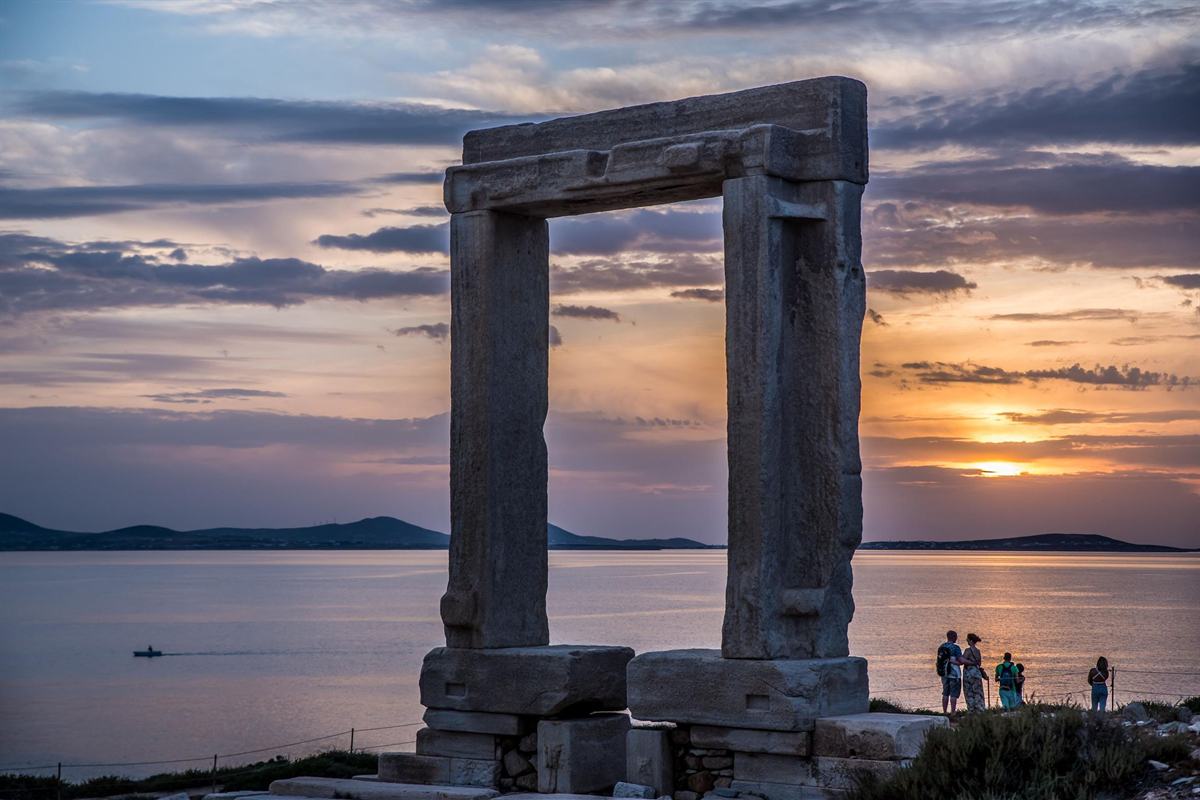
A Naxos tour is a sightseeing trip around the largest island of the Cyclades, from the marble gate of the Portara to the mountain villages inland. It pairs well with the Greece tours that start on Naxos.
What is a Naxos tour?
A Naxos tour is a sightseeing trip, meaning a visit to places of interest, by road around Naxos. Naxos is an island of the Cyclades, a cluster of islands in the Aegean. The trip takes in its town, villages and sights on the island.

Among the Cyclades islands, Naxos is the biggest. It is also the tenth largest Greek island by surface area. The island covers 430 square kilometres and has 148 kilometres of coastline. That size makes a Naxos tour a trip across real distance, not a short stroll in one town.
Naxos lies near the centre of the Cyclades, south of Mykonos. To the west, Paros is 8 kilometres away, across a narrow channel. On the map, Ios sits midway between Naxos and Santorini. These neighbours show where the island sits within the group. A Naxos tour takes place near the centre of that group.
Chora is both the main town of Naxos and its seat of government. The 2021 census is an official count of people living in a place. It recorded 8,897 residents in Chora, out of 20,578 residents on the island. Side by side, those two figures show the size of the town against the whole island.
- Port: Naxos Town’s port carries ferry traffic for people and goods to and from the island.
- Fertility: Naxos is the island with the greatest fertility among the Cyclades islands.
- Mountain range: The range drops steeply in the east and gently in the west, toward land good for growing crops.
Tourism is travel for pleasure, together with the business of providing and supporting that travel. So a Naxos tour is a pleasure trip for visitors and also part of that business. The travellers enjoy the trip, and the business keeps it running.
Which old quarters of Naxos Town does a Naxos tour show?
A Naxos tour winds through the old Venetian castle quarter and the lanes below it in Naxos Town. Kastro and Chora are the old quarters of the town. Kastro is the plain word for the old castle quarter of the town.
Marco Sanudo founded the Kastro in 1207, and Venetian and Latin lords lived inside it. The Kastro is a round fortress built over the hilltop that held the ancient acropolis. An acropolis is the high fortified part of an ancient city. So a Naxos tour walks over ground with an ancient past.
The Kastro had three gates, and two of them still stand today. Stonework tells its own story at Trani Porta. There, a vertical cut in a marble pilaster was a Venetian measure for fabric lengths. A pilaster is a flat column set into a wall. That one cut ties the stone to Venetian trade.
The Della Rocca Barozzi Tower counts among the oldest mansions in the Kastro area. The Tower of Crispi is the only survivor of the twelve towers believed to have protected the Kastro. A Naxos tour then takes in both towers, which link an old mansion with the Kastro’s old defences.
- Catholic Cathedral: This medieval building has a marble floor and memorial stones bearing family crests.
- Bourgos: This lower town below the castle has narrow, covered alleyways forming a virtual labyrinth with unexpected dead ends.
- Joined houses: Bourgos’s joined houses formed a wall that protected the settlement from invaders arriving by sea.
The Paralia seafront has a pedestrian street of shops and restaurants plus a walkway by the sea. A Naxos tour reaches Grotta, the site of the Mycenaean city of Naxos. Mycenaean means from the Bronze Age Greek mainland culture. Its remains are partly underwater.
Why does the Portara draw a Naxos tour?
A Naxos tour includes the Portara, the huge marble gateway of an unfinished temple to Apollo. The temple sits on an islet beside Naxos Town. A causeway built in 1919, a raised path across water, joins the islet to the town.
Work on the temple began around 530 BC under the tyrant Lygdamis. A tyrant is a ruler who took power by force. Work stopped by around 524 BC at the latest, when a Sparta-led alliance removed Lygdamis from power. That fall from power is the history that a Naxos tour meets at the gate.
The temple followed the Ionic order, a style of Greek column and building. It measured 38 metres in length and 16 metres in width. The marble door frame has five pieces, and it originally had four. Each piece weighs up to 20 tons. On a Naxos tour, the frame shows how large the work was.
Carved bumps on the marble pieces held ropes to lift the pieces by wooden crane. Builders normally remove such bumps at the end of construction. These bumps are still there, which shows the temple was never completed. The marks are a clear record of how the builders lifted the heavy marble pieces.
- Castle reuse: During the Venetian period, parts of the temple were reused to build the Castle of Naxos.
- Direction: The temple faces the holy island of Delos, close by.
- Sunset crowds: Large crowds gather at the temple during the sunset, so the gate is busy then.
The massive marble pieces of the gate were left in place. This is thought to be because they were too heavy to move. That is why a Naxos tour finds the gate still standing right where the builders left it.
Which hill villages does a Naxos tour cross?
A Naxos tour climbs from the coast up to the mountain villages Halki, Filoti and Apiranthos. Each village has its own history, its own buildings and its own story. Together they show the inland side of the island, which lies away from the sea.
Halki is one mountain village that a Naxos tour can include in its route inland. The grand Barotsi tower, later called Gratsia, dates from the early 17th century and was raised by a Venetian family. Panagia Protothronos in Halki has five layers of decoration, from early Christian times to the 13th century.
Filoti stands 400 metres up and lies about 18.2 kilometres from Naxos Town. Altitude is the height of a place above sea level. The village sits below Mount Zas, with the mountain rising above it. The 2021 census, an official headcount, found 1,617 residents in Filoti.
A Naxos tour can also reach Apiranthos. Apiranthos had 722 residents in the 2011 census, making it the second largest village on Naxos after Filoti. Its dialect, a local way of speaking, resembles that of mountain Cretan villages. For that reason, one view holds that Cretans built Apiranthos in the 10th century.
- Towers: Apiranthos grew around two 17th-century towers that once belonged to Frankish landowners, medieval Latin and Venetian lords.
- Lanes: The village keeps its Venetian architecture and narrow cobbled lanes with arches.
- Museums: The four museums are archaeological, folk art, geological and natural history.
Keramoti, Apiranthos, Koronos and Komiaki together form the emery-producing area of Naxos. Emery is a hard rock that is used to grind and polish. A Naxos tour that reaches Apiranthos therefore enters the emery area, a working part of the island.
What does Mount Zas add to a Naxos tour?
A Naxos tour adds Mount Zas, the tallest peak of the Cyclades. It rises above the village of Filoti and brings together Greek myth, ancient history and wide sea views. It gives the island a story as well as a skyline to remember.
Mount Zas, on the island of Naxos, rises 1,001 metres. The village of Filoti lies about 18.2 kilometres from Naxos city. Anyone planning a Naxos tour can use that distance to place the mountain on a map. The name Zas comes from the Greek god Zeus, so the mountain carries the name of a god.
Myth says Zeus spent his childhood on Mount Zas, after being taken from a cave on Crete. The story is a myth, so it belongs to old tales, not to recorded history. On a Naxos tour, the peak is where the old tale of the young god is set.
The Cave of Zas lies 630 metres above sea level, south-east of Filoti. Inside the cave, the chambers are up to 11 metres long. They hold large stalactites, which are mineral spikes hanging from a cave roof. They also hold large stalagmites, which are mineral spikes rising from a cave floor.
- Carving: Near the cave, a carving in the rock says “Zeus Melosios”, calling Zeus the protector of the sheep.
- Inscriptions: Two identical inscriptions on rock were carved by the same technician in the 4th century BC.
- Routes: Two routes reach the summit, and the easier one starts at the Agia Marina chapel.
People used the Cave of Zas from the Late Neolithic, the end of the Stone Age. Use went on until Early Cycladic III, a late part of the Bronze Age in the Cyclades. That long past gives a Naxos tour a deeper story.
Which ancient sites does a Naxos tour pass?
A Naxos tour reaches ancient marble sites away from the main town. These include the giant unfinished kouros at Apollonas and the temples near Sangri on the island. A kouros is a statue from ancient Greece that shows a young man standing.
At Apollonas, a Naxos tour finds an unfinished giant statue, 10.45 metres high. It is the largest known sculpture of Archaic times. Archaic is the Greek period of the 7th to 6th centuries BC. Academic works leave Gruben’s view undisputed: the monolith, a single block of stone, was too heavy to transport.
A Naxos tour can include the Flerio kouros, whose full height is calculated exactly at 5.55 metres. The Flerio statue broke at the legs in an accident while being moved lower down the quarry. The kouros was carved early in the 6th century BC, like the Gorge kouros.
The Temple of Sangri was built around 530 BC and is among the oldest Ionic temples. Ionic is a style of ancient Greek building. Scholars call the Gyroulas temple a ritual hall of Demeter and Kore. Demeter is the Greek goddess of grain, and Kore is her daughter, also called Persephone.
- Sangri: A partial restoration of the temple finished in 1994, and a small site museum opened in August 2001.
- Yria: Work on the fourth and largest temple began around 580-570 BC, and only that temple is restored.
- Gyroulas: Excavation showed the temple was built entirely of marble, from the walls to the roof tiles.
A smaller church of Saint John the Theologian was later built inside the apse of the Gyroulas basilica. An apse is the rounded end of a church, and a basilica is a big church from the early Christian era. A Naxos tour can reach this place too.
Which beaches does a Naxos tour reach?
A Naxos tour passes the long sandy beaches south of Naxos Town. These include the beaches of Agios Georgios, Agios Prokopios, Agia Anna and Plaka. Not every tour stops to swim at these beaches, so the plan for the day is worth checking.
Agios Georgios beach lies 1 km from the Naxos port, which puts it close to the town. Its fine sand and the clear, shallow water suit families with young children. For that reason, a Naxos tour with a family group can treat this beach as a gentle stop.
Agios Prokopios beach lies 4 km from Naxos port and 5 km from the main town, Chora. It is a very long beach of coarse sand, which means sand made of larger grains. A Naxos tour that reaches this beach sees a setting that includes both sand dunes and crystal-clear waters.
Agia Anna beach lies 5 km from Naxos port and 6 km from Chora. Plaka offers a long strip of golden sand that carries on from Agia Anna beach. Greece’s Blue Flag programme names Agios Georgios, Agia Anna and Agios Prokopios among the awarded beaches of Naxos. A Blue Flag goes to beaches with clean water and good safety.
- Limanaki beach: This beach lies west of Mikri Vigla and stretches 3,200 metres as far as Kastraki village.
- Alyko Beach: This beach lies about 17 km from Naxos Town, well beyond the beaches near the port.
- Pyrgaki: This very long sandy beach on the south-western coast has views toward Iraklia and Ios.
Mikri Vigla village lies about 18 km south of the city of Naxos. That is farther out than the beaches near the port of Naxos. Travellers who want a swim on a Naxos tour can ask the tour leader which beaches are included.
What food and drink does a Naxos tour taste?
A Naxos tour offers tasting stops with local potatoes, cheeses and a citron liqueur. Citron is a large lemon-like fruit. The stops present food and drink tied to the island. Each taste links back to the land and the people behind it.
The potato has its own story on a Naxos tour. Patata Naxou is a registered PGI potato name, with EU protection from 27 June 2008. The PGI label, short for Protected Geographical Indication, marks goods linked to one place. Growers cure the harvested potatoes under cover of straw, which dries them so they keep.
Graviera Naxou is a registered PDO cheese name, with EU protection dating from 21 June 1996. The PDO label, short for Protected Designation of Origin, marks goods made in one place with local methods. Graviera of Naxos is made with 80 to 100 percent cow’s milk. Cow’s milk is the main part of the cheese.
Arseniko Naxou is a hard table cheese that a Naxos tour can include at a tasting stop. Makers traditionally use non-pasteurised sheep’s and goats’ milk, which is milk not heated to kill germs. The cheese is left to mature for at least three months before release. Each whole wheel carries a PDO label.
- Taste: Arseniko Naxou has an intense taste, described as spicy and bittersweet.
- Texture: The cheese also has a buttery, soft texture, which describes how it feels in the mouth.
- Aroma: Arseniko Naxou has a rich aroma, so smell is part of the tasting too.
A Naxos tour can stop for Kitro of Naxos liqueur. Its flavour comes from leaves, shoots and fruit of the citron tree (Citrus medica). It has been produced as a brand since 1896, when Naxos licensed its first distillery.
What history and myths frame a Naxos tour?
A Naxos tour moves from Greek myth to the real history of the island. In the story, Theseus abandoned Ariadne on the island of Naxos. In the Bronze Age, Naxos was an important centre of Cycladic culture. The word Cycladic means of the Cyclades islands.
The story says Dionysus saw Ariadne sleeping on Naxos, fell in love with her and married her. Visitors on a Naxos tour hear this love tale as a myth, not as recorded history. One myth sets the childhood of the young Zeus in a cave on Mount Zas on Naxos.
Cycladic culture is famous above all for its flat figures of women. Makers carved these figures from the white marble of the islands. Early Cycladic culture evolved in three phases, starting around 3100 BC. Those phases show that the culture changed and developed over time. The figurines remain the best-known sign of this culture today.
In 1207, the Venetian nobleman Marco Sanudo created the Duchy of the Archipelago. A duchy is a land ruled by a duke. The Ottomans annexed that duchy in 1579, which means they added it to their own lands. A Naxos tour follows this change of rule on the island, from Venetian to Ottoman.
- Marble: Naxian marble made the roof tiles of buildings at ancient Olympia and the Athenian Acropolis.
- Emery: Naxos is famous for emery, a grinding and polishing rock rich in corundum, a very hard mineral.
- Statehood: Naxos became part of the fully independent Greek state in 1830.
Together, myth, early art, changing rulers and stone give the island’s past its layers. Each stop on a Naxos tour adds one new layer to the story of the island. Visitors leave knowing why the island’s history is told in both legend and fact.
What questions come up about a Naxos tour?
A Naxos tour is served by an airport on the island. The Small Cyclades are a group of small islands beside Naxos. Temperatures and rain differ between April, July and October at the Naxos town station. The Archaeological Museum of Naxos holds collections of figurines and vases.
Which airport serves a Naxos tour?
Naxos Island National Airport stands near Agios Prokopios, a place on the island of Naxos itself. The airport lies 3 km from Naxos city. A traveller who lands there is that far from the city. The runway at the airport is 900 metres long.
Which small islands lie beside a Naxos tour?
The Small Cyclades are a cluster of islands in the Aegean Sea, inside the Cyclades archipelago. They lie south-east of Naxos and comprise 32 islands and rocks. Four of the Small Cyclades are inhabited, meaning people live there: Ano Koufonisi, Irakleia, Donousa and Schoinoussa.
Which season suits a Naxos tour?
Naxos town station highs average 18.7 °C in April, 27.1 °C in July, 21.9 °C in October. Naxos town station precipitation (rain) averages 17.6 mm in April, 0.9 mm in July, 38.6 mm in October. Naxos town station averages 6.0 precipitation days in April, 0.4 in July, 5.5 in October.
What does the Archaeological Museum of Naxos hold near a Naxos tour?
The museum building, a historic monument, sits atop the Kastro. Its Early Cycladic marble figurines, from the Cyclades’ Bronze Age, rank second only to Athens’ National Archaeological Museum. It holds vase collections from the Mycenaean and Geometric periods. Geometric means an early Greek period named for pottery patterns.