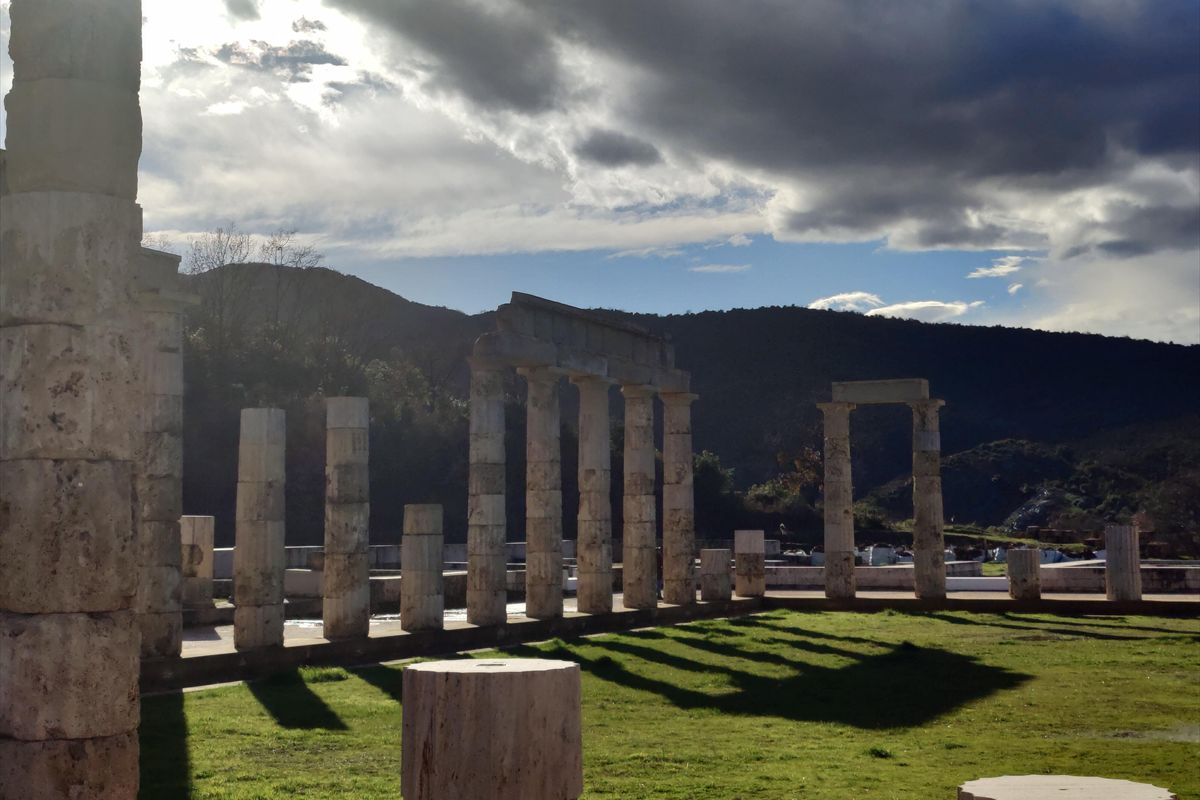
A Vergina day trip is a visit to Vergina, the village in northern Greece where the ancient Macedonian capital of Aigai stood. It is one of the history-and-archaeology Greece tours that start from Thessaloniki.
What is a Vergina day trip?
A Vergina day trip is a visit to Vergina, a small town in the Greek region of Macedonia. The town lies in Imathia, Central Macedonia, within Veroia municipality, an area run by one local council. It is best known as the site of ancient Aigai.

Macedon had Aigai as its first capital. A capital is the city where a ruler and a government sit. Aigai also has UNESCO World Heritage Site status, so UNESCO names it on its World Heritage list. That status is one reason to plan a Vergina day trip around the site.
UNESCO calls Aigai exceptional evidence of the change from the classical city-state to rule by an empire. Evidence is proof that shows what happened. A city-state is a city that rules itself. Imperial structure means rule by an empire, which governs other lands. Classical refers to the ancient world of Greece and Rome.
Vergina was its own municipality until 2011. It then merged with Veroia under the Kallikratis Plan, a Greek plan for joining local councils. In 2011, the Vergina municipality had 2,464 residents, and 1,242 of them lived in Vergina itself. A Vergina day trip therefore goes to a small community, not a city.
- Modern town: In 1922 the modern settlement grew up between the older villages of Kutlesh and Barbes.
- Settlers: Greek families from Asia Minor, now in Turkey, settled the town when Greece and Turkey exchanged populations.
- Name: The metropolitan of Veroia, a senior church leader, suggested the name Vergina, taken from a legendary queen.
The archaeological museum of Vergina was built to house the artifacts found at the site. Artifacts are objects that people made or used long ago, and archaeology studies them. A Vergina day trip can include the museum, where those finds are kept.
What was Aigai on a Vergina day trip?
A Vergina day trip leads to the site of ancient Aigai, which was the original capital of Macedon. Macedon was the ancient kingdom of the Argeads, the people who ruled it. It lay in the region called Lower Macedonia.
The city lay in the valley of the Haliacmon, on the lower slopes of the Pierian Mountains. Lower slopes are the ground at the base of a mountain range. Aigai lay between Vergina and Palatitsia. A Vergina day trip therefore explores the ground between those two places, where the city once stood.
The name Aigai relates to the Greek word for goat and translates as ‘goat town’ in English. Diodorus said an oracle told Perdiccas the First to found his city where white-horned goats rest at dawn. An oracle is a holy place or voice believed to pass on the will of the gods.
In the first years of the 4th century BC, Archelaus shifted the Macedonian capital northeast to Pella. A capital is the city where the government of a kingdom sits. After that move, Aigai no longer held that rank. A Vergina day trip therefore explores the story of an older capital of the kingdom.
- Sacred city: Aigai stayed Macedon’s sacred city, with worship sites, a royal palace and graves of kings.
- Archaeology: Léon Heuzey of the French School at Athens led the first archaeological mission at Aigai in the 1860s.
- Euripides: He wrote and presented his last tragedies, which are serious stage plays, at Aigai.
Aigai joins a legend, a royal past and modern study in one valley. A Vergina day trip tells how those parts fit the land around them. No single tour covers every site, so the stops depend on the tour chosen.
Who lies in the Royal Tombs on a Vergina day trip?
A Vergina day trip reaches the Royal Tombs. There Andronikos named Tomb II as the resting place of Philip II, Alexander the Great’s father. Who lies in each tomb is still debated, so each name given here is only one view among others.
Andronikos became convinced that the Great Tumulus hill concealed the tombs of the Macedonian kings. A tumulus is a mound of earth built over a grave. In 1977 he uncovered four buried tombs, and two of them had never been disturbed. That discovery is the heart of a Vergina day trip.
The Golden Larnax is made of 24-carat gold and weighs 11 kilograms. A carat is a measure of gold purity, and 24 is the top mark. A larnax is a small chest that holds the bones of the dead. Its lid carries the sixteen-rayed Sun of Vergina, a sun symbol with sixteen rays.
A 5.6-metre hunting painting above the Doric entrance is thought to show Philip and Alexander. The Doric style is an ancient Greek way of shaping columns. The tomb’s single wall painting shows Persephone seized by the God of the Underworld. A Vergina day trip rests on readings like these, each a view.
- Tomb III: Andronikos identified it as the resting place of Alexander IV, whose parents were Alexander the Great and Roxana.
- Bartsiokas study: It says Tomb I held Philip II and Tomb II belonged to Philip III.
- Persephone painting: It is believed to be the work of the painter Nicomachus of Thebes.
A golden wreath inside the golden larnax held 313 oak leaves and 68 acorns. Acorns are the nuts of the oak tree. Finds like this wreath turn a Vergina day trip into a close look at royal history.
What does the Museum of the Royal Tombs hold on a Vergina day trip?
A Vergina day trip leads to a museum of grave goods, which are objects buried with the dead. The collections were recovered from digs, called excavations, that began in 1861. The museum sits 75 km west of Thessaloniki, centered around the royal tombs of Aigai.
Among the tomb objects in the collection is a silver and gold diadem with a Heracles knot. A diadem is a headband worn as a sign of royal power. The Heracles knot is a decorative knot. On a Vergina day trip, this headband shows what a royal tomb held.
The tomb also held silver and bronze vessels from the funeral feast, a meal linked to a burial. Vessels are containers for food and drink. Carved ivory ornaments from the couch were found there too. Ivory is the hard, pale material that comes from elephant tusks. Bronze is a metal made from copper and tin.
In the tomb attributed to Philip II, gold armour and greaves were also found. Greaves are armour worn to protect the lower legs. One greave was custom fitted to Philip’s deformed leg, so it was shaped to suit that leg. On a Vergina day trip, the greave shows armour fitted to one person.
- Setting: The underground museum began construction in 1993 and was inaugurated, meaning officially opened, in 1997.
- Layout: The exhibits are presented in four areas that connect to one another.
- Gateway: The entrance holds a partly outdoor display of sculptures found in the city sanctuaries, or holy places.
The museum also presents jewelry and body adornments from the 9th century BC Lady of Aigai. Body adornments are ornaments worn on the body, and BC marks years counted back from year one. Her pieces add to what a Vergina day trip offers.
What does the Palace of Aigai show on a Vergina day trip?
A Vergina day trip leads to the Palace of Aigai, which was the largest building in classical Greece. The palace stands on a plateau, which is flat high ground. That plateau lies directly below the acropolis, the high upper part of the ancient city.
Excavations date the construction of the palace to the reign of Philip II of Macedon. One suggestion names the architect Pytheos of Priene as the designer. The name is only a suggestion, not a settled fact. On a Vergina day trip, that question about the designer stays open.
A large courtyard, an open yard inside a building, forms the palace’s centre. Doric colonnades flank it. A colonnade is a line of columns, and Doric is a column style of ancient Greece. On the north side, a big gallery faced the stage of the neighbouring theatre. It also faced the Macedonian plain.
The palace was decorated with mosaic floors, walls of painted plaster and fine relief tiles. A mosaic is a design of tiny stones in a floor, and relief tiles carry raised shapes. High-quality marble stucco, a fine plaster, covered the stonework and building parts. These finishes give a Vergina day trip its picture of a royal home.
- Columns: Nearly 30 large columns around the main peristyle, a ring of columns, have been reconstructed.
- Mosaics: More than 5,000 square feet of mosaics, among them the myth scene of Europa’s abduction, have been conserved.
- Restoration: Angeliki Kottaridi led the restoration work at Aigai in the 2000s.
Taken together, these parts let a visitor read the palace like a plan of a royal home. A Vergina day trip turns old stone into a clear set of rooms, walkways and decorated surfaces. That clear picture is what the visit offers.
What does the Theatre of Aigai show on a Vergina day trip?
A Vergina day trip can include the Theatre of Aigai, where Philip II fell. He had come for the wedding of Cleopatra, his daughter, and King Alexander of Epirus, a neighbouring kingdom. The theatre marks where that royal wedding day took a sudden turn.
The theatre belongs to the later half of the 4th century BC and lies close to the palace. Visitors on a Vergina day trip learn that Philip entered it unprotected. He wished to appear easy to approach for the Greek diplomats and dignitaries at the event. Diplomats speak for their states, and dignitaries are important guests.
The attacker was Pausanias of Orestis, one of Philip’s seven bodyguards. A bodyguard is a person whose job is to protect a ruler from harm. After the killing, Pausanias ran for his associates, who were waiting with horses at the entrance to Aegae. Associates are people who were connected to him.
Three of Philip’s other bodyguards chased the assassin, the person who had carried out the killing. His horse tripped on a vine. Alexander the Great, Philip’s son, was proclaimed king of Macedonia on the spot. Proclaimed means publicly announced as the new ruler. A Vergina day trip tells this story at the theatre.
- Eukleia: Among the excavated remains is the sanctuary of Eukleia, a sacred place set aside for worship.
- Mother of the Gods: The site also holds the sanctuary of the Mother of the Gods.
- City walls: The excavated remains also include the walls of the ancient city.
Excavators are experts who carefully dig up and study the remains of ancient places. They uncovered the royal capital’s theatre in the 1950s and 1960s. Thanks to their work, a Vergina day trip tells the story of that royal wedding day.
Who was Philip II behind a Vergina day trip?
A Vergina day trip is easier to follow with one name in mind: Philip II. He ruled the kingdom of Macedon from 359 BC until his death. That reign gives a visitor a clear frame for the whole period and its main events.
Two events from his reign are worth knowing. About 7,000 Illyrians, an ancient people, died when Philip defeated them at the battle of Erigon Valley. In 356 BC Philip conquered the town of Crenides and renamed it Philippi. Knowing these events lets a Vergina day trip feel like part of a longer story.
In 338 BC Philip defeated an alliance of Thebans and Athenians at the Battle of Chaeronea. These were people from the two Greek cities of Thebes and Athens. In 336 BC he sent Parmenion and an army of 10,000 men into Asia Minor. That region lies in modern Turkey.
In 338/7 BC Philip was recognized as military leader of the League of Corinth, a Greek confederation. A confederation joins states by agreement. Cavalry means soldiers on horseback. Philip’s cavalry grew from 600 riders to 4000 between the Illyrian battles and 334 BC. Those numbers give a Vergina day trip a military backdrop.
- Phalanx: Philip created the Macedonian infantry formation, a block of foot soldiers.
- Sarissa: Each soldier in the phalanx carried this long spear.
- Aigai: This was the ancient capital of the kingdom of Macedon, meaning its main city.
Philip was assassinated in October 336 BC at Aigai. That event closes the story of his reign. Once the dates, battles and army are clear, a Vergina day trip makes more sense. Every name and number above then has a place.
What does Pella add to a Vergina day trip?
A Vergina day trip gains a royal city when a tour adds the stop at Pella. Pella served as capital of the ancient Greek kingdom of Macedon up to the Roman conquest in 168 BC. A visit shows the city where that kingdom was ruled.
Pella saw the birth of Philip II in 382 BC and, later, of Alexander the Great in 356 BC. A Vergina day trip that includes this stop reaches the birthplace of both men. The ancient site is 1 km away from the modern town of Pella, in the region of Central Macedonia.
In ancient times Pella was a port in Lower Macedonia. An inlet, an arm of the sea reaching inland, linked the port to the Thermaic Gulf. Since then the harbour and gulf have silted up, filling with mud and sand. That change left the site of Pella inland, away from the sea.
Digs by archaeologists at Pella revealed rooms with mosaic floors. A mosaic is an image formed from tiny pieces of stone. The floors show a lion hunt. They also show Dionysus, a god of Greek myth, riding a panther, a large wild cat. These scenes add story to a Vergina day trip that stops at Pella.
- Street plan: Pella’s streets follow a grid plan: parallel lines that meet at right angles.
- Museum: Mosaic floors from the Houses of Dionysus and of the Abduction of Helen are displayed in the museum.
- Palace hill: The palace, a royal home, stands on a 70 m high hill north of the city.
Unlike the palace at Aigai, Pella’s palace was also a place of government, where the kingdom was run. That difference gives a Vergina day trip with a Pella stop a clear point to compare. It was a seat of power too.
Which river and mountains lie near a Vergina day trip?
A Vergina day trip has two natural landmarks: the Haliacmon, Greece’s longest river, and the Vermio Mountains. The Haliacmon measures 297 km in total length and flows entirely on Greek soil. The Vermio Mountains form a range, which is a long chain of connected mountains.
A Vergina day trip reader learns that the Haliacmon begins in the Gramos mountains, near the Albanian border. The river also feeds Lake Polyfyto, an artificial lake, meaning one made by people. It was made after a hydroelectric dam, a wall holding back water to make electricity, was built.
Southeast of Veria, the Haliacmon enters the central Macedonian plains, which are wide areas of flat land. The river also crosses the Imathia and Pieria regional units of Central Macedonia. A regional unit is a set area of government inside a larger region, such as Central Macedonia. The river passes through two of them.
A map made for a Vergina day trip can show where the Haliacmon ends. The river reaches the sea west of the delta of the Axios, which is also called the Vardar. A delta is low, flat land that forms where a river drops mud and sand at the sea.
- Vermio location: The Vermio Mountains lie between the Imathia and Kozani regional units.
- Foot of the range: Veria, the capital of Imathia, stands at the base of the Vermio range.
- Chamitis peak: Chamitis peak, 2,065 metres high, is the top of the Vermio range and lies west of Naousa.
Planners of a Vergina day trip also meet the Haliacmon’s drainage basin, which covers 8,813 square kilometres. A drainage basin is the territory drained by one river and its streams. Water from all of that land finds its way into the Haliacmon.
What questions come up about a Vergina day trip?
A Vergina day trip is served by Thessaloniki Airport and starts in the city of Thessaloniki. The Vergina site lies close to the town of Veria. April, July and October bring different temperatures and rain, so the season shapes the day.
Which airport serves a Vergina day trip?
Thessaloniki Airport has the IATA code SKG, a three-letter label for airlines. Its ICAO code, a four-letter label for air traffic control, is LGTS. It has two terminals (passenger buildings), set in a T-shape. The control tower stands in the junction between them. In 2019 it handled 6,897,057 passengers.
Which season suits a Vergina day trip?
Aristotle University station gives April, July and October average highs of 19.7 °C, 32.3 °C and 22.1 °C. Aristotle University station logs average precipitation of 37.5 mm, 27.0 mm and 43.7 mm in those months. Thessaloniki Airport station averages 11.1, 6.7 and 9.3 precipitation days (rainy or snowy days).
Which town lies nearest to a Vergina day trip?
Veria serves as capital of Imathia, a regional unit. A regional unit is a government area within Greece. The municipality of Veria, a local government area, had a population of 62,655 in 2021. From Veria’s city centre, the Vergina archaeological site is 12 km to the south-east.
Which city is the usual start for a Vergina day trip?
Cassander of Macedon founded the city of Thessaloniki in 315 BC, counting years back from year 1. Thessaloniki was built 40 km southeast of Pella, the capital of the Kingdom of Macedonia. The municipality of Thessaloniki covers 19.307 square kilometres, a unit for measuring area.