
An Agistri Aegina cruise is a day at sea from Athens to two islands of the Saronic Gulf, with swim stops between them. It sits among the Greece tours that start from the Athens coast.
The sections below cover the start points, the sea route, Aegina, Agistri, the small islands on the way, the history of these waters and common questions.
What is an Agistri Aegina cruise?
An Agistri Aegina cruise is a day cruise from Athens that links the islands of Aegina and Agistri. Both islands sit in the Saronic Gulf of Greece. Passengers leave the city by sea, visit both islands in one outing and come back the same day.
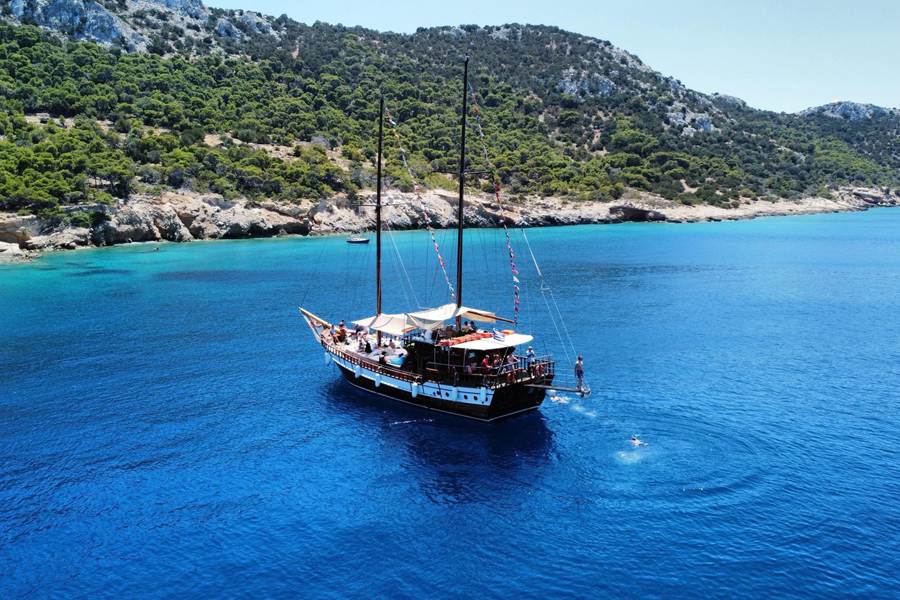
Maritime cruising covers leisurely trips on yachts and cruise ships. These trips range from simple day trips to long voyages around the whole world. An Agistri Aegina cruise belongs to the short end of that wide range of trips. It keeps the relaxed, unhurried spirit that defines all sea cruising.
Aegina’s own municipality sums up the island with two ideas that fit a short sea trip. The island lies close to Athens, and yet it still gives visitors a real sense of escape. In the 2021 Greek census, the settlement of Aegina town counted 6,633 permanent residents.
Agistri is the other half of an Agistri Aegina cruise. The 2021 Greek census gives a clear picture of who lives in its settlements. Megalochori counted 627 permanent residents at that time. Skala, another settlement on the island, counted 326 permanent residents. Both figures describe year-round residents, not summer visitors.
- Culture: Aegina’s strong cultural identity rests on the Temple of Aphaia, Saint Nektarios Monastery and Kapodistrian buildings.
- Island life: Beaches, traditional villages, the landscape and pistachio-led local produce give Aegina an authentic, hospitable character.
- Tourism: Aegina is a popular tourist stop today, and holiday home building has boomed on the island.
Two more settlements on Agistri also appear in that same census. Metochi counted 71 permanent residents, while Limenaria counted 60. Numbers this low point to village life on a small scale. An Agistri Aegina cruise shows passengers this side of the Saronic Gulf.
Where does an Agistri Aegina cruise start?
An Agistri Aegina cruise sets out from the Athens shoreline. Two harbours there stand out for island trips. Piraeus is a huge passenger port with heavy traffic. Flisvos Marina is the second option, with a past link to Aegina day-cruises from its quay.
Piraeus is a key harbour to know before an Agistri Aegina cruise. By 2015, it served 8.1 million passengers a year. That total made it the EU’s sixth-largest passenger port. Its western part handles cargo services. Parts of the Themistoclean Walls and the Eëtioneia mole still survive in good condition at the harbour entrance.
Flisvos Marina has its own sea story. A Greek cruise ship made day-cruises from there to Hydra, Aegina and Poros. Marina names can confuse first-time visitors. The Athens Marina at Phaleron was formerly called Faliro Marina. On the Piraeus railway, the Faliro and Moschato stations opened in 1882.
Travellers with spare time before an Agistri Aegina cruise can explore the old shore of Phaleron. Pausanias placed Phaleron on the coast. He set it 20 stadia from Athens, and the same 20 stadia from Cape Kolias. The ancient site appears to be the headland around the church of St George.
- Metro stop: Alimos station is the nearest metro stop to Alimos, in the east of the municipality.
- Coast road: Poseidonos Avenue runs along the coast as one of the main roads of Alimos.
- Other main roads: Kalamakiou Avenue and Alimou Avenue are the two other main roads of Alimos.
An Agistri Aegina cruise begins where Athens meets the sea. Piraeus brings scale and old harbour walls. Flisvos Marina brings a past of island day-cruises. Checking the exact harbour name on the booking avoids a wasted trip to the wrong quay.
What volcanic coast surrounds an Agistri Aegina cruise?
An Agistri Aegina cruise sails the Saronic Gulf, where fault lines dominate, above all in the northwest. Volcanic Methana lies in the gulf’s southwest, along with Kromyonia at the Isthmus, Aegina and Poros. Sousaki, a dormant volcano, stands in northeastern Corinthia.
Fault lines dominate the Saronic Gulf. The northwestern part of the gulf shows this pattern above all. The sea and shore around an Agistri Aegina cruise sit inside this faulted zone. Beaches line stretches of the gulf coast. One stretch runs from Galataki to Kineta. Another stretch runs from Megara to Eleusis.
Methana is a volcano peninsula about 50 km southwest of Athens. Volcanic activity there began 1 million years ago. It went on from time to time until 300 years ago. Tectonic faults cut across the peninsula, so the risk of earthquakes stays high. The major fault cuts the town of Methana from west to east.
Sousaki is a dormant volcano and solfatara field in northeastern Corinthia. It was active during the Pliocene and early Quaternary periods. Its last eruption was a side eruption. That eruption created new land in the Gulf of Megara. Sousaki brings the volcanic theme of an Agistri Aegina cruise onto dry land.
- Methana: This volcano peninsula lies about 50 km southwest of Athens and is crossed by tectonic faults.
- Sousaki: This dormant volcano and solfatara field sits in northeastern Corinthia and last erupted from its side.
- Kromyonia: This spot at the Isthmus shares the gulf’s southwest with Methana, Aegina and Poros.
An Agistri Aegina cruise moves through a gulf marked by faults and volcanic ground. Methana, Aegina and Poros share the gulf’s southwest. Sousaki rests dormant in northeastern Corinthia. On Methana, tectonic faults keep earthquake risk high for the peninsula.
What does an Agistri Aegina cruise show on Aegina?
An Agistri Aegina cruise reveals a side of Aegina built on long layers of history. One clear example is Paliachora, the abandoned old town of the island. Its empty ruins spread across the east, south and west slopes of its peak.
Jewish heritage adds another layer to the Aegina stop on an Agistri Aegina cruise. The Aegina synagogue dates from the 4th century AD. It stayed in use until the 7th century AD. In the courtyard of the Archaeological Museum of Aegina, a Romaniote synagogue mosaic still survives. It carries clear geometric motifs.
The story of Saint Nectarios includes a close personal friendship. Savvas of Kalymnos was his best friend. After the death of Nectarios, it was Savvas who buried him. Later on, Savvas painted the very first icon of Nectarios. So the friend who laid him to rest also created his first painted image.
The Tower of Markellos adds a chapter about defence to an Agistri Aegina cruise. Its Venetian period brought a wave of new building work. A castle was built in that time. Fortified walls went up as well. Watchtowers were built too, rounding out the defensive works of those Venetian years.
- Kolonna digs: The Austrian Archaeological Institute at Athens has taken part in excavations at Kolonna on Aegina.
- Relics: The relics of Nectarios were removed from his grave on 2 September 1953.
- Hymn script: His original Agni Parthene hymn script remains on view on his monastery bedroom prayer table.
In later times, the Tower of Markellos took on a civic role. It served as police headquarters. It also housed government agencies until the mid-19th century. So an Agistri Aegina cruise shows how one old tower moved from defence work to public service.
What does an Agistri Aegina cruise show on Agistri?
An Agistri Aegina cruise shows an island of old villages, forest trails, sea rocks and quiet beaches. For history, the key spot is Skala. There, the churchyard of Agioi Anargyroi holds a memorial. It honours heroes who fell under Ottoman rule.
History fans on an Agistri Aegina cruise can look out for Megalochori. A register from 1812 lists Agkistra as the older name of this village. The village has another name, Milos. That name comes from the windmill standing at the edge of the village. Both names link visitors to the island’s long past.
Swimmers on an Agistri Aegina cruise can head for the village of Limenaria. Here, Mareza is a rock platform over the sea, ideal for diving. Walkers also start from Limenaria. A loop trail runs past Aponisos on traditional footpaths. The footpaths pass through dense vegetation along the way.
A moderate trail suits active visitors who want a walk as well as a swim. It crosses forest and passes the chapel of Agioi Theodoroi. It also passes Kontari peak, a panoramic high point. The route ends at Dragonera beach, so walkers finish beside the sea. Forest, chapel, views and beach all fit into one walk.
- Easy beach: Dragonera beach is easy to reach by road for visitors who skip the trail.
- Quiet coves: Along the coast, Skliri beach comes first, followed by Chalikiada, a completely isolated beach.
- Dorousa: The islet of Dorousa falls under the community of Agistri in administrative terms.
Agistri’s population grew markedly between 1879 and 1907. After that, the numbers held steady, with ups and downs, until 1991. Each village keeps part of that story for visitors on an Agistri Aegina cruise. A day ashore brings these old records to life.
Which other Saronic islands surround an Agistri Aegina cruise?
An Agistri Aegina cruise ties in with the islands of Moni, Psyttaleia and Salamis. The small islets of Kyra and Spalathronisi also join that short list. Ancient Kekryphaleia has been linked with these two islets, but its exact location remains uncertain.
On an Agistri Aegina cruise, Moni stands out for its wartime past. An old military observation post sits on its summit. That post operated during the Second World War. Today, visitors to Moni can watch its animals in their natural environment. They keep their distance and follow wildlife protection rules at all times.
Psyttaleia has an old nickname. For a long time, people called it Lipsokoutali. The word means half-spoon. The name comes from the island’s shape as seen from Mount Aigaleo. Psyttaleia also had a dark role for a short time. It served as a naval prison and as a place of exile for political dissidents.
Salamis holds a hard war memory in the waters of its harbor. On April 23, 1941, Luftwaffe bombs fell on that harbor. The attack sank two Greek battleships, the Kilkis and the Lemnos. This event adds a darker chapter to the island stories of an Agistri Aegina cruise.
- Naval base: Parts of Salamis are restricted because a naval base sits on the island.
- Pine forest: A pine forest covers southern Salamis, an unusual sight for western Attica.
- Dockyards: Salamis’s maritime industry focuses on the Ampelakia dockyards and the north side of Kynosoura peninsula.
Salamis is home to about 31,000 permanent residents. In peak season, its population rises to 300,000. That jump marks Salamis as the busy one among these islands. Together, these islands give an Agistri Aegina cruise a wide mix of stories.
What history does an Agistri Aegina cruise cover?
An Agistri Aegina cruise covers ancient money, sea wars and gold. Aegina’s turtle coins are seen as an important early trading currency. Its sailors clashed with Athens and fought Persia. The Aegina Treasure adds earrings, diadems and a gold cup to the story.
Aegina’s story starts with money. Its coins carried a turtle design. Experts see them as an important early trading currency. The Aeginetic weight standard was one of two in general Greek use. The other was the Euboic-Attic. On an Agistri Aegina cruise, the turtle coins open the island’s long story.
Aegina and Athens clashed in ancient times. A Delphic oracle told Athens to wait thirty years before any attack. Athens still prepared reprisals against the island. The Aeginetans struck back in their own way. They seized Athenians during a festival at Sounion. This feud is a key chapter for any Agistri Aegina cruise.
Aegina also played a part in the war against Persia. At Salamis, Xerxes watched an Ionian ship capture an Aeginetan ship. He then had the Phoenicians beheaded. Herodotus adds another scene. He says the Aeginetans ambushed the retreating Persian fleet. The Persian ships were trying to leave the straits at the time.
- Treasure: The Aegina Treasure holds two pairs of earrings, three diadems, a bracelet and a gold cup.
- Earrings: One pair takes the form of double-headed snakes circling two pairs of facing greyhounds.
- Phoenix: Governor Kapodistrias signed the decree that authorised the phoenix currency on 12 April 1828.
- Launch: The official launch date for the new phoenix currency was set as 1 October 1829.
An Agistri Aegina cruise turns these old records into a story told at sea. Turtle coins, the Aegina Treasure and the battle at Salamis all lead back to Aegina. Knowing this past adds depth to each view of the island from the deck.
What do travellers ask about an Agistri Aegina cruise?
An Agistri Aegina cruise raises four common questions. Travellers ask how the summer meltemi wind behaves at sea and how ferries reach Aegina. They also ask about clean water for swimming and the amount of sunshine during the trip.
Does the meltemi wind affect an Agistri Aegina cruise?
The etesians, also called meltemia, are widely known local winds in Greece. In summer, this cooling wind blows over eastern Greece, especially across the archipelago. It matters on an Agistri Aegina cruise, since the Etesian wind can turn very strong at times. On those days, the strong wind makes sailing difficult.
Can travellers reach Aegina by ferry without an Agistri Aegina cruise?
Yes, travellers can. Souvala, on the north side of Aegina, has the island’s second-busiest port for passenger traffic. In summer, a local route gives Souvala very frequent connections from the port of Piraeus. Souvala also lies very close to the port of Piraeus, which makes it ideal for quick escapes.
Is the water clean for swimming on an Agistri Aegina cruise?
On Aegina, large pine forests run down to the crystal-clear turquoise water of Agia Marina bay. Beaches in Greece can earn a Blue Flag. To earn one, a beach must meet at least thirty criteria across four categories. As of 2015, Greece held Blue Flags on 395 beaches and 9 marinas.
What weather comes with an Agistri Aegina cruise?
A high amount of sunshine is a special feature of Greek weather. In summer, Greece gets up to 12–13 hours of sunshine a day. Even in winter, it gets six hours. The islands of the Attica region have even milder winters. On Hydra, the January average low stays above 10 °C.