Acropolis tickets are the official passes to the ancient citadel above Athens and the monuments on its slopes. A visit with them is one of the classic Greece tours in the capital.
What are Acropolis tickets?
Acropolis tickets are the official passes that let visitors enter the ancient hilltop site in Athens. Greece’s Ministry of Culture and Sports sells them online, for both the Acropolis and its Slopes. The state seller offers a clear and trusted route to entry.
The site behind Acropolis tickets is an ancient citadel. It sits high on a rocky outcrop over the city of Athens. Its name describes this raised setting. The word joins two Greek terms. Akron stands for the highest point, and polis stands for city. Ticket holders walk up to this high ground.
UNESCO gives the Acropolis hill an average height of 156 metres within the Athens basin. The whole hill measures roughly 170 by 350 metres. These figures describe the area that a ticket opens to visitors. Visitors explore this ground step by step, from the lower slopes to the upper rock.
The rock has a flat top with a surface area of about 3 hectares, or 7.4 acres. This level ground forms the summit of the site. Acropolis tickets grant entry to this upper area. Visitors cross the open space on foot and see the ancient remains up close.
The Acropolis of Athens has held World Heritage status since 1987, as Greece’s Ministry of Culture records. UNESCO calls the Acropolis the supreme expression of architecture adapted to a natural site. In plain words, the buildings and the rock fit together. A ticket opens the way to a place with world standing.
- Single use: The “Acropolis and Slopes” ticket allows no re-entry after leaving the Acropolis or South Slope.
- Site security: The Ephorate of Antiquities of Athens runs the site for the Ministry and handles security.
- UNESCO listing: Acropolis tickets admit visitors to cultural property 404, listed under criteria i to iv and vi.
The Acropolis has worked as an archaeological site since 1833. That start came soon after the founding of modern Greece. Today, Acropolis tickets give each visitor entry to a place with that long record of study and care.
Which monuments on the rock do Acropolis tickets cover?
Acropolis tickets open the whole hilltop site and the monuments standing on it. The way in leads through the Propylaea, the monumental marble gateway at the rock’s western end. Beyond it lie temples, sanctuaries and the remains of older buildings across the summit.
Two temples form the core of any walk on the summit. Work on the Parthenon began while the Delian League stood at its peak. The Erechtheion went up in Pentelic marble on ground that was far from level. Both temples sit within the area that Acropolis tickets open.
No temple on the Acropolis is smaller than the Temple of Athena Nike. It honours two figures together, Athena and Nike. Its modest scale sets it apart from every other temple on the rock. The name itself explains its purpose, since both honoured figures appear in it.
Phidias made the giant bronze Athena Promachos between 450 and 448 BC. Its place was behind the Propylaea. The statue stood on a base of 1.50 m, and its total height reached 9 m. Visitors with Acropolis tickets now walk the ground where this bronze figure once stood.
The Brauroneion was the sanctuary of Artemis Brauronia on the rock. It lay between two other structures, the Chalkotheke and the Propylaea. The sanctuary takes its name from the title of the goddess it served. So Artemis, too, held a place of worship on the summit. Acropolis tickets cover this ground as well.
- Bronze store: The Greek name Chalkotheke means ‘bronze store’, and the building stood on the Acropolis.
- Building date: The main Chalkotheke building is thought to date to the mid-fifth century BC, like the Parthenon.
- Early worship: The Brauroneion on the rock was first dedicated during the reign of Peisistratos.
Foundations of a substantial building survive on the rock’s north-west edge. Scholars identify these remains with the Arrephorion. Acropolis tickets therefore reach well beyond the famous temples, to quieter traces like this one. A slow loop of the summit brings each of them into view.
Which slope sites do Acropolis tickets cover?
Acropolis tickets cover the ancient sites on the south slope below the rock. Among them are the Theatre of Dionysus, the Asklepieion and the Odeon built by Herodes Atticus. The Stoa of Eumenes, the Odeon of Pericles and the Peripatos path also sit on this slope.
The Theatre of Dionysus is a key stop for visitors holding Acropolis tickets. In the fourth century BC, under Lycurgus, the theatre had room for up to 25,000 spectators. Its two front rows survive in part today. These rows are thrones made from Pentelic stone. In ancient times, the thrones were reserved as seats of honour.
The orator Herodes Atticus built the Odeon in AD 161. He raised it in memory of his wife, Aspasia Annia Regilla. The building seated 5,000 people for music concerts. It was the largest venue of its time. The Odeon forms part of the slope area that Acropolis tickets cover.
Telemachos Acharneas founded the Asklepieion in 419–418 BC. He set it up during the Peloponnesian War. The site later gained a Doric stoa, built in 300/299 BC. The stoa had two storeys. Its front carried 17 Doric columns. Acropolis tickets include a walk past the Asklepieion remains.
King Eumenes II of Pergamon donated a stoa to Athens around 160 BC. The building bears his name today. Visitors know it as the Stoa of Eumenes. It stood two storeys tall. Its length reached 163 m, and its width measured 17.65 m. Those two numbers describe a long, slim building.
- Odeon of Pericles: Pericles first built this Odeon in 435 BC for the Panathenaea festival music contests.
- Odeon size: Excavations show foundations of 62.40 by 68.60 m, with 90 pillars holding up the roof.
- Peripatos path: An ancient inscription gives the length of this path as five stades and eighteen feet.
One more site sits on the south face of the Acropolis. The Choragic Monument of Thrasyllos was erected there in 320–319 BC. With Acropolis tickets, visitors see the theatre, stoas, odeons and this monument on one slope walk.
Which other sites join Acropolis tickets in the combined ticket?
Acropolis tickets also come as a combined ticket for the other ancient sites of central Athens. It adds the Ancient and Roman Agoras, Hadrian’s Library, Kerameikos, the Temple of Olympian Zeus and the Lyceum. Each site shows a different side of the ancient city.
With Acropolis tickets in combined form, the Ancient Agora is a natural next stop. Its site lies to the northwest of the Acropolis, and the Areopagus hill borders it to the south. At the Agora’s north-west corner rises the Temple of Hephaestus. This Doric temple crowns Agoraios Kolonos, a hill beside the old square.
The Stoa of Attalos is a covered hall with columns. King Attalos II of Pergamon built it. He ruled from 159 to 138 BC. Workers rebuilt the hall between 1952 and 1956. The Museum of the Ancient Agora now fills it. For holders of Acropolis tickets, the museum adds context to the ruins.
The Roman Agora was laid out about 100 metres to the east of the older agora. Builders raised it between 27 and 17 BC. Inside its grounds stands the Tower of the Winds. This marble tower has eight sides. Eight carved reliefs show the wind gods. Both agoras fit into one short walk.
In ancient Athens, Kerameikos was the quarter of the potters. Its name gave English the word ceramic. Its outer part held the public graveyard of the city. In 431 BC, Pericles gave his funeral oration in that graveyard. With combined Acropolis tickets, visitors see a side of Athens beyond its temples.
- Temple of Olympian Zeus: Building started in the 6th century BC and ended under Hadrian 638 years later.
- Lyceum: Aristotle founded his Peripatetic school of philosophy at this site in 334 BC.
- Lyceum today: Its remains came to light in 1996 and now rest inside a park in modern Athens.
Hadrian’s Library completes the set of sites. Roman Emperor Hadrian created this library in AD 132. It lies on ground north of the Acropolis. Taken together, these stops turn Acropolis tickets into a walk across the ancient heart of the city.
How do Acropolis tickets relate to the Acropolis Museum?
Acropolis tickets and the Acropolis Museum ticket are two separate purchases. The pass for the archaeological site on the rock does not open the museum doors. A visitor who plans to see both places buys one ticket for each. Each ticket works on its own.
The museum was built with a clear aim. Its job is to keep every find from the Acropolis rock and its slopes. Acropolis tickets lead visitors up to the ruins in the open air. The museum then adds the indoor half of the same story.
The museum rises at the foot of the Acropolis, by its southeastern slope. It sits on the ancient road that climbs up to the rock. Just 280 metres separate the building from the Parthenon. The walk between them covers 400 metres. Visitors with Acropolis tickets reach the museum in a short stroll.
The building is the work of architect Bernard Tschumi, who designed it with Greek architect Michael Photiadis. Their design spreads the collections across three separate levels. A fourth level sits in the middle of the building. That middle floor is home to the café, the shop and the offices instead of exhibits.
Inside, a long rectangular hall has a floor that slopes upward. The rising floor echoes the climb that holders of Acropolis tickets make up to the rock. In the Parthenon hall, 48 columns mark out the shape of the ancient temple. The same columns also frame the temple marbles shown in that space.
- Collection size: Over 4,250 objects are shown across 14,000 square metres of museum space.
- Glass floors: Sections of the floor are made of glass, so visitors look straight down onto the excavations below.
- Caryatids balcony: The five original Caryatids stand on a balcony, where visitors see them from every side.
On 20 June 2009, the museum first opened its doors to the public. For visitors who hold Acropolis tickets, it makes a natural next stop on the same outing. A climb up the hill and a walk through the halls round off the day.
Which entrances take Acropolis tickets?
Acropolis tickets lead visitors to the entrances on Dionysiou Areopagitou. This car-free street traces the south slope of the hill. It lies in the Makrygianni district of Athens. Knowing the street name makes the right gate easier to find on arrival.
The street has two clear ends. One end starts at Amalias Avenue, close to Hadrian’s Arch. The other end reaches Philopappos Hill. From there, the same walkway carries on under a new name, Apostolou Pavlou. Holders of Acropolis tickets can follow this route from either end to reach the gates.
Arriving by metro keeps the trip simple. Acropolis metro station stands just east of the Acropolis Museum. The station lies south of Dionysiou Areopagitou. Travellers carrying Acropolis tickets can leave the station and head north. That walk brings them onto the street that holds the south slope gates.
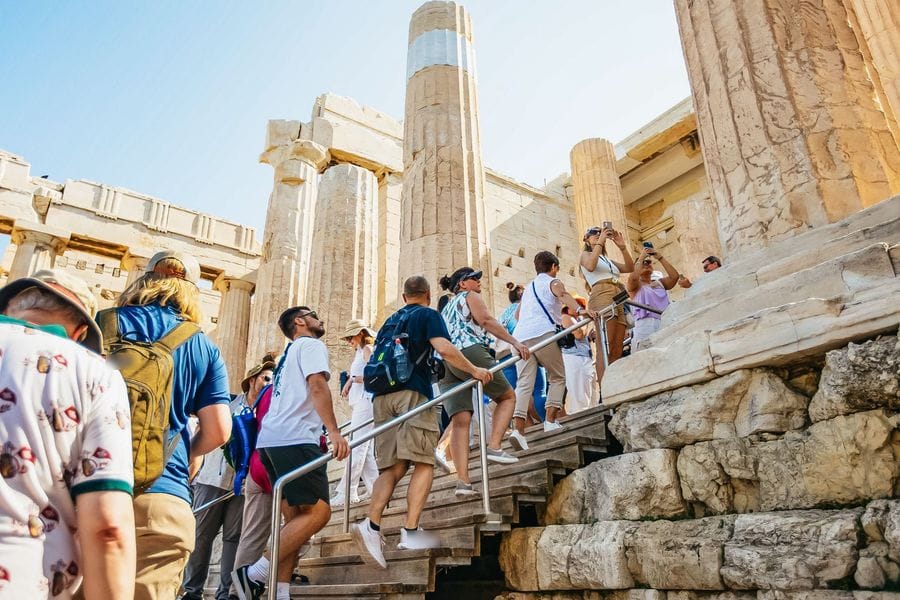
On the rock, the Propylaea marks the historic way in. This Doric building complex served as the ceremonial gateway to the Acropolis of Athens. Acropolis tickets open the hill where it stands. The path to it arrives from the west. On that side, the route passes through the Beulé Gate, a late Roman addition.
The Beulé Gate sits below a monumental staircase. Those steps climb east for about 37 m and end at the Propylaea. In modern times, the lower gate has taken on a new role. It now serves as an exit for tourists leaving the Acropolis. That makes it a handy marker for leaving.
- Theatre of Dionysus: The entrance to this ancient theatre lies on Dionysiou Areopagitou, near Makrygianni Street.
- Odeon of Herodes Atticus: Its entrance stands near the far end of the same street, Dionysiou Areopagitou.
- Areopagus: Also called the Hill of Ares, this rocky outcrop rises northwest of the Acropolis.
Plaka spreads over the Acropolis’s northeast slope, away from the south slope gates. The district sits between Syntagma and Monastiraki squares. Acropolis tickets bring visitors onto the hill from the south. Plaka offers a second area to explore on the other side.
What does the Parthenon show to holders of Acropolis tickets?
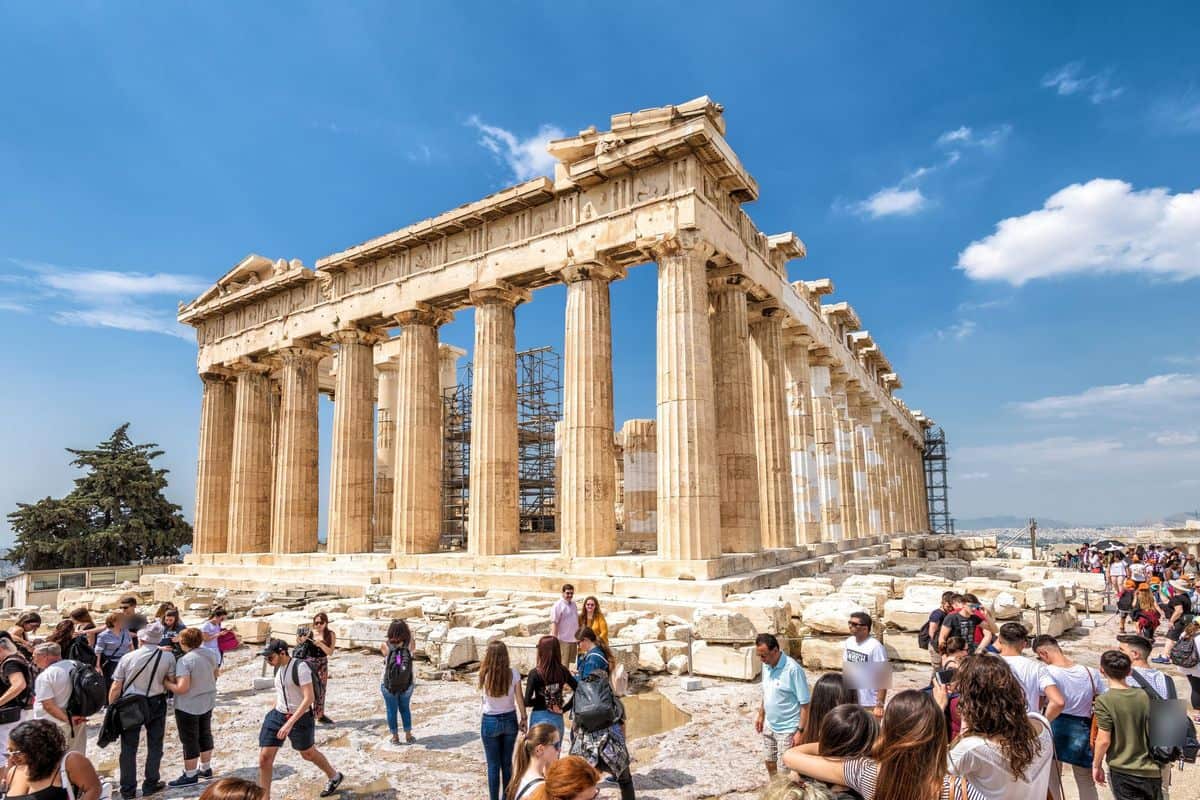
Acropolis tickets lead to the Parthenon, a former temple on the Athenian Acropolis dedicated to the goddess Athena. It was the largest temple in classical Athens and the peak of Doric architecture. Its ruins reward a slow, careful look from every ticket holder.
UNESCO credits the Parthenon to Iktinos and Kallikrates. Both worked with the sculptor Pheidias. Their work on the temple ran from 447 to 432 BC. Visitors with Acropolis tickets stand before a building shaped by this team of three. Knowing these names turns a walk past old stones into a meeting with real makers.
The column plan catches the eye straight away. Each end of the temple carries eight columns. A standard Doric temple has six at each end. Along each long side, seventeen columns stand in a row. Counting them all is a simple way to grasp the true size of the building.
The floor holds a quiet secret. The stylobate, the temple’s floor, bulges upward at its centre. The rise measures 10.3 cm over 70 m. That is a tiny lift across a very long stretch of stone. Anyone with Acropolis tickets who knows about the curve sees the plain floor in a new light.
The temple’s outer entablature held 92 metopes. Fourteen of these panels sat at each end of the building. Thirty-two more ran along each long side. Added together, they formed a full ring around the top of the temple. Holders of Acropolis tickets can picture that ring as they look up at the ruins.
- Frieze: A 160 m frieze atop the inner walls shows a procession and an assembly of gods.
- Pediments: Pausanias wrote that the pediment sculptures told of Athena’s birth and her contest with Poseidon for Athens.
- Marble: High-quality marble from Mount Pentelicus went into much of the building work on the Athenian Acropolis.
During the 1687 siege, a Venetian bomb hit the Parthenon. At the time, the Ottomans were using the temple as a munitions dump. Acropolis tickets bring visitors face to face with a building that still stands after that strike.
What do the Erechtheion and Propylaea show to holders of Acropolis tickets?
Acropolis tickets bring visitors to two key buildings on the hill. The Erechtheion, on the north side, is the Ionic temple of Athena and Poseidon-Erechtheus. The Propylaea, begun by Mnesicles in 437 BC, is the western gate with Doric columns of Pentelic marble.
Holders of Acropolis tickets see a temple whose exact building date is still debated. Scholars traditionally placed the Erechtheion at about 421–406 BC. Newer scholarship now favours the 430s instead. So the temple belongs to one of two periods, depending on which view a reader trusts.
The Porch of the Maidens is a key stop for anyone with Acropolis tickets. Six carved female figures serve as its supports. They face south and stand on a low wall. Today, replicas of the Caryatids stand in their place on the porch. The copies keep the original layout clear for visitors.
The Propylaea shows holders of Acropolis tickets a gate left unfinished. Builders completed just three parts: the central hall, the north-east Pinakotheke hall and a south-east hall in shortened form. Builders abandoned the work in 432 BC. The lifting bosses stayed on the stones, and other blocks were never dressed.
Why did the gate end up smaller than its original plan? Scholars have put forward a set of reasons. One is the tight limits of the site itself. Another is religious objection over shrines close by. Cost also appears on the list. Each idea helps explain why the design stopped short.
- Lost Caryatid: One Caryatid was taken away from the building and now stands in the British Museum.
- Sacred olive: The Pandroseion held the sacred olive tree Athena gave Athens after beating Poseidon in the contest for Attica.
- Poseidon’s marks: A hole in the north porch ceiling was linked to Poseidon’s thunderbolt, and marks below to his trident.
Visitors with Acropolis tickets can then look to the right of the gateway. The Temple of Athena Nike rises there, set on a steep bastion in the southwest corner. It rounds off a visit to the western approach of the hill.
Which visitor rules come with Acropolis tickets?
Acropolis tickets come with the standard rules found at Greek archaeological sites. The Ephorate of Antiquities of the Cyclades gives a clear example of these rules. Its visitor rules ban climbing on the monuments, and this ban covers every visitor at its sites.
Pets face a clear limit under the same standard rules. The Cyclades ephorate bans pets from its archaeological sites. Two exceptions apply to this ban. Dogs for blind visitors are allowed. Assistance dogs for disabled people are allowed as well. Travellers with a pet can arrange care for the animal before using Acropolis tickets.
Cameras and drones face their own limits under the standard rules. The Cyclades ephorate bans professional photography and video filming without a permit. A photographer hired for a shoot needs that permit before the visit. Drones carry a separate rule. The ephorate bans flying a drone at its sites without prior approval.
On the hill itself, physical barriers back up the rules. A low fence surrounds the Parthenon to prevent damage to the temple. Holders of Acropolis tickets see the temple from outside this barrier. The ground also calls for care. The Ministry of Culture reports past Acropolis accidents. The slope and slippery ground caused them.
New paving has changed the walk up the hill. The new paths give a smooth, anti-slip surface. The Ministry calls this surface fully safe for visitors. Weather can also change a visit. Extreme heat in Greece forced authorities to close the Acropolis at midday. The goal was to prevent heat illness among tourists.
- Food and smoking: The Cyclades ephorate bans eating food and smoking at its archaeological sites.
- Entry zones: The e-ticket system issues no extra Acropolis tickets once an entry zone reaches its limit.
- Free entry: EU visitors aged up to 25 enter free by showing a police ID card or passport.
Protection of the past links each of these rules. Greece’s Central Archaeological Council is the supreme advisory body on protecting antiquities. Visitors with Acropolis tickets share that aim when they respect the fence, the paths and the bans.
What history stands behind the sites on Acropolis tickets?
Acropolis tickets open a site with a very long human story behind it. People already lived on the Acropolis hill in the 4th millennium BC, the evidence shows. Every later age then left its own mark on the same summit.
The Cyclopean circuit wall once ringed the hilltop. It ran for 760 m and stood up to 10 m high. Its thickness ranged from 3.5 to 6 m. These figures show how seriously the hill’s defenders took safety. This wall stayed the main defence of the Acropolis until the 5th century BC.
Acropolis tickets also tell a story of loss and later rebuilding. The Persians sacked Athens in 480 BC. At that moment, the Older Parthenon was still under construction. Later, Athens stood victorious over the Persians. In the 5th century BC, the city began a grand building programme under Pericles.
The ancient story behind Acropolis tickets has a clear end point. The last major ancient building there was the small, round Temple of Roma and Augustus. After that, the summit entered a Christian age. In the Byzantine period, the Parthenon served as a church. The church was dedicated to the Virgin Mary.
The medieval story behind Acropolis tickets is just as rich. Under the Latin Duchy, the Parthenon became the cathedral. The Propylaea turned into part of the ducal palace. Under Ottoman rule, the summit changed once again. The Parthenon then became a mosque. The Erechtheum served as the governor’s private harem.
- Independence: Byzantine, Frankish and Ottoman features were cleared to bring back the monument’s original form.
- 1843: The Parthenon mosque was pulled down in this year, ahead of the tower.
- 1875: The Frankish Tower came down in this year, following the earlier loss of the mosque.
Acropolis tickets therefore cover far more than one ancient age of Athens. Settlers, builders, priests and rulers each changed the hill in turn. Each stone and each change of use fits into one long story of the same summit.
What restoration work do Acropolis tickets let visitors see?
Acropolis tickets give entry to a live restoration site on the Parthenon. Teams have returned the temple’s 46 column drums and capitals to their places. They also swapped the old iron clamps from an earlier repair for new titanium clamps.
The old iron clamps came from Nikolaos Balanos. He restored monuments on the Acropolis of Athens between 1894 and 1939. Balanos used no lead in his repairs. Instead, he wrapped his clamps in reinforced concrete. He believed this concrete shell was waterproof and kept the metal dry.
The concrete shell failed. Water still seeped through to the iron inside the stone. The iron rusted and expanded. The swelling clamps pressed hard against the marble around them. The pressure cracked the stone and split blocks apart. Acropolis tickets now show visitors the fix for that damage.
Two dates stand out in this rescue. In 1975 the Greek government set up the Committee for the Conservation of the Acropolis Monuments. In 1999 the Acropolis Restoration Service was created. It brought academic and technical staff into the works. Visitors with Acropolis tickets now see the results of that wider team.
New white marble fills the eroded parts. It comes from Mount Penteli, the same mountain quarried in antiquity. The scale of the work is huge. In all, 2,675 tons of architectural members were restored. Teams also reassembled 686 stones from original fragments. Acropolis tickets open the way to this rebuilt stonework.
- Folding crane: A crane moves marble blocks on the Parthenon and folds away beneath the roofline when idle.
- Titanium dowels: Restorers use titanium dowels, and each repair is designed so future experts can fully reverse it.
- Caryatids: From 2011 to 2015 a special laser cleaned soot and grime from the Caryatids, sparing their patina.
Not every original piece stays on the hill. Important and fragile sculptures from the site were transferred to the Acropolis Museum. Holders of Acropolis tickets can follow the restoration story from the open hill to these protected works indoors.
How do Acropolis tickets work for visitors with reduced mobility?
Acropolis tickets held by visitors with disabilities get checked at one gate only. That gate is the Main Entrance, not the South entrance. Anyone arriving with a wheelchair or a walking aid plans the day around that gate. The lift, the weather and the paths shape the rest.
The Acropolis gained a new lift for people with mobility difficulties in 2020. The lift does not sit at the main gate itself. A separate entrance lies north of the Central Entrance. From there, a 350-metre path leads to the lift. Visitors holding Acropolis tickets follow this path before the climb begins.
The lift rises about 25 metres up the hill. It stops on the summit plateau, just north of the Erechtheion. Wheelchair users never ride it alone. Trained security staff always travel with them in the cabin. This rule keeps every trip calm and safe for riders with Acropolis tickets.
The weather decides whether the lift runs at all. The service stops during heavy weather or strong winds. Holders of Acropolis tickets check the forecast before setting out. On the summit, the wheelchair route west toward the Propylaea is steep. Its gradient is more than 6 percent, so a strong helper makes a real difference.
The paths on the hill have changed in recent years too. New reinforced concrete paths were added in 2021 to improve accessibility. They aim to make the site easier to cross on wheels. Not everyone welcomed them, though. The new paths caused controversy among archaeologists, who study the ancient site.
- Old museum lift: Beside the old Acropolis Museum, a second lift carries visitors down to its courtyard and restrooms.
- Museum entrances: Every Acropolis Museum entrance has special ramps for wheelchairs and for strollers as well.
- Museum floors: The Acropolis Museum offers lift access and toilets for people with disabilities on every floor.
Ramps on this rock are not a modern idea. Past the Beulé Gate, an archaic ramp leads up to the zig-zag Mnesiklean ramp, which still stands today. Acropolis tickets checked at the right gate open the way to that old story.
Which season suits a visit with Acropolis tickets?
Acropolis tickets pay off in spring and autumn, when the hilltop feels mild for a long walk. Downtown Athens averages a pleasant daily high of 21.1 °C in April. The climb over old marble stays comfortable for visitors of every age.
Autumn offers a second calm window for the hill. October brings an average daily high of 24.4 °C to downtown Athens. That warmth feels mild on the open rock and along the marble paths. Visitors holding Acropolis tickets in October can climb at an easy pace. A water bottle still helps.
Summer brings tough conditions for a hilltop visit. In July, the city centre averages a daily high of 34.3 °C. The average UV index downtown reaches 10 that month. Sun cream, a hat and water bottles matter on the bare rock. Early slots help visitors avoid the strongest sun.
Heatwaves add another risk. Athens officials announced a closure of the Acropolis at midday during the 2023 European heatwave. On 23 July 2023, the Nea Filadelfeia station in Athens recorded 45.4 °C. Visitors with Acropolis tickets for high summer can check official notices before setting out. A sudden closure can upset a carefully planned day.
Winter suits visitors who prefer cool air over heat. The coastal Elliniko station averages 13.5 rain days in December. A rain jacket and shoes with firm grip help on damp stone paths. Booking Acropolis tickets for winter works best with a flexible plan. A dry morning between showers suits the climb well.
- Sunshine: The coastal Elliniko station logs an average of 362.7 sunshine hours in July.
- Hot nights: Land breezes can keep summer nights hot near Piraeus, with an August low near 27 °C.
- Inland heat: Inland stations such as Nea Filadelfeia register July mean maximums as high as 36.5 °C.
Early summer brings its own extremes. On 26 June 2007, an automatic station beside Nea Filadelfeia hit 47.5 °C, a European record for June. For a calm, comfortable climb, Acropolis tickets for spring or autumn remain the safer choice.
What views do Acropolis tickets open over Athens?
Acropolis tickets open the way to the ancient rock in Athens, with hills and temples nearby. The Athens urban area lines the Saronic Gulf along its northern shore. The landmarks around the rock help visitors read the shape of the city.
Lycabettus is a hill in the heart of Athens. Its summit stands at 277 metres above sea level. No other spot in central Athens rises higher than this peak. Trip plans that start with Acropolis tickets can add this summit as a second high stop later.
The Philopappos Monument stands on Mouseion Hill in Athens. That hill lies to the southwest of the Acropolis. On a map, the monument and the ancient rock sit on two separate hills. After a visit with Acropolis tickets, a walker heads southwest to reach the monument. That route joins two hilltops in one day.
West of the Acropolis, the Pnyx stands under 1 kilometre away. That short gap puts the two sites within walking reach of each other. A walker who leaves the rock and turns west reaches it on foot. Holders of Acropolis tickets can add the Pnyx to the same outing with little extra effort.
Anafiotika was built in Cycladic style. White walls and small spaces shape the place. Together they give visitors an island feel without leaving Athens. After the ancient stones of the Acropolis, this stop brings a change of mood. Its white walls also make clean backdrops for photos.
- Temple of Olympian Zeus: The temple stands roughly 500 metres from the rock, to the south-east.
- Panathenaic Stadium: No other stadium in the world is built entirely of marble.
- Hymettus: Its highest point, Evzonas, has an elevation of 1,026 metres.
Acropolis tickets cover the rock itself, while the sites around it fill in the wider city. A route that adds one or two nearby stops turns the visit into a wider walk through Athens.
Which caves and springs line the rock that Acropolis tickets reach?
Acropolis tickets lead to a rock marked by sacred caves and natural springs. Three cave openings dominate the north-west slope of the rock. Each opening is dedicated to a different god. The three gods honoured there are Pan, Zeus and Apollo, each with a separate shrine.
On the rock that Acropolis tickets reach, the Klepsydra spring rises naturally on the north-west slope. It lies near the point where the Peripatos meets the Panathenaic Way. Excavators found its spring house built into a natural cave. That cave collapsed in antiquity.
The spring’s well later fell into disuse, and the effect showed during the 1822 siege. The Turkish garrison on the rock faced a lack of water. In the end, that shortage forced the garrison to surrender. Visitors with Acropolis tickets reach the same slope where that spring lies.
Cave B belonged to Apollo Hypoakraios. The name means Apollo under the High Rocks, or under the Long Rocks. Marble plaques found nearby identified this cave. They carry a dedication to Apollo from the nine archons. For holders of Acropolis tickets, the plaques explain why this opening carries Apollo’s name.
The Middle Cave, known as cave C, dates to the 5th century. It is credited to Zeus, either as Zeus Olympios or as Zeus Keraunios. Pan’s place here rests on a war story. Tradition says Pan helped the Greeks win at Marathon in 490 BCE. He did so by spreading panic among the Persians.
- Geology: Springs and karstic caves sit where the Athens schist meets the Acropolis limestone.
- East slope: The Aglaureion is the largest Acropolis cave, measuring 14 m across its mouth.
- Deep fissure: A rock fissure extended about 35 m to a bed of soft marl, where a well was dug.
One path ties these places together. The Peripatos links the shrines scattered around the Acropolis hill. On Acropolis tickets, the path turns separate caves and springs into one connected walk. Each stop adds a god, a story or a water source.
What questions come up about Acropolis tickets?
Acropolis tickets come with clear limits on what they open. The rock, the museum, the nearby hills and the free days each follow separate rules. Learning these rules before the trip saves time on the day. It also helps visitors plan the order of their stops.
Do Acropolis tickets include entry to the Acropolis Museum?
No. The Acropolis Museum needs its own ticket, apart from the pass for the rock and its linked sites. That museum ticket opens every exhibition area. It also opens the excavation under the building. The museum sits on the ancient road up to the rock, by the southeastern slope.
Do Acropolis tickets cover the Theatre of Dionysus and the slopes?
The Ministry states that Acropolis tickets are valid for the archaeological site and its slopes. The Theatre of Dionysus sits on the south slope. It once belonged to the sanctuary of Dionysus Eleuthereus. In 161 AD, the Roman Herodes Atticus built his grand odeon on the same slope.
Do Acropolis tickets cover the Areopagus and the hills next to the rock?
The Areopagus council met on the Hill of Ares, a rocky rise to the northwest of the Acropolis. In 2002, an effort began to fence Philopappos Hill and add it to the single unification ticket. A residents’ movement formed that November to keep the hill open. Its legal win came in 2015.
Are there days when Acropolis tickets are free?
Yes. On 6 March, the Acropolis site lets visitors in free to honour Melina Mercouri. European Heritage Days bring free entry too, on the last weekend of September. The Acropolis Museum has its own free days, which include 6 March, 25 March and 28 October.