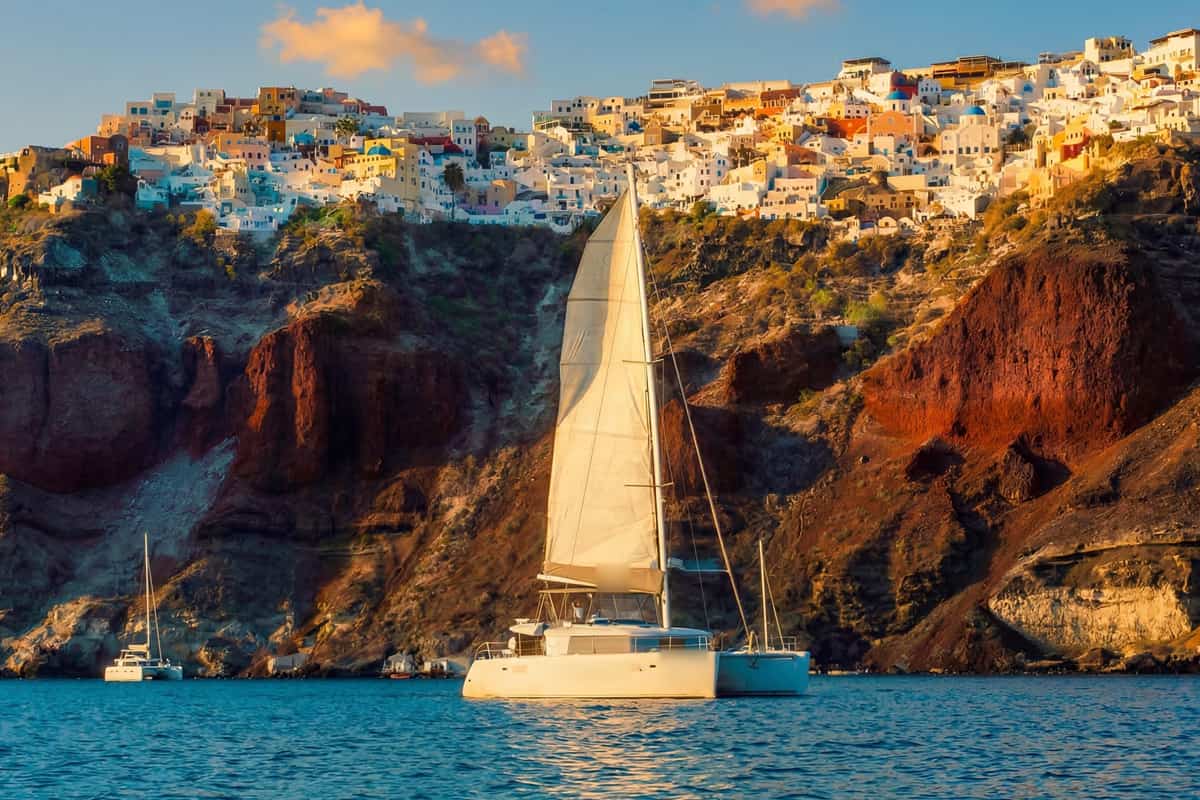
A Santorini catamaran cruise is a sailing trip on a twin-hulled boat around the caldera, the volcano and the south coast of Santorini. It is one of the Greece tours in the Cyclades.
What is a Santorini catamaran cruise?
A Santorini catamaran cruise is a boat trip around the island on a catamaran. This type of boat sits on twin hulls of the same size, side by side. A skipper steers the boat past the island coast and the smaller islets nearby.
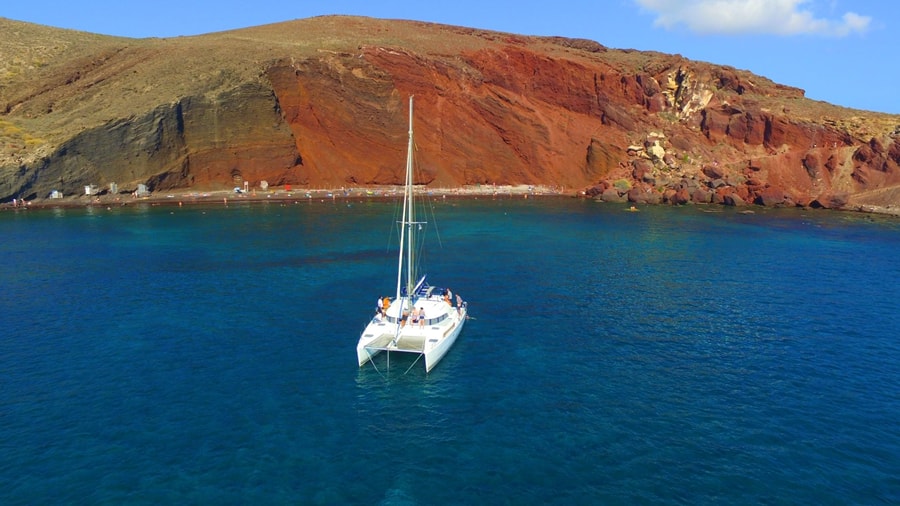
The island of Santorini lies in the south of the Aegean. The Greek mainland is roughly 200 km away, to the northwest. A Santorini catamaran cruise starts here and stays in the waters around the island. Passengers take in the island views from the open deck of the boat.
The two-hull design shapes the ride. The broad space between its two hulls fights rolling and keeps the boat from tipping over. Thanks to that gap, the boat needs no ballast. Its wider stance can cut heeling and wave motion compared with a single-hull boat. For passengers, less heeling means a flatter deck under their feet.
Hard numbers show how stable this boat type is. Tipping over a fifty-foot cruising catamaran takes four times the force. The comparison is with a matching monohull, a boat with one hull. Passengers on a Santorini catamaran cruise ride on this steadier two-hull base.
- Island group: The Santorini volcanic group spans Thera, Therasia, Aspronisi and the two Kameni islands.
- Therasia: This island covers about 9.3 km² and counted 249 inhabitants at the 2021 census.
- Burnt names: Nea Kameni means ‘new burnt’, while neighbouring Palea Kameni means ‘old burnt’.
Santorini is the southernmost island in the Cyclades group. The island covers about 73 km² and had 15,480 residents in 2021. On a Santorini catamaran cruise, passengers see this small island and its shoreline from the open sea.
Where does a Santorini catamaran cruise start?
A Santorini catamaran cruise is a sailing tour, and sailing tours use Amoudi Bay as their staging point. This is where the trips gather before they set off. The bay sits below Oia, in the high volcanic cliffs of western Santorini.
Vlychada harbour plays a different role. No other anchorage on Santorini gives boats such safe shelter from storms. When strong winds hit, crews bring their boats into this calm water. For a Santorini catamaran cruise, a safe shelter matters as much as a scenic start.
Athinios matters to travellers arriving on the island by ferry. Santorini’s main ferry port, it sits roughly 10 km south of Fira. Ferry passengers step ashore here before moving on. Knowing this distance helps travellers plan the trip from the ferry to a Santorini catamaran cruise.
Skala is one more harbour where boat trips begin. From Skala, tour boats head out to Nea Kameni and other spots around Santorini. This gives travellers another choice beside Amoudi Bay. Each harbour has its own setting, so the right pick comes down to taste and travel plans.
- Vlychada beach: White volcanic rocks and black sand form the setting around this stretch of shore.
- Athinios cliffs: Tall volcanic cliffs in a mix of colours ring the port, and a zigzag road climbs to the top.
- Cable car: Built to spare people about 600 steep steps or a mule ride up from the Old Port.
The area around Oia also holds boat history. Armeni Bay, southwest of Oia, was once an important boatbuilding centre. In those days, people reached it on foot or by mule. That past links each Santorini catamaran cruise to an older island trade.
What does a Santorini catamaran cruise show of the caldera?
A Santorini catamaran cruise shows the caldera from sea level, with the whole basin around the deck. This ring of cliffs and sea stretches about 12 km by 7 km across. From the water, villages and islands fit into one wide view.
Close to the inner coast, the catamaran sails below a sheer drop. The cliff face shows bands of hardened lava, piled one on top of the next like pages in a book. From the low deck, each band stands out clearly. Clifftop viewers look down and miss this side view.
A Santorini catamaran cruise sails over the remains of a round island. Its centre collapsed as the magma chamber below emptied in an eruption. That collapse formed the caldera. The Minoan eruption broke the ring on both sides of Therasia, opening two new channels into the basin.
High above the water, villages line the cliff tops. Oia stretches along the northern rim of the caldera, between 70 and 100 metres over the water. Imerovigli stands on the rim itself, with narrow paved paths running through it. From the deck, both look like a thin band of buildings.
- Ring: Therasia and Aspronisi sit on the outer ring, around the central Kameni islands.
- Aspronisi: Its name means ‘White Island’ in Greek, as part of it is white pumice.
- Depth: The sea inside the caldera reaches 385 metres at its deepest point.
Cruise ships anchor off Skala, where visitors get up to Fira by cable car, by donkey or on foot. A Santorini catamaran cruise sees the same cliffs from a lower, closer angle. The caldera unfolds one cliff at a time.
What does a Santorini catamaran cruise show at the volcano and hot springs?
A Santorini catamaran cruise shows Nea Kameni and Palea Kameni, two young volcanic islands. Both islands grew during the last two thousand years, as dacite lava and ash erupted again and again. Palea Kameni is a small island with a hot spring of its own.
The islands kept changing long after ancient times. Major eruptions in the past 300 years struck in 1707–1712, 1866–1870, 1925–1928 and 1939–1941. Each period spanned more than one year. Passengers on a Santorini catamaran cruise sail past land that is young by the standards of geology.
On the volcano, visitors climb a gravel path to the crater top at 130 metres. From there, they can walk the full rim. Steam and carbon dioxide still escape at the current active crater. The volcano is dormant, not dead, and the rising gas makes that plain.
The thermal water near the volcano stays degrees warmer than the open sea around it. When a Santorini catamaran cruise stops near the hot spring, swimmers can feel this difference. The shift from open sea to heated water turns a simple swim into a science lesson. It shows the heat the volcano still holds.
- Ancient record: Ancient writers record that Palea Kameni appeared above the waves in 197 BCE, then called Hiera.
- Lava dome: In 1950, the latest small eruption built a lava dome.
- Unrest: From January 2011 to April 2012, 10 to 20 million cubic metres of magma swelled the chamber.
Scientists from ISMOSAV keep a close watch on Nea Kameni, which is protected as a scientific site. Passengers who land there walk on ground that experts treat with care. A Santorini catamaran cruise blends time on the water with a close look at real science.
Which beaches does a Santorini catamaran cruise pass?
A Santorini catamaran cruise sails past shores of red, black and white sand. The colour of each beach depends on the rock layer exposed along the coast. That is how the island has its Red, Black and White beaches.
Red Beach takes its name from the colour of its sand. Oxidised iron turns the grains a deep, rusty red. Landslides are a real risk in this area. Parts of it have been closed to visitors on land since 2013. On a Santorini catamaran cruise, the red shore stays in view.
The eastern side of the island looks darker. Its shores are lined with black volcanic sand. Kamari beach runs southwest from Monolithos. It stretches to the foot of Mesa Vouno, the second-highest peak on Santorini. From a Santorini catamaran cruise, that peak helps to pick out Kamari.
At Perissa, fine jet-black sand covers the shore. The same dark sand also lines the seabed. Water off darker beaches like this one is noticeably warmer. The reason is simple: the dark lava absorbs heat. A swim near the black sand makes that warmth easy to feel.
- Vlychada view: Its pale, wild cliffs against the blue Aegean give the beach the look of a moonscape.
- Vlychada size: The beach stretches 750 metres in length and averages 20 metres in width.
- Vlychada direction: The shore faces south, so boats approaching from that side see it head-on.
Not every shore carries a famous name. Santorini’s municipality lists Mesa Pigadia among its lesser-known beaches. A Santorini catamaran cruise offers a chance to spot shores like this from the deck. The better-known red and black beaches are only part of the view.
What sunset does a Santorini catamaran cruise meet?
A Santorini catamaran cruise that sails at sunset on the west side meets the evening sun off Oia. The village lies at the island’s north-west tip. Its location gives excellent views of the sun going down over the caldera.
The point where the sun sets moves with the seasons. North of the equator, spring and summer sunsets fall in the northwest. In autumn and winter, the sunset shifts to the southwest. Passengers on a Santorini catamaran cruise see the sun drop in a new spot across the year.
In the last light, Oia changes colour quickly. For a brief moment, its white houses and the caldera catch every shade of the setting sun. A Santorini catamaran cruise gives passengers an open view of the scene from the water. Cameras come out as the light shifts.
Below Oia, Ammoudi harbour sits on the village’s western side. A steep flight of stairs, north of Fort Londsa, runs down to it. Thirasia lies less than a mile across the water from Ammoudi. From a deck between the two, both shores look close enough to touch in the evening light.
- Oia castle: The ruined hilltop castle, once the Argyri family seat under the Venetians, works as a 360-degree lookout.
- Venetian defence: The castle shared a defence system with Pyrgos and ranked among the island’s strongest fortresses.
- Akrotiri Lighthouse: A lighthouse from 1892 stands west of Akrotiri village, on Santorini’s westernmost tip.
Oia is not the only strong sunset point on Santorini. The Akrotiri Lighthouse is also known far and wide for its sunset views. A Santorini catamaran cruise on the west side looks toward the same evening sky as these two lookouts.
What history does a Santorini catamaran cruise cover?
A Santorini catamaran cruise covers the Thera eruption, the blast that shaped the island’s past. Radiocarbon dating places that eruption between 1620 and 1530 BC. From the deck, the views link straight back to this ancient story.
The eruption of Thera rates VEI 7 on the volcanic explosivity scale. Between 28 and 41 cubic kilometres of material shot out in the blast. That places it among history’s largest volcanic events. Its tsunamis, 35 to 150 metres high, wrecked the northern coast of Crete, 110 km away.
In the 16th century BC, a blanket of volcanic ash covered Akrotiri. That layer helped preserve the fine frescoes on its walls. Today, Akrotiri’s uncovered southern tip shows multi-level buildings. Walls there rise up to eight metres high, entombed in ash. The ash turned the site into a time capsule.
Spyridon Marinatos, the man who discovered Akrotiri, put forward a bold idea. He suggested that Plato’s story of Atlantis reflects the Minoan eruption. The link stays a theory, not a proven fact. Even so, the tale adds drama to a Santorini catamaran cruise across these waters.
- Name origin: Santorini is a short form of Saint Irene, the name of an old church in Perissa village.
- Venetian era: Under Venetian influence, the name Santorini dates back to at least the mid-twelfth century.
- 1956 earthquakes: Earthquakes in 1956 killed 53 people on the island and injured 100 more.
The ruins of Ancient Thera crown Mesa Vouno, a limestone hill. This archaeological site dates from the classical era. From the eruption to the legend, each chapter adds depth to a Santorini catamaran cruise.
Which season suits a Santorini catamaran cruise?
A Santorini catamaran cruise suits the hot season, which runs from June through October on the island. July and August form the peak season. Hot weather makes swimming stops and time on the open deck easy for every passenger to enjoy.
Santorini’s climate is semi-arid and hot: summers stay dry, while winters bring more rain. Average July rainfall at the island’s weather station is just 0.03 mm. For a Santorini catamaran cruise, this means rain clouds play almost no part in a July sailing day. Passengers can plan swims with confidence.
The etesians, also known as meltemia, are strong, dry north Aegean winds. They blow through the summer until mid-September. Leisure sailors favour these winds because they give a good, steady sailing wind. That steady breeze is one reason summer suits a catamaran trip under sail around the island.
Spring on Santorini starts in April and brings milder temperatures. A Santorini catamaran cruise in spring suits travellers who prefer gentle warmth to strong summer heat. The island has fewer crowds then, so the day feels calmer from harbour to deck. Photographers gain a quieter island for their shots.
- Summer heat: The Santorini weather station records an average August high of 30.2 °C.
- Winter rain: In December, the island’s weather station averages 54.6 mm of rain across the month.
- Winter cold: In January, the average low at the Santorini weather station drops to 10.1 °C.
When the etesians blow hard, yachts and inter-island ferries can stay tied up in port. For that reason, a summer Santorini catamaran cruise needs a flexible plan. A spare day on the island gives room to rebook if the skipper calls off a trip.
What questions come up about a Santorini catamaran cruise?
A Santorini catamaran cruise brings up a handful of common questions. Visitors ask about sea swimming, the island’s wine, seasickness on board and travel links to the island. Each answer rests on recorded facts about Ammoudi, Assyrtiko vines, motion sickness and island transport.
What is the water like for a swim on a Santorini catamaran cruise?
Ammoudi offers a good example of local sea conditions for swimmers. Officials recorded its bathing water as clear and clean. The seabed drops steeply there, reaching 5 metres deep about 30 metres from shore. Ammoudi’s orientation and shape also shelter its shore from the prevailing winds.
How does Santorini wine relate to the island seen from a Santorini catamaran cruise?
Assyrtiko, a white wine grape, is native to Santorini. Growers train the vines low in basket-shaped kouloura. These baskets guard the fruit against fierce sun and wind. The island’s volcanic soils hold no clay, so the phylloxera pest cannot survive there. Wine and coastline share the same volcanic island.
Is seasickness less of a problem on a Santorini catamaran cruise?
Seasickness has a simple cause. It comes from a boat’s rocking motion or its movement while sitting in the water. Catamarans fill a niche where speed and sea-kindliness count for more than bulk capacity. Simple habits help against motion sickness: holding the head steady and fixing the eyes on the horizon.
How do visitors reach the island for a Santorini catamaran cruise?
Travellers joining a Santorini catamaran cruise arrive by air or sea. Santorini’s airport sits roughly 6 km from central Thira town, to the southeast. Buses, taxis, hotel car pickups and hire cars serve its terminal. Ferries link the island with Piraeus every day, with up to 5 direct summer crossings.