
An Acropolis tour is an expert-led walk through the ancient citadel of Athens, its myths and its long history. It is one of the Greece tours that start in central Athens.
What is an Acropolis tour?
An Acropolis tour is an expert-led visit to the greatest and finest sanctuary of ancient Athens. This sanctuary was dedicated mainly to Athena, the patron goddess of the city. A tour leader explains the stories tied to this sacred ground.
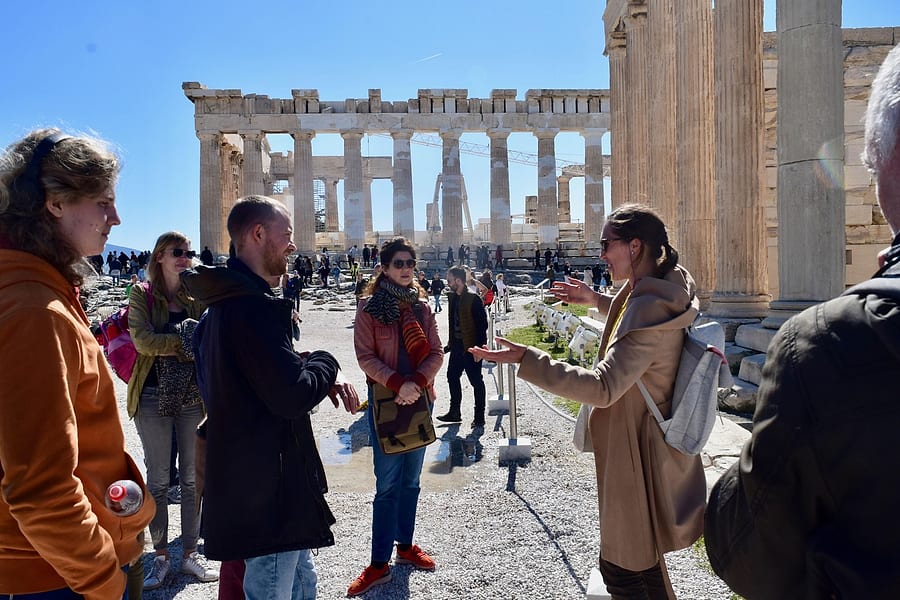
Visitors on the hill walk through the heart of Athenian legend. The famed myths of ancient Athens are tied to this sacred precinct. The city’s greatest festivals belong to the same ground. Its earliest cults are linked to this place too. On an Acropolis tour, each stop connects a story to the stones underfoot.
Athena held more than one role on this hill. Athenians honoured her as the goddess of their city. She was also their war goddess and their goddess of victory. Craft workers saw her as their protector. An Acropolis tour explains what each of these four roles meant to the city.
Time matters on an Acropolis tour, because the hill changed across the centuries. The sanctuary reached its peak in the archaic period. That era stretched from the mid-6th century BC to the early 5th century BC. Learning these dates helps visitors read the ruins in the right order.
The 5th century BC saw the Parthenon, the Propylaia, the Erechtheion and the temple of Athena Nike rise. Leading architects and sculptors worked on them. The Acropolis of that century reflects the splendour of Athens under Perikles. It also shows the power and wealth of the city in that era.
- Striking and complete: UNESCO finds no surviving ancient Greek monument group more striking or more complete than this one.
- Birthplace of ideas: According to UNESCO, democracy, philosophy, theatre and free speech all began on this hill.
- Global influence: Neo-Classical monuments across the world drew inspiration from the Acropolis buildings, UNESCO notes.
The hill also carries meaning far beyond Greece. From at least the mid-18th century, Western tradition has treated the Acropolis as a symbol of Classical Greece. An Acropolis tour lets visitors stand inside that symbol and hear the stories behind it.
Which ancient route does an Acropolis tour follow?
An Acropolis tour traces the Panathenaic Way, the ancient route to the rock. This road ran 1.5 kilometres from the Dipylon Gate in northwest Athens. From that gate, the road led across the ancient city and up to the Acropolis.
The Kerameikos site lets visitors walk the opening blocks of the Panathenaic Way toward the Acropolis. The Dipylon gate, where the road started, covered about 1,800 square metres. It was called the largest gate of the ancient world. An Acropolis tour that adds this stop shows how grand the city entrance was.
Beyond the gate, the road crossed into the Agora from the northwest. In the classical period, it reached 20 metres wide at that entry point. Underfoot, the road’s main surface was hard pebble. Higher up, retaining walls held the ground in place. Steps eased the final climb onto the Acropolis.
In the first century CE, builders paved the road between the southeast of the Agora and the Acropolis. The paving reused older blocks of poros stone and marble. Those blocks came from a building of the Periclean period. An Acropolis tour that passes here follows a road partly built from recycled stone.
From the Agora, the road reached the Eleusinion. It then ascended the rock through the western Propylaia. On an Acropolis tour along this road, the total rise is 94 metres. The climb sharpens near the top. There, the road gains 55.3 metres in its last 249 metres below the Acropolis.
- Procession: Over 1,000 people marched up the Way, led by the high priestess and temple treasurers.
- Peplos: Behind those leaders came the arrephoros, who carried the peplos up the road.
- Races: The apobates race on the Way saw armoured contestants leap off and back onto a moving chariot.
A statue once stood beside the Way in the centre of the Agora. It showed Harmodios and Aristogeiton, the killers of the tyrant Hipparchos. An Acropolis tour pausing here links the road to the city’s political past.
Which myths does an Acropolis tour tell?
An Acropolis tour tells the old stories of Athens, its rulers and its goddess. The tales on the hill begin with Athena herself. In classical myth, she was the favourite child of Zeus. She was born fully armed, springing from his forehead.
An Acropolis tour then turns to Cecrops. He was thought to be born from the soil of Athens. He had the upper body of a man and the lower body of a snake. His own son did not take his place. Erechtheus, also called Erichthonios, followed him instead. His parents were Hephaestus and Gaia.
Athena once gave a box to the daughters of Cecrops. Their names were Herse, Aglaurus and Pandrosus. She warned them never to look inside. Pandrosus obeyed the goddess and left it shut. But Herse and Aglaurus were overcome by curiosity, so they opened the box. Inside lay the infant Erichthonius.
The sight drove Aglaurus and Herse mad. Both sisters leapt to their deaths from the northern slope of the Acropolis. Erichthonius himself has the snake as his symbol. Athena’s statue in the Parthenon showed him in this form. He appeared as a snake behind her shield.
Another sad story told on an Acropolis tour belongs to Aegeus. He saw black sails and believed they meant his son was dead. It was a mistake, but he did not know that. Aegeus then took his own life. In one version of the story, he leapt from the Acropolis itself.
- Athena Polias: Polias means “of the city” and names Athena as the protectress of Athens.
- Athena Parthenos: The warrior maiden was called Parthenos, “virgin”, since she was believed to stay a virgin forever.
- Nike Apteros: Pausanias called the Athena Nike temple a temple of Nike Apteros, or “Wingless Victory”.
Ritual matters here as well. At the Arrhephoria, two girls lived near the temple of Athena Polias. They carried hidden objects down an underground passage. That walk below ground adds one more layer to an Acropolis tour.
Which festival shaped the sites on an Acropolis tour?
An Acropolis tour leads through sites shaped by the Panathenaia, the great festival of Athena. Its Panathenaic Games for the goddess took place in Athens every four years. The games began in 566 BC and carried on right until the 3rd century AD.
The big games were not the only celebration for Athena. The Lesser Panathenaia was held every single year. It was a sister festival to the Great Panathenaia. The word Lesser marks the smaller of the pair, while Great marks the larger one. On an Acropolis tour, both names come up again and again.
The festival rituals included a large number of sacrifices to Athena. Poseidon and other gods received sacrifices as well. Sacrifice also appears in stone on the Parthenon frieze. On the north frieze, four cows and four sheep are led to sacrifice. On the south frieze, ten cows head the same way.
Athena also received a special robe, called the peplos. Young women began weaving it at the Chalkeia, a festival of arts and crafts. The cloth was purple and saffron-yellow. The cloth showed the mythic war between gods and giants. The gift was clothing and a picture of a legend at once.
When the weaving was done, the peplos went up the Acropolis. It was made for the wooden statue of Athena Polias. That statue stood inside the Erechtheion. An Acropolis tour that reaches the Erechtheion stands at the end of the robe’s climb. Its journey ended beside that wooden figure of the goddess.
- Chariot prize: The winner of the chariot race took home 140 Panathenaic amphorae full of olive oil.
- Sacred oil: Athena’s sacred grove at Akademia supplied the prize oil.
- Riders in stone: Horsemen make up 46% of the whole Parthenon frieze, close to half of it.
The main scene of the Parthenon frieze is believed to show the Panathenaic peplos, though scholars dispute it. Even so, an Acropolis tour shows how one festival for Athena left its mark on the whole hill.
Which lost statues does an Acropolis tour describe?
An Acropolis tour describes three statues of the goddess Athena that the ancient city once honoured. The Athena Parthenos was a giant figure made of gold and ivory. The Athena Lemnia and an ancient olive-wood figure of the goddess complete the group.
The Athena Parthenos stood about 13 metres, or 42 feet, high. The goddess wore a helmet. She held a large round shield and a spear. Her sacred snake rested beside her. Together, these details let visitors on an Acropolis tour picture the armed goddess at her full size.
The Varvakeion Athena is held by the National Archaeological Museum in Athens. It is a copy of the Athena Parthenos made in the Roman era. After an Acropolis tour, this museum lets visitors compare the spoken story with a real statue. The copy turns the story into something solid.
The Athena Lemnia was a classical Greek statue of the goddess. It stood on the Acropolis of Athens. Pausanias says Phidias made it in bronze around 450-440 BC. The work was for Athenians on Lemnos. Visitors on an Acropolis tour can tie the name Lemnia to Lemnos to remember it.
The olive-wood figure of Athena was kept in the Erechtheion in Athens. Athenians believed this figure had fallen from the heavens. In their eyes, it came down as a gift to their city. An Acropolis tour shares this belief because it shows how Athenians saw their goddess.
- Nike: In her right hand, the Athena Parthenos held a statue of Nike, 2 metres high.
- Fate: The original Athena Parthenos was lost at an unknown date within the first millennium.
- Scandal: After he finished the Athena Parthenos, Phidias was charged with embezzlement.
Phidias reportedly fled to Olympia. In Olympia he created the gold-and-ivory Zeus, and he died there. This last chapter takes the story away from Athens. It reminds visitors on an Acropolis tour that the people behind these statues had lives of their own.
What does an Acropolis tour tell about Pericles and democracy?
An Acropolis tour tells the story of Pericles, top orator and statesman of Athens. He led the city from roughly 461 to 429 BC, the Age of Pericles. Small-group visits tie the temples of that era to the workings of Athenian democracy.
The democratic thread starts before Pericles. In 508 BC, the reformer Cleisthenes overhauled the Athenian constitution. His changes set that constitution on a democratic footing. An Acropolis tour that skips this step tells half the story. The marble on the hill rose in a city that already ran on these rules.
Money is the next stop on an Acropolis tour. In 454–453 BC, Athens moved the treasury of the Delian League from Delos to its own city. Pericles used those funds to pay for the Propylaea and the Parthenon. The same treasury also covered the golden statue of Athena made by Phidias.
From as early as 507 BC, Athenians gathered on the Pnyx hill for their popular assemblies. Pericles, Aristides and Alcibiades spoke there, within sight of the Parthenon. An Acropolis tour that points out the Pnyx joins both sites in one view. The temples crown one hill; the assembly met on the other.
Then the story turns dark. The Plague of Athens struck in 430 BC, the second year of the Peloponnesian War. The disease killed an estimated 75,000 to 100,000 people. That loss was around a quarter of the population. These numbers show the true scale of the crisis.
- Ten groups: Cleisthenes sorted citizens into ten groups by where they lived, not by their wealth.
- Ostracism: The word comes from ostraka, the pottery sherds Athenians used as voting tokens.
- Family tie: Pericles’s mother, Agariste, was the niece of the Athenian reformer Cleisthenes.
The tale on the rock ends with its central figure. Pericles and members of his family died of the plague in 429 BC. An Acropolis tour that follows this arc reads Athenian democracy in the ruins of one hill.
How does an Acropolis tour explain the Parthenon Marbles?
An Acropolis tour explains the Parthenon Marbles by linking the temple on the rock to its missing sculptures. Between 1801 and 1812, Lord Elgin’s agents removed about half the surviving Parthenon sculptures. Tour leaders then trace the permit, the sale and the return campaign.
The story starts with a disputed permit. Elgin told a House of Commons committee that a July 1801 Ottoman firman authorised the removals. Turkish archives, however, have yielded no official record of that firman. An Acropolis tour sets both points side by side, so visitors can weigh the claim themselves.
Back in London, the marbles became a question for Parliament. In June 1816, after more debate, members voted 82 to 30 to buy them. The Greek side later made a formal request of its own. In 1836 Greece’s King Otto asked Britain to return the four Athena Nike frieze slabs.
The modern campaign took shape in 1983. That year, the Greek government formally requested every Acropolis sculpture held in the British Museum. Melina Mercouri also held a televised debate with British Museum director David M. Wilson. While awaiting the marbles’ return, she ran an international competition to build the New Acropolis Museum.
Inside the Acropolis Museum, the missing pieces become easy to spot. White casts mark the sculptures now held in London. Gaps are left where sculptures no longer survive at all. An Acropolis tour ending here lets visitors compare the casts, the gaps and the surrounding sculptures.
- Pediment figures: Elgin’s collection in London includes 21 figures from the Parthenon’s pediments.
- Metopes: The same collection holds 15 metopes showing battles between Lapiths and centaurs.
- Frieze: Visitors on an Acropolis tour learn that the collection also contains 75 metres of frieze.
The dispute then reached UNESCO. In 2013 Greece asked UNESCO to mediate, but Britain and the British Museum declined. In 2021 UNESCO found Britain obliged to return the sculptures and urged talks with Greece. Each Acropolis tour leaves visitors to weigh both positions.
What does an Acropolis tour show at the Areopagus?
An Acropolis tour stops at the Areopagus, a sacred hill in Athens. This rock was tied to Ares. It was also tied to underworld gods of punishment and vengeance. Myth, murder trials and early Christian history all meet on this one hill.
Greek myth gives the hill a dark start. In the tale, Ares killed Halirrhothius, a son of Poseidon. The other gods did not ignore the deed. They gathered on this hill and put Ares on trial for the killing. On an Acropolis tour, this myth turns a plain rock into a stage for justice.
History took over from myth. Athenians appear to have held homicide trials on the hill as early as the 7th century BC. In 594 BC, Solon heavily reshaped the Areopagus Council. He restructured the rest of the Athenian state as well. An Acropolis tour explains this long legal past in plain terms.
The hill also appears in Greek drama. The Eumenides, a play by Aeschylus from 458 BC, sets a trial here. Orestes faces judgement for killing his mother. In the play, a jury of twelve Athenian citizens hears the case. The goddess Athena supervises the whole hearing. Visitors can picture the scene on this rock.
Christian history adds another layer to the hill. The Apostle Paul gave his Areopagus sermon in Athens. His speech is recorded in Acts 17:16–34. Acts 17:34 says that Dionysius the Areopagite became a Christian after hearing Paul speak. On an Acropolis tour, this stop links ancient law with the early church.
- Ephialtes’ reforms: In 462/461 BC, reforms linked to Ephialtes stripped the council of nearly every power except murder trials.
- Luxury houses: Remains of four luxurious houses from the 4th-6th century AD lie on the hill’s northern edge.
- Modern stairway: A modern stairway now climbs the rock, giving visitors a way up to the summit.
After his conversion, Dionysius became the first Bishop of Athens. His title, the Areopagite, ties him to this hill. An Acropolis tour that includes the Areopagus covers myth, law, drama and faith in a single stop.
Which Plaka and Anafiotika streets does an Acropolis tour walk?
An Acropolis tour that heads down from the rock enters Plaka and Anafiotika, the neighbourhoods below its slopes. Plaka stretches from Filomousson Square, close to where Kydathineon Street meets Adrianou Street, down to Monastiraki. Street names, churches and monuments mark the way through both areas.
No district of Athens is older than Plaka. It has been lived in without a break since Neolithic times. The name itself once had a smaller reach. Before the time of King Otto, Plaka meant only the area around the Lysicrates monument. Today the label covers the whole web of lanes below the rock.
Adrianou is the largest street in Plaka. It divides the district in two: Ano Plaka, below the Acropolis, and Kato Plaka further down. Adrianou and Tripodon Street can both be traced back to ancient times. Walking Adrianou, an Acropolis tour follows the line where the two halves meet.
The Lysicrates monument stands in an excavated square on Plaka’s edge. That square lies directly below the Acropolis cliff. The monument is round and rests on a high square podium. It is the first Greek monument with Corinthian order on its outside. From the square, an Acropolis tour sees monument and cliff together.
The first houses in Anafiotika were built while King Otto ruled. They appeared when Anafi workers came to refurbish his palace. Only 45 houses remain today. The lanes running from Stratonos Street to the Acropolis rock have no names. With no names to follow, these lanes suit a slow Acropolis tour on foot.
- Tower of the Winds: Of every clock tower built in classical antiquity, this is the only one still standing.
- St George of the Rock: This 17th-century church roughly marks where the Anafiotika houses end on the eastern side.
- Agios Simeon: Also from the 17th century, this church roughly marks the western edge of Anafiotika.
Wandering the lanes of Plaka brings glimpses of the Acropolis. The view appears between neoclassical buildings and Byzantine churches. For an Acropolis tour, these streets add a second look at the past below the rock.
What does an Acropolis tour show at night?
An Acropolis tour at night shows the lit Rock from the streets below. For the first time, the lighting picks out each monument on its own, separate from the walls and its neighbours. Walkers can see every building as its own shape against the dark sky.
Emmy-winning lighting designer Eleftheria Deko was chosen to design the new lighting on the Rock. In January 2020, her studio was picked over other respected lighting firms. An Acropolis tour after dark lets a small group judge her work from the city. Each glowing stone on the skyline follows that design.
The old HID lamps on the Rock gave way to 609 LED projectors. That is 40% fewer light sources than the hill had before. The technical upgrade also cuts light pollution in the night sky. A tour leader can point out this change as the group looks up from below.
Five more monuments are now lit for the first time. Among them are the Asklepieion and the Sanctuary of Aphrodite. Before this change, these spots stayed dark after sunset. An Acropolis tour at night can now pick out these extra sites from the city as well.
Thiseio is famous for its pedestrian streets and its views of the Acropolis. Cafés and open terraces give walkers a place to sit and look up at the lit hill. An Acropolis tour that ends here leaves time for a drink with the monuments in view.
- Areopagus: This height gives panoramic views over nearby hills and sites, above all by night.
- Philopappos: The Philopappos tomb stands opposite the Acropolis, inside the formal boundaries of the ancient city.
- Parthenon shows: Sound-and-light shows have also been staged at the Parthenon in Athens.
The marbles also look whiter than ever under the new light. It brings out the relief of each monument’s decoration. A night walk through the streets ends with a sharp view of the Rock against the Athens sky.
Which archaic finds from the rock does an Acropolis tour cover?
An Acropolis tour covers the Archaic statues and temple carvings found on the rock. Once the Persians were expelled from Athens, the Athenians buried the desecrated items in a ceremony. The korai trace almost a century of Archaic Attic sculpture, from 570 to 480 BC.
Between 1885 and 1890, Panagiotis Kavvadias, Wilhelm Dörpfeld and Georg Kawerau uncovered the rest of the Perserschutt. The German word means “Persian rubble”. The “kore pit” north-west of the Erechtheion gave up nine to fourteen korai in its first dig. An Acropolis tour at the Erechtheion passes near that spot.
On an Acropolis tour, the Peplos Kore gives a clear lesson in ancient paint. She is a white marble figure, 118 cm high, made around 530 BC. When new, her surface was brightly painted. The pale stone seen today hides that first look, so visitors must imagine the colour.
Pediment carvings form the next group of finds. A pediment is the triangle at each end of a temple roof. On one Hekatompedon pediment, a three-bodied figure is thought to show either Nereus or Typhon. Digs in 1887 and 1888 found a Herakles and Hydra group from another building’s pediment.
Pediment sculptures credited to the Old Temple show two scenes. In the first, Athena fights a band of giants. In the second, two lions attack a bull. One shows a goddess at war; the other, animal strength. An Acropolis tour that pairs them shows one temple with two kinds of story.
- Calf Bearer: The figure grips the calf’s legs firmly, forming a bold X-shaped composition.
- Kritios Boy: This is the first known statue from classical antiquity to use contrapposto.
- North wall: Unfinished marble column drums and old temple beams are built into it, facing the city.
The Acropolis Museum shows the Rampin Rider with a plaster head. The original head stays in the Louvre. The stand-in lets visitors see the rider whole. An Acropolis tour that ends with him shows one Archaic find split between two museums.
How did ancient builders raise the temples on an Acropolis tour?
An Acropolis tour reveals that the temples rose through hard labour and smart engineering. Marble for the Parthenon frieze was cut on Mount Pentelicus. The heavy stone was then hauled 19 km to the Acropolis and lifted, piece by piece, into position.
The story starts far from the rock. The Pentelikon quarry that supplied Parthenon marble still shows chisel and wedge marks on its rock faces. Part of the ancient paved path also survives on the slope. Quarried blocks were dragged down it on sledges. Knowing this early stage gives an Acropolis tour more meaning.
Raising each block was the next challenge. Lifting holes were cut above a block’s centre of gravity. For archaeologists, these holes prove that Greek builders used cranes. The cranes were powered by men or by animals such as donkeys. An Acropolis tour brings this muscle-driven method to life.
Fitting the stones together demanded great care. Not one Parthenon block, architrave or frieze piece is a plain rectangular block. Each one had its own exact shape. Builders joined the blocks with long iron H pins. Every pin was fully coated in lead to stop rust.
The columns hold a quiet surprise. Parthenon columns swell gently, an effect known as entasis. The builders kept this swelling subtle, at a ratio of 1/550 to 1/600. Such a small figure means the curve hides in plain sight. A careful look on an Acropolis tour helps visitors notice this fine detail.
- Column flutes: Greek builders set plain column drums first, then carved the flutes so every groove lined up.
- Leaning columns: Parthenon end columns lean towards the centre; corner columns stand about 65 mm out of plumb.
- Shared work: Slaves, foreigners and Athenian citizens built the Parthenon together, doing the same jobs for equal pay.
All this work needed money as well as skill. In 449 BC, Pericles proposed a decree that released 9,000 talents. The money was meant to fund the rebuilding of Athenian temples. An Acropolis tour today walks through the results of that bold political choice.
How colourful were the temples on an Acropolis tour?
An Acropolis tour today shows the Parthenon in plain stone, yet it was once bright with colour. Ancient artists painted its frieze in red, blue, green, yellow and gold, among other colours. That mix gave the carved band a bold, rich look.
Why does an Acropolis tour show so little of this colour? By the 18th century, the paint on classical buildings had fully weathered off. No paint survives on the Parthenon frieze today. Even so, remnants on the frieze of the Hephaisteion hint at a blue background. That clue helps experts picture the missing layer.
Colour once picked out details high on the Parthenon. Its metopes had red backgrounds. These stood out against the triglyphs, which were painted medium or dark blue. A painted sima also topped the sloping cornices of the pediment. This band carried palmettes and bright golden lotus flowers.
Work on lost colour carries on today. The Acropolis Museum studies archaic paint with spectroscopic analysis. Its experts also use special photography. On top of that, they test colours on Parian marble. Each step adds a new clue. That research gives an Acropolis tour a much richer story.
Statues tell a similar story. Colour on the Acropolis korai was clearly visible when they were dug up. Sadly, that colour broke down quickly afterwards. In archaic sculpture, gods also received blonde hair. This painted hair was meant to make each god radiate power. Anyone on an Acropolis tour can picture these golden heads.
- Gods in Color: Vinzenz Brinkmann developed this exhibition concept, which was first shown in Munich in 2003.
- Peplos Kore cast: In 1975, a Cambridge museum painted a cast of her to copy her original look.
- Finished only when painted: The Parthenon counted as complete only once its sculptures had been painted as well.
Pale stone is not the end of the story on an Acropolis tour. Egyptian blue glows strongly in infrared light. Because of this, researchers can detect it on objects that look unpainted. The colour has faded from sight, yet science still finds it.
What modern Greek history does an Acropolis tour recall?
An Acropolis tour recalls the Greek War of Independence, when the ancient rock became a fortress under attack. The Ottoman siege of the Acropolis began on 25 August 1826. Greek defenders inside the walls faced a close blockade and bombardment.
Between 1822 and 1825, Greeks built a bulwark named after Odysseas Androutsos to guard the Klepsydra spring. During the siege, small detachments from Georgios Karaiskakis’s army slipped through Ottoman lines. These men carried supplies to the besieged garrison on the Acropolis. Both details belong on an Acropolis tour focused on the siege.
Yannis Makriyannis helped organise the Acropolis defence in 1826. When Yiannis Gouras died, Makriyannis became provisional commander. He paid a heavy price in the fighting. Defending the Acropolis, he was badly wounded three times, in the head and the neck. On an Acropolis tour, his story shows the human cost of the siege.
The year 1827 brought two hard blows for the Greek side. Georgios Karaiskakis was killed on 23 April 1827 at the Battle of Phaleron. A rifle bullet struck him during the fight. On 5 June 1827, the Acropolis surrendered. It was the last Ottoman victory of the Greek War of Independence.
A new state also meant new ideas for the ancient rock. Karl Friedrich Schinkel planned a royal palace on the Acropolis for the new Kingdom of Greece. The design stayed on paper, and the palace never rose. Visitors on an Acropolis tour find no royal home among the ruins.
- Garrison holdout: The Turkish garrison on the Acropolis did not surrender until March 1833.
- Occupation flag: As the Axis occupation started in 1941, German soldiers hoisted the Nazi war flag above the Acropolis.
- Act of defiance: That same year, Manolis Glezos and Apostolos Santas climbed the rock and tore the flag down.
German troops left Athens on 12 October 1944. By the end of that month, they had quit mainland Greece. An Acropolis tour that adds these modern chapters shows the rock as a living part of Greek history.
Which ancient plays come alive on an Acropolis tour?
An Acropolis tour ties the ancient city to the plays of four great writers. The Athens Epidaurus Festival stages tragedies by Aeschylus, Sophocles and Euripides. It also stages comedies by Aristophanes, so these old stories still reach live audiences today.
On an Acropolis tour, the story begins with the City Dionysia, the festival behind these plays. On its first day, a procession carried Dionysus’s wooden statue to the theatre. Tradition says the actor Thespis staged the first tragedy at the festival in 534 BC. His name gave English the word ‘thespian’.
An Acropolis tour also explains how the contest worked. Three playwrights each presented three tragedies and one satyr play on successive festival days. So each writer brought four works to the stage. In 472 BC, Aeschylus staged a production that included The Persians. Pericles served as its choregos.
Contest results add drama of their own. At the 458 BC Dionysia, Aeschylus won with the Oresteia, while Sophocles took second place. Big names did not always win. In 431 BC, Euripides placed third with Medea. Euphorion, son of Aeschylus, finished ahead of him, and so did Sophocles.
Comedy also has a place on an Acropolis tour. In 414 BC, Aristophanes took second place at the City Dionysia with The Birds. Money for each show came from two sources. Choregoi paid for costumes, the chorus, scenery and masks. The state covered the flute player and paid the actors.
- Chorus: A tragic chorus had twelve or fifteen members, and each wore the same mask as one character.
- Masks: Masks of organic materials were dedicated at Dionysus’s altar after shows, so none survive.
- Modern stage: The Athens Festival uses the Odeon of Herodes Atticus as its main stage.
A small-group Acropolis tour turns these dates and names into a clear story. Visitors leave knowing who won, who lost and who paid for each show. Those details make a later night at the theatre far richer to watch.
What questions come up about an Acropolis tour?
An Acropolis tour raises four main questions for visitors. They ask who holds the legal right to lead an Acropolis tour. They ask which finds from the rock reached the museum. They also ask how the hill looked under Ottoman rule and who led the first digs.
Who can lead an Acropolis tour as a licensed professional in Greece?
Greece’s Ministry of Tourism keeps an official register of licensed tour leaders, called the Mitroo Xenagon. Holders of a diploma from the ministry’s school for tour leaders have the right to practise. Each entry in this register goes with an official tour leader identity card.
Which finds from the rock can an Acropolis tour follow into the Acropolis Museum?
The Peplos Kore, found in three pieces north-west of the Erechtheion in 1886, is in the Acropolis Museum. The Moschophoros, or Calf Bearer, was dug up in fragments on the Acropolis in 1864. Workers found the Kritios Boy’s torso in 1865 while digging the old Acropolis museum’s foundation.
What did the hill look like before the clearing that shaped today’s Acropolis tour?
In 1686 the Ottomans pulled down the Temple of Athena Nike and used its stones for defences. Under Ottoman rule, the Propylaea served as a powder magazine and gun battery and suffered serious damage. The surviving Athena Nike parapet, then called a tower, acted as a gun emplacement.
Who led the first excavations behind the modern Acropolis tour?
Ludwig Ross began his Acropolis work in January 1835. It is described as the site’s first systematic excavation. Kyriakos Pittakis became the first Greek to head the Greek Archaeological Service, as Ephor General of Antiquities. As unpaid custodian of Athens’ antiquities, he also showed foreign visitors around the Acropolis.