
A Corfu boat trip follows the coast of the green Ionian island, from the Venetian forts of Corfu Town to the coves of Paleokastritsa. It pairs well with the Greece tours that start on Corfu.
What is a Corfu boat trip?
A Corfu boat trip is a day out on the water along the coast of Corfu. The boat leaves a harbour and sails along the island’s shore. At the end of the day, it returns to the same harbour where the trip began.
Corfu belongs to the Ionian Islands group. Apart from the Diapontian Islands, it is the northernmost island along the west coast of Greece. Corfu lies off the coast of Epirus, yet the island does not count as part of Epirus. A Corfu boat trip shows this setting from the sea.
Corfu ranks seventh among the Greek islands by surface area. It covers 592.9 square kilometres of land. The island stretches about 64 km in length. Its greatest width reaches about 32 km. These figures give a sense of scale before a Corfu boat trip sets out.
UNESCO places Corfu’s Old Town off the coasts of Albania and Greece. The town lies where the Adriatic Sea begins. UNESCO added the Old Town to its World Heritage List in 2007. ICOMOS, UNESCO’s advisers on monuments, gave the advice behind that decision. Fortresses of Venetian origin dominate the town and its port.
- Coastline: Counting its capes, the coast of Corfu stretches for 217 km around the island.
- Population: Corfu city has 23,541 residents, while the whole island has 99,134.
- Capital city: The Ionian Islands region has Corfu city as its capital.
Boat tours can affect the environment, so sustainability is a growing issue for them. Travellers planning a Corfu boat trip can ask the skipper how the crew protects the sea. They can also ask how the crew handles waste on board.
Where does a Corfu boat trip leave from?
A Corfu boat trip sets out from harbours such as Corfu port, Gouvia, Kassiopi and Agios Stefanos. Each one offers a different starting point on the island. Visitors can pick the harbour closest to their stay or to the islands they plan to see.
A Corfu boat trip from Corfu port begins near the small island of Vido. Vido sits at the mouth of the port, right where the harbour meets the open sea. Boats from this harbour also run regular services to the Diapontia Islands. These are small islands off Corfu’s north-west.
Gouvia is a village and resort that sits beside a natural harbour. It lies around 8 km north of Corfu town. Thanks to this position, Gouvia makes a fitting site for the largest marina on Corfu. A marina is a harbour built for yachts and smaller boats, with berths along its piers.
Kassiopi harbour offers another starting point. Excursions set off from this harbour for every part of Corfu. The harbour also appears in old writing. Cicero wrote of a short stay when he sheltered in the harbour. He called the place Cassiope. A Corfu boat trip from Kassiopi starts from the same harbour he described.
- Distance: Agios Stefanos lies 35 km from Corfu town, so the trip starts far from the city.
- Harbour: Agios Stefanos has a safe harbour on the north-west side of Corfu.
- Islands: This harbour looks straight out at the four Diapontia Islands across the water.
At Gouvia, the past sits close to the present day. Ruins of the old Venetian shipyard still stand behind the modern marina. A Corfu boat trip from this harbour starts within sight of those ruins, where ships were once built.
Which west coast coves does a Corfu boat trip reach?
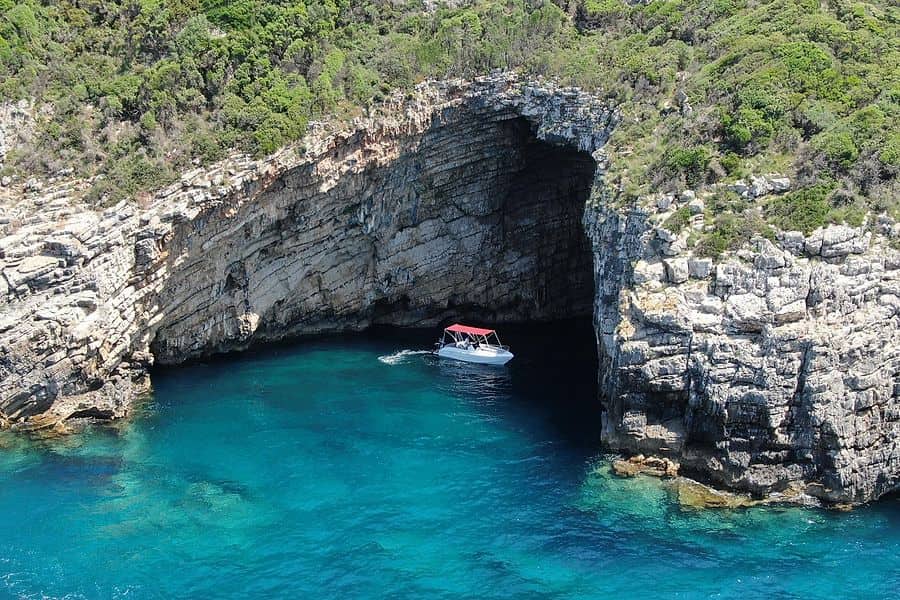
A Corfu boat trip on the west coast can reach the bay of Palaiokastritsa. Its beach has sand and turquoise waters. Routes differ from boat to boat, so not every trip stops at each cove. The sea on the day also shapes the plan.
Up on the skyline, Angelokastro sits on the highest peak of Corfu’s shoreline. This lofty site lies on the northwest coast of the island, near Palaiokastritsa. Palaiokastritsa means “Old Little Castle”, a name taken from nearby Angelokastro. So a Corfu boat trip here links the water below with the heights above.
The bay of Palaiokastritsa also has a tie to an old story. It is suggested as the spot where Odysseus landed and first met Nausicaa. The idea is a suggestion, not a proven fact. A Corfu boat trip into this bay lets passengers arrive by sea, as the story says Odysseus did.
Liapades village sits on the northwest side of Corfu, 3 km from Palaiokastritsa. That short distance keeps both shores on the same stretch of sea. Rovinia is one of the beaches near the village. A Corfu boat trip that heads past Palaiokastritsa can add Liapades to the day without a long detour.
- Monastery: Built in 1225, the Palaiokastritsa monastery adds a sight of history to the bay.
- Cliff heights: Angelokastro rises 305 m (1,000 ft) on a sheer cliff over the sea.
- Coastline: Palaiokastritsa is known for its great cliffs and for the beaches that lie close by.
Chomi beach, near Liapades, can be reached only by sea. That makes it a natural goal for a boat on this coast. Land visitors cannot walk or drive to it, so the cove belongs to those who arrive by water.
What does a Corfu boat trip show of Corfu Town from the sea?
A Corfu boat trip shows the old town from the water, where its defences are easiest to read. Venetian engineers designed its three forts. For four centuries, these forts guarded the sea trade of Venice against the Ottomans. From the deck, each wall makes sense.
From the water, the old fort shows itself as a citadel, a walled stronghold that guards a town. A moat, which is a ditch full of water, cuts it off from the town. This moat holds seawater. Today it also serves as the Contrafossa marina, with small boats moored inside.
A Corfu boat trip also brings St George’s church into view, below the high point of the citadel. Its design is classical, with six Doric columns. Old wall sections of the citadel face a quieter threat. Chiefly on the east side, they are slowly eroding, and pieces are falling into the sea.
Vido sits at the mouth of Corfu port, roughly 1 km to the north of the old fort. Under 1 km across, it stays in clear view on a Corfu boat trip. The sea near Vido became the grave of more than 5,000 people. A mausoleum, a tomb building, holds the remains of fallen Serbian soldiers.
- New Fortress: This huge complex of fortifications dominates the northeastern part of Corfu Town.
- Lion of St Mark: The winged lion, symbol of Venice, decorates the New Fortress walls at regular intervals.
- Mon Repos: This mansion went up under British rule, built by Sir Frederick Adam, then the British Lord High Commissioner on the islands.
The islet of Lazaretto has its own story. In the 16th century, under Venetian rule, the islet gained a leprosarium. This was a hospital for people with leprosy, and it gave the islet its name. A Corfu boat trip joins these stories in one view.
What does Mouse Island add to a Corfu boat trip?
A Corfu boat trip past Mouse Island adds faith, myth and art to the day at sea. The islet carries the Greek name Pontikonisi, which means “Mouse Island” in English. It is a small Greek islet that lies near the island of Corfu.
The main feature of Pontikonisi is a Byzantine chapel of Christ Pantokrator. Its builders raised the chapel in the 11th or 12th century. For travellers on a Corfu boat trip, it turns a pleasant sea view into a lesson in history. Passengers on deck can study its shape and think about the centuries it has stood.
The islet also carries a legend. In Homer’s Odyssey, Poseidon turned a Phaeacian ship to stone. He did this because the ship had helped his foe, Odysseus. In Classical times, people identified Pontikonisi as that petrified ship. The tale is myth, not history, yet it gives the view from deck a sense of story.
Art lovers find one more link on a Corfu boat trip. Pontikonisi is named as a possible inspiration for Isle of the Dead, a painting by Arnold Böcklin. The link remains a possibility rather than a proven fact. Still, the idea adds a quiet, thoughtful mood to the moment the boat glides past the islet.
- Trees: Though the islet is small, it is very green and full of trees.
- Height: The land rises about 2 metres at its natural high point above the sea.
- Cypresses: The small chapel stands amid a grove of cypress trees on the lush islet.
The islet also holds a more personal story. On Pontikonisi, part of the ashes of conservationist Gerald Durrell and of his sister Margaret were scattered. For passengers on a Corfu boat trip, this detail adds a note of quiet memory.
Which sea creatures live along a Corfu boat trip?
A Corfu boat trip crosses a sea with four regular dolphin species. These are cetaceans, the animal group of whales and dolphins. Risso’s dolphins join bottlenose, common and striped dolphins in Corfu’s waters. Wild animals move freely, so no sighting is promised.
The Tethys Research Institute is a non-profit group founded in 1986. Its purpose is to support marine conservation. Its long-term Ionian Dolphin Project has been running since 1991. Long studies of this kind let scientists compare dolphin numbers across decades. That record helps visitors on a Corfu boat trip understand the animals nearby.
The project’s research covers three Natura 2000 areas. Natura 2000 links protected nature sites across the European Union. The three are the Gulf of Ambracia, the Inner Ionian Archipelago and the Paxos-Antipaxos waters. In the Inner Ionian Archipelago, common dolphins fell sharply between 1995 and 2007. The drop is tied to overfishing.
Every Corfu boat trip adds to sea traffic, and boat disturbance is a real issue. In the Inner Ionian Archipelago, boat-based tourism is a main source of disturbance for monk seals. Posidonia oceanica is a seagrass that grows in meadows on the seabed. Rising temperatures and anchor damage both threaten these meadows.
- Study species: The Ionian Dolphin Project follows bottlenose dolphins, common dolphins and Mediterranean monk seals.
- Loggerhead turtles: Kyparissia Bay holds the second-largest loggerhead turtle nesting in the Mediterranean, after Zakynthos.
- Corfu dwarf goby: This fish lives nowhere except Korission Lagoon and the springs around it.
On the island itself, Korission Lagoon and its surroundings are protected under the Natura 2000 network. This status covers the lagoon water and the land around it. Visitors on a Corfu boat trip see the sea side of an island with a protected lagoon.
Which season suits a Corfu boat trip?
A Corfu boat trip suits summer and early autumn best, when the sea stays warm for swimming. Off Corfu in the Ionian Sea, August water reaches an average maximum near 25.8 °C. In October, the sea off Corfu still averages 22.4 °C.
Heat shapes summer days at sea. At the Corfu airport station, the average July high reaches 31.2 °C. A Corfu boat trip in July runs best with an early start. Each passenger needs water and a hat. Greek Civil Protection says that in a heatwave, children avoid sun after swimming and wear hats.
The summer maestro is a mild wind blowing from the sea to the coast. The mistral is a different wind, and the maestro does not match it. A Corfu boat trip on a maestro day meets a gentle breeze. During a storm, Greek Civil Protection tells anyone in the sea to get out quickly.
Corfu’s climate table cites WMO station 16641, filed under the name Kerkyra airport. The fifth month at the Corfu airport station averages 276.8 hours of sunshine. A Corfu boat trip in late spring therefore enjoys plenty of bright hours on open water. Sun cream and sunglasses belong in each passenger’s bag.
- April rain: The Corfu airport station averages 12.2 days with rain in April, so plans stay flexible.
- Yearly rain: The Corfu airport station records an average of 1111.3 mm of rain each year.
- October air: At the Corfu airport station, the average October high falls to 23.2 °C.
Before boarding, passengers check the latest forecast and listen closely to the skipper’s safety briefing. A towel, sun cream and a spare shirt make each swim stop easier. On a small-group boat, the host has more time for each passenger’s questions.
What questions come up about a Corfu boat trip?
A Corfu boat trip draws four common questions about the coast and the island. Sivota adds beaches and a naval past, while Albania is a neighbour reached by ferry. A castle overlooks a north-east fishing village, and the airport gives aerial views on landing.
What do Sivota and its Blue Lagoon add to a Corfu boat trip?
Since the 2011 local government reform, Sivota has belonged to the Igoumenitsa municipality. Beaches form the main tourist draw of Thesprotia, and the Sivota resort stands out above all. The fleet commanders of Corcyra, the ancient name of Corfu, made the Sybota islands their base of operations.
How does Albania link to a Corfu boat trip?
The Corfu Channel is a sea passage. It runs from the Adriatic Sea in the north to the Ionian Sea. Ferries sail from Corfu to Saranda in neighbouring Albania. Both traditional and high-speed vessels work this crossing. Butrint was declared a UNESCO World Heritage Site in 1992.
Which north-east coast villages face a Corfu boat trip?
Kassiopi Castle stands on the northeastern coast of Corfu and looks down on the fishing village of Kassiopi. Lawrence Durrell settled at Kalami in early 1936, in a fisherman’s cottage known as the White House. Mount Pantokrator is the highest point on Corfu, at 906 metres.
Where is the airport for a Corfu boat trip?
The island airport is named after Ioannis Kapodistrias, who was a Corfiot and a European diplomat. On landing, passengers get aerial views of Pontikonisi, the Vlacherna Monastery and the hills of Kanoni. Chalikiopoulou Lagoon, also called Lake Chalikiopoulou, lies south of Corfu town.