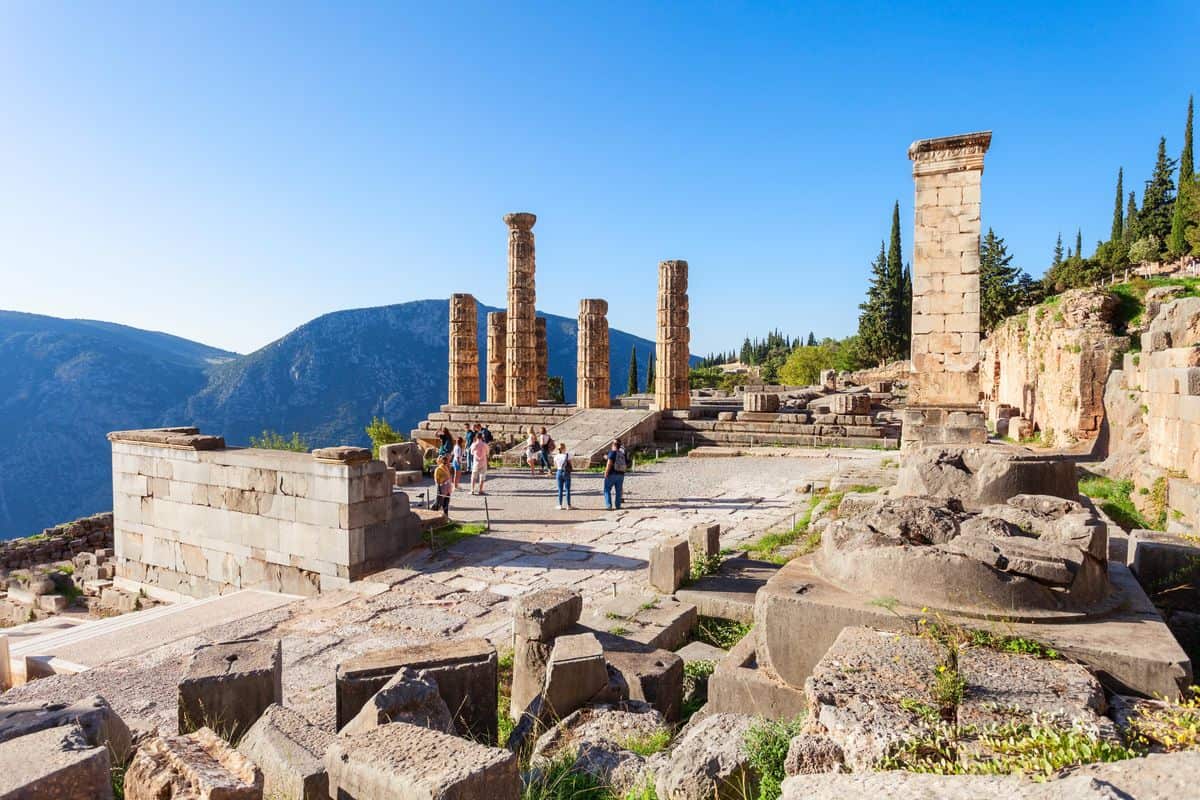
A Delphi day trip from Athens heads north-west to the ancient sanctuary of Apollo on the slopes of Mount Parnassus and returns the same evening. It is one of the classic Greece tours that start from the capital.
What is a Delphi day trip from Athens?
A Delphi day trip from Athens is a one-day outing to the ancient sanctuary of Apollo at Delphi. Travellers leave a home or hotel in Athens in the morning. They return to the same place in the evening of that day.

The main goal of a Delphi day trip from Athens is the sanctuary of Apollo. The sanctuary was Pan-Hellenic, so it belonged to the whole Greek world rather than to one city. Apollo belonged to the Olympian gods. The ancient Greeks linked him with light, knowledge and harmony.
The sacred precinct of ancient Delphi occupies the southwestern side of Mount Parnassus. A Delphi day trip from Athens therefore leads travellers into a mountain setting. The ruins and the modern town of Delphi lie close together. The town sits immediately west of the archaeological site.
For centuries, the sanctuary of Delphi stood at the heart of Greek life. It was the cultural centre of the ancient Greek world. It was the religious centre as well. The site also became a symbol of Greek unity. A walk through its ruins shows a place that once linked a whole people.
In 1987, Delphi joined the UNESCO World Heritage List. The committee took this step at its 12th session. Delphi is listed under five cultural criteria, numbered one, two, three, four and six. Each Delphi day trip from Athens visits a site with world heritage status.
- Region: Delphi lies in the regional unit of Phocis, in Central Greece.
- Criterion one: Under this criterion, UNESCO calls the layout of Delphi a rare artistic achievement.
- Criterion three: Delphi stands as a one-of-a-kind witness to the religion and civilisation of ancient Greece.
The community of modern Delphi has a population of 867 people. The ancient ruins next to it remain the focus of each visit. A trip here pairs this small living town with the remains of the old sanctuary on the slope above.
Which road does a Delphi day trip from Athens take?
A Delphi day trip from Athens heads north-west out of the Greek capital. The road north towards Delphi passes Thebes, which lies about 50 km from Athens. Further on, the same road passes near Livadeia, a town 90 km north-west of Athens.
The road north from the capital runs along the A1 motorway. One section of this motorway links Metamorfosi, in Athens, with Thebes. In 1998, that section had six lanes. Travellers on a Delphi day trip from Athens can use this wide stretch to leave the city behind.
Thebes has a deep link with Greek storytelling. The city was the setting of Greek myths about Cadmus, Oedipus, Dionysus and Heracles. These figures belong to legend, not to recorded history. Their stories lend the early part of the drive an ancient feel. Myth returns further along the road.
Livadeia lies about five kilometres west of National Road 3. The town connects to that road through National Road 48. The same National Road 48 also passes north of the town of Distomo. On a Delphi day trip from Athens, these road numbers help travellers follow the route on a map.
The name Distomo carries a painful memory. On 10 June 1944, the Germans massacred civilians at Distomo. The dead were ordinary people, not soldiers. The massacre was a war crime. Travellers passing the area can pause to remember the victims. Their story deserves respect from every visitor.
- Herkyna springs: In Livadeia, shallow grottos with niches at these river springs are said to mark the Trophonius oracle.
- Daulia: In myth, Oedipus came to Daulia, where three roads crossed, while travelling towards Thebes.
- Cleft Way: On this road, myth says Oedipus met King Laius, who was travelling to Delphi.
The route to Delphi also has a sporting side. The first stage of the Tour of Greece cycling race covered 170 km from Athens to Delphi. A Delphi day trip from Athens links the same two places with far less effort.
What does Arachova add to a Delphi day trip from Athens?
A Delphi day trip from Athens gains a second stop when the route includes Arachova. This mountain town lies just 8 km east of Delphi. The short detour swaps ancient stones for a lived-in village with its own history, food and traditions.
Arachova sits at an altitude of about 970 m. The town clings to the southern side of Mount Parnassus. From its streets, the town looks down over the Pleistos valley. A Delphi day trip from Athens with this stop lets visitors stand high on the mountain itself.
The town centre holds a huge, steep cliff and the Bell Tower. Dense ivy covers the tower. At the top of the tower sits a large clock, 10 m tall. Travellers on a Delphi day trip from Athens can stop in the centre to photograph both landmarks.
Arachova is famous for black wine and colourful textiles. Its name is also tied to carpets, rugs, handicrafts and woodcut creations. On the food side, Formaela stands out. This hard cheese is produced only in Arachova. Together, these goods give a stop here a clear local flavour.
Arachova also holds a page of Greek history. In 1826, at the Battle of Arachova, Greek rebels under Georgios Karaiskakis beat the Ottomans. Karaiskakis ordered his officers to occupy the town’s church of Agios Georgios. The order also covered the houses around it. The battle gives the town a story beyond food and crafts.
- Town streets: Small uphill houses and cobbled streets of traditional architecture frame a panoramic view.
- Protected cheese: Since 1996, Formaela has held EU protected designation of origin status.
- Festival day: On 23 April, the town shows its local customs at celebrations for patron Saint George.
The Parnassos Ski Centre has no lodging of its own. Arachova is one of the nearest places to stay for skiers heading there. A Delphi day trip from Athens that pauses here also reveals a base for a return visit.
What was the Oracle seen on a Delphi day trip from Athens?
A Delphi day trip from Athens reaches the place where the Pythia once spoke. Pythia was the title given to the chief priestess serving Apollo’s temple at Delphi. Her answers to visitors’ questions were called the oracle.
In Apollo’s tradition, the oracle spoke in the year’s nine warmest months. Purification ceremonies always fell on the month’s seventh day. That day was sacred to Apollo. A Delphi day trip from Athens takes visitors to where these rites took place.
Inside the temple, the Pythia took her seat on a tripod in the adyton, the inner room. She held laurel leaves and a dish of spring water. Petitioners drew lots to decide their turn. But envoys from city-states and larger donors got a higher place in the line.
Cicero noted that no expedition or colony went ahead without the sanction of the oracle. One old tale is believed to be legend rather than history. In it, the oracle told Croesus that an attack on Cyrus meant the end of a great empire.
Leaders also argued over the meaning of the oracle’s words. Themistocles argued that the oracle’s wall of wood referred to the Athenian navy. A Delphi day trip from Athens links the sanctuary with that city. Its leaders once looked to Delphi for answers like this one.
- Know thyself: This was one of the three best-known maxims at the temple entrance.
- Nothing in excess: This second maxim stood at the same temple entrance beside the first.
- Surety is ruin: The third of these well-known maxims completed the set at the entrance.
One main story claimed vapours rising from an opening in the rock put the Pythia in a frenzy. Two geological faults cross each other right below where the adyton is thought to have stood. A Delphi day trip from Athens passes that spot today.
What does the Temple of Apollo show on a Delphi day trip from Athens?
A Delphi day trip from Athens reaches temple ruins that date from the fourth century BC. They belong to a peripteral Doric building. Peripteral means a row of columns ran around all four sides. Doric names a plain, sturdy style of Greek column.
The present building had earlier versions. The writer Pausanias says the fourth temple on the site was built of stone. He names its builders as Trophonius and Agamedes. That stone temple burned down in 548 BC. Visitors on a Delphi day trip from Athens stand close to where it once rose.
A later temple is tied to one family. The historian Herodotus credits the temple’s beauty to the Alcmaeonid family. This family held the building contract from the Amphictyonic League. Their temple was built around 513 BC. It was the oldest Doric temple with significant marble elements.
The temple contract asked for limestone. An unexpected rise in the budget then paid for white Parian marble columns. The temple’s stylobate, the stone floor on which the columns stand, measured 21.65 by 58.00 metres. The outer row held six columns across each end. Fifteen columns ran along each long side.
The Late Archaic temple was destroyed in 373 BC. Its sculptures were found buried in the ground after that loss. Three men are named as builders of the fourth-century temple: Spintharus, Xenodoros and Agathon. On a Delphi day trip from Athens, the standing stones show their work.
- Adyton: Beyond the cella, the main room, lay the adyton, an inner room kept for Apollo’s priests alone.
- Terrace: The temple stood above the sanctuary on a large terrace held up by a polygonal wall.
- Freedom records: That wall records about a thousand manumissions, the legal freeing of slaves.
The temple of Apollo has been partly restored. The Chiot altar and the Tholos were partly restored as well. A Delphi day trip from Athens shows these rebuilt parts beside fallen stones. The mix helps visitors picture how the sanctuary once looked.
What does the Sacred Way show on a Delphi day trip from Athens?
A Delphi day trip from Athens follows the Sacred Way, the ancient route that visitors still walk today. The path zig-zags two hundred metres up the hillside to the altar. Along the way rise the remains of buildings paid for by Greek cities.
Votive sculptures once lined the first stretch of the Sacred Way. A votive sculpture was a statue offered to a god as thanks. Treasuries lined the second stretch. A treasury was a building that stored smaller offerings. It also showed off the art and splendour of the city that ordered it.
A Delphi day trip from Athens passes the site of the Siphnian Treasury. It stood near the start of the Sacred Way. Beside it stood the Treasury of the Sikyonians. Parts of two older Sikyonian buildings lie under the Sikyonian Treasury’s foundations. Those pieces were buried, not reused.
The City of Athens paid to rebuild the Athenian Treasury. The French School at Athens did the work in 1903-1906. Its inscription says the Athenians gave it to Apollo as first fruits from the Persians at Marathon. First fruits meant the first share of a gain.
On a Delphi day trip from Athens, walkers reach the Sibyl rock between the Athenian Treasury and Stoa. It is an outcrop shaped like a pulpit. A pulpit is a raised stand for a speaker. A stoa is a long porch whose roof rests on a row of columns.
- Stoa columns: The Stoa of the Athenians had seven single-block Ionic columns on a 26.5-metre stepped base.
- Serpent Column: Its three bronze snakes paid tribute to the 31 Greek city-states that battled at Plataea.
- Move to Constantinople: Constantine the Great moved the Serpent Column from Delphi to Constantinople in 324.
In 2015, a bronze cast copy of the Serpent Column was set up at the Delphi site. Thanks to it, a Delphi day trip from Athens shows the column’s form on its home ground. The copy makes the climb’s story easier to picture.
What do the theatre and stadium add to a Delphi day trip from Athens?
A Delphi day trip from Athens gains two extra sights beyond the Temple of Apollo. The theatre offers a stage for drama, and the stadium offers a ground for sport. The theatre stands higher up the hill than the temple, overlooking the sanctuary and valley.
The theatre dates from the 4th century BC, but its story did not stop there. Workers remodelled it in 160/159 BC. A second remodelling followed for Nero’s visit in 67 AD. Visitors on a Delphi day trip from Athens therefore see a building shaped by three stages of work.
The seating falls into two zones. The lower zone held 27 rows of seats, while the upper zone held only eight. The theatre held seats for about 4,500 spectators. That figure helps visitors picture a full audience, row upon row, facing the stage from both seating zones.
After excavation, the theatre came back to life as a stage. It hosted plays at the 1927 and 1930 Delphic Festivals, the work of Sikelianos and Eva Palmer. Palmer directed Prometheus Bound, trained its Greek chorus and wove every costume from scratch. The old seats once again faced live drama.
The stadium lies on the highest spot of the archaeological site of Delphi. On a Delphi day trip from Athens, reaching it means the highest climb on the site. The track measures 177.55 metres long and 25.50 metres wide. Walking its full length gives a real sense of the distance ancient runners covered.
- Stone seating: In the second century AD, Herodes Atticus funded stone seats and an arched entrance.
- Race start: The east starting line keeps two rows of grooved slabs for runners’ feet.
- Field size: Space allowed up to 20 athletes at once, though the tracks soon fell to 17.
The stadium held about 6,500 spectators. Picturing those crowded stands brings a Delphi day trip from Athens to a lively close. Together, the theatre and stadium show Delphi as a home for plays and races as well as worship.
What does the museum show on a Delphi day trip from Athens?
A Delphi day trip from Athens can take in a museum laid out in fourteen rooms on two levels. Statues make up the main part of the display. A walk through these halls turns the ruins outside into faces, figures and stories.
The Charioteer of Delphi is an ancient Greek bronze statue from around 470 BC. The figure is life-size and stands 1.8 metres tall. It once belonged to a larger group that included a chariot and horses. Visitors can picture the full team racing in front of the driver.
Carved from marble, the Sphinx of Naxos shows a sphinx. It stands 2.22 metres tall, well above head height. The east frieze of the Siphnian Treasury opens with the Twelve Olympians gathered over the Trojan War. A Delphi day trip from Athens with a museum stop takes in both works.
Room 3 is dominated by the kouroi Kleobis and Biton. Kouroi are statues of young men. This pair was made at Argos between 610 and 580 BC. The silver bull holds the record as the earliest known large-scale statue made wholly of forged metal. Forged metal is hammered, not poured.
The Acanthus Column shows a group of dancers. They seem to have held a tripod crowned by the omphalos. An omphalos is a stone said to mark the world’s navel. The same room shows this stone too. A Delphi day trip from Athens that stops here sees both pieces together.
- Inscription: The Charioteer’s base names Polyzalus, ruler of Gela in Sicily, as the donor who offered the statue to Apollo.
- Antinous: A statue of Antinous was set up in the Delphi sanctuary after his death in 130 AD.
- First museum: The first, small Delphi museum opened in 1903 to show finds from French excavations.
Greek architect Alexandros Tombazis renovated the museum again between 1999 and 2003. The renovated halls give the ancient works a fresh setting. A Delphi day trip from Athens gains real depth when travellers save time for these galleries.
What does the Tholos add to a Delphi day trip from Athens?
A Delphi day trip from Athens gains a round ancient building when visitors add the Tholos. This circular structure stands inside the sanctuary of Athena Pronaia. Builders raised it between 380 and 360 BC, and its curved outline still draws the eye.
An outer ring of 20 Doric columns once formed a circle 14.76 metres across. Doric columns are plain and sturdy. Inside stood 10 Corinthian columns. Corinthian columns are slimmer, with tops carved like curling leaves. This mix of styles is a detail worth noting on a Delphi day trip from Athens.
Three of the outer Doric columns have been restored. They make the Tholos a favourite photo spot at Delphi. Restored columns help visitors imagine how the full ring once looked. A Delphi day trip from Athens that includes this stop leaves travellers with a lasting picture of Delphi.
Written sources add a name to the story. In his book De architectura, Vitruvius names the architect of the vaulted temple at Delphi. He calls that architect Theodorus Phoceus. An architect plans a building and its shape. A vaulted building has an arched or curved ceiling.
Athena had three temples in this same sanctuary over time. The first was built of grey porous stone in the 7th century BC. Fifteen columns of the second temple stood until a rock fall destroyed them in 1905. The third, from about 360 BC, stood at the west of the Marmaria terrace.
- Massaliot treasury: A treasury stored gifts; this one, of Parian marble, resembled a small temple with two front columns.
- Gymnasium: The ancient training ground lay between the Castalian Spring and Athena Pronaia’s sanctuary.
- Palaestra: West of this wrestling yard sits a round pool 10 metres across and 1.80 metres deep.
The so-called Marmaria is this sanctuary of Athena Pronaia. For centuries, locals took building material from it. A gap of about 800 metres separates the Tholos from the main ruins at Delphi. A Delphi day trip from Athens can cover both areas in one visit.
Which myths does a Delphi day trip from Athens recall?
A Delphi day trip from Athens recalls myths of Zeus, Apollo, Gaia and the serpent Python. One myth says Zeus sent two eagles, from the east and the west. They crossed above Delphi’s omphalos, the navel stone known as Gaia’s navel.
Earlier myths give the oracle first to the goddesses Themis and Phoebe. The ground they held was sacred to Gaia. A separate myth places a serpent called Python at the head of the oracle. In that story, the oracle sat in the cult centre of Python’s mother, Gaia.
A Delphi day trip from Athens also brings the writer Hyginus to mind. In his version, a jealous Hera sent Python to chase Leto. Leto was then pregnant with Apollo and Artemis. Hyginus adds that Apollo, just four days old, chased Python to Delphi. There the infant god killed the serpent with arrows.
The tale does not end with Python’s death. To atone for killing Gaia’s son, Apollo left to work as a lowly servant. He spent eight years in this menial service. Only then did he return, forgiven. A Delphi day trip from Athens recalls a god who paid for his deed.
The Homeric Hymn to Apollo tells how the god first came to Delphi. In this ancient poem, he arrived as a dolphin. He carried a band of Cretan priests with him. The Cretans entered his shrine as its priests. They worshipped him as Delphineus, which means “of the dolphin”.
- The Pythia: The priestess took her title from Pytho, a name Greeks tied to the serpent’s rotting corpse.
- Delphyne: The Suda, a Byzantine encyclopaedia, says Delphi took its name from this she-serpent Apollo killed there.
- Winter god: Myth says Apollo left his temple in winter, and his half-brother Dionysus took his place.
Parnassus brings one more layer of myth to a Delphi day trip from Athens. In ancient belief, this mountain was sacred to Dionysus, Apollo and the Corycian nymphs. The Muses made their home there too.
What were the Pythian Games seen on a Delphi day trip from Athens?
A Delphi day trip from Athens stands where the Pythian Games took place. These games honoured Apollo at Delphi. They were one of four Panhellenic, or all-Greek, festivals. The other three were the Olympic Games, the Nemean Games and the Isthmian Games.
On a Delphi day trip from Athens, one legend opens the tale of the games. It says Apollo set them up to celebrate his victory over the serpent Python. At first the festival came every eight years. It had one contest: a hymn to Apollo sung with the cithara, a kind of lyre.
In 586 BC the Delphic Amphictyony, a league of neighbouring states, held its first games at Delphi. That same year, Sakadas of Argos won with a piece called the Nomos Pythicos. It was music for the aulos, a reed pipe. The tune told the story of Apollo battling the serpent Python.
At its peak, the athletic programme held four foot races. Boxing, wrestling and the pentathlon were part of it too. The pankration, which blended wrestling and boxing, completed the list. A Delphi day trip from Athens brings this sporting past to life for visitors who enjoy ancient history.
The final day belonged to the horses. Horse and chariot races took place at a hippodrome down on the Krisa plain, near the sea. The chariot races drew famous names. Rulers such as Cleisthenes of Sikyon and Hieron of Syracuse raced their chariots at the Pythian Games.
- Rank: The games ranked second in importance, behind only the Olympic Games.
- Schedule: Later they ran on a four-year cycle, falling two years after each Olympics, between the Nemean and Isthmian Games.
- Prize: Winners received a bay laurel wreath, sacred to Apollo, cut in Thessaly’s Vale of Tempe.
The Pythian Games carried on even as the new faith of Christianity rose. They were still celebrated at least until AD 424. A Delphi day trip from Athens brings visitors close to this long tale of music and sport.
What nature surrounds a Delphi day trip from Athens?
A Delphi day trip from Athens reaches the slopes of Mount Parnassus, which rises to 2,457 metres. Its highest peak, high above the ruins, is called Liakoura. This mountain frames the views across the ancient site and the land around it.
Above the ruins stand the Phaedriades, twin cliffs about 700 m high. Their name means “the shining ones”. It fits, because the rock faces still reflect a dazzling glare at noon. On a Delphi day trip from Athens, these pale walls rise straight behind the temples. They dominate the skyline.
The slopes of Parnassus are wooded with dense growth, and the fir is the main tree. These firs give the mountain a dark green cover. The national park also protects endemic plants. Two of them are the Parnassian peony and the Cephalonian fir, both growing wild on these slopes.
Far below the ruins runs the Pleistos river. It flows west between Parnassos and Kirphe, passing south of Delphi. It then crosses the Crissaean plain. A Delphi day trip from Athens offers clear views over this valley from the ancient terraces. The river forms the lowest layer of the scenery.
Olive groves fill the Pleistos valley and carry the nickname “sea of olives”. These groves date back to prehistoric times. From the hills, the grey-green treetops resemble a wide sea. The town of Amfissa stands at the northern rim of the Crissaean plain’s olive forest. It sits between Giona and Parnassus.
- National park: Since 1938, Delphi’s sacred precinct has belonged to Parnassos National Park.
- Birds of prey: Peregrine falcons and golden eagles have both been recorded on Mount Parnassus.
- Corycian Cave: This cave lies on the southern slopes of Parnassus, north of Delphi, inside the park.
The wider Delphic Landscape has been a declared protected area since 1981. The protected area takes in the scenery around the ruins as well as the ancient stones. A Delphi day trip from Athens therefore joins history and nature in a single outing.
What does the Castalian Spring add to a Delphi day trip from Athens?
A Delphi day trip from Athens gains a sacred stop at the Castalian Spring. This is the holy spring of Delphi. It lies in the ravine of the Phaedriades cliffs. The visit adds water, rock and ancient stories to a day among ruins.
Ancient visitors treated the spring as a place of cleansing. Pilgrims coming to consult the oracle stopped here to wash and drink. Contestants in the Pythian Games did the same. The spring also served the Pythia and the priests for their own cleansing. They did this before giving oracles.
The Archaic fountain house dates to the 6th century BC. Its basin is lined with marble and ringed by benches. A short aqueduct fed the fountain house. Pipes ending in lion-headed spouts shared the water out. On a Delphi day trip from Athens, these remains reveal a planned ancient water system.
Higher up stands the Roman fountain. It dates to the 1st century BC and sits about 50 metres above the Archaic one. The centuries between the two fountains show the spring kept its value. A Delphi day trip from Athens that stops here shows both Greek and Roman work at one spring.
Myth adds another layer to the visit. The story says the nymph Castalia was the daughter of Achelous. Apollo pursued her, and she leapt into the spring. The tale links the spring to a god and a nymph. Visitors who know the story see more than water.
- Rock niches: Niches carved into the rock once held the votive offerings that pilgrims gave to the gods.
- The Muses: In the myth, Apollo consecrated the nymph Castalia to the Muses.
- Poetic inspiration: Roman poets regarded the Castalian Spring as a source of poetic inspiration.
Today the spring’s water is largely diverted to supply the modern town of Delphi. In this way, the old sacred source still serves the people who live nearby. A Delphi day trip from Athens feels richer when it includes the spring.
How was the site rediscovered that a Delphi day trip from Athens visits?
A Delphi day trip from Athens reaches a sanctuary lost for centuries and then found again in stages. Cyriacus of Ancona is the first person known to have rediscovered Delphi. He found the site on 21 March 1436, long before any digging began.
The loss began when Emperor Theodosius I shut down the Delphic oracle in 381 AD. He acted during the late Roman persecution of pagans. Later, in the seventh century AD, a new village called Kastri grew over the ruins. Its homes covered the ground a Delphi day trip from Athens now explores.
Kastri was a real village, not a handful of huts. With about 100 houses and 200 people, it once stood on top of the site. In 1870, an earthquake left Kastri derelict. The village above the ruins was in poor shape. That loss opened the way for excavations at Delphi.
In 1891, the Greek government gave the French School at Athens permission for long-term excavations. The school now had the right to dig at Delphi for years to come. Théophile Homolle directed the French School at Athens from 1891 to 1903. He also led the Delphi excavation.
In 1892, the French School at Athens began a project called the Great Excavation. In French, it is known as La Grande Fouille. Both names point to the size of the task. Visitors on a Delphi day trip from Athens walk across the ground this dig opened up.
- Village move: The entire village of Kastri was moved to the spot where Delphi village stands now.
- Small railway: Work crews laid a Decauville railway, which is a small portable railway, on the site.
- Debris wagons: V skip wagons ran on these rails and hauled the debris away from the site.
One find came while the work was still under way. The Charioteer statue was discovered in 1896 during excavations at Delphi. A Delphi day trip from Athens now shows the sanctuary those crews brought back into daylight.
Which season suits a Delphi day trip from Athens?
A Delphi day trip from Athens suits spring and autumn best, when the weather is mild. At Arachova, the weather station near Delphi, April averages a daily high of 13.5 °C. October there averages a daily high of 19.3 °C.
Summer at Arachova brings warm weather. In July, the Arachova station averages a daily high of 26.7 °C. Nights in Arachova stay pleasant, even through the height of summer. Daytime sun is stronger, so a Delphi day trip from Athens in July suits an early start.
The Amfissa weather station lies on the plain below. There, July brings an average daily high of 34.1 °C. Greek Civil Protection warns against long walks or running in the sun during a heatwave. On hot days, visitors do well to rest in the shade and carry plenty of water.
Winter is a cold season at Arachova. January at the Arachova station averages a daily high of only 5.9 °C. The same station records an average of 129.4 mm of precipitation in January. A Delphi day trip from Athens in winter calls for warm layers and a waterproof jacket.
Cold months bring snow to the mountain. It falls on Arachova in winter, though less than on the north side of Parnassus. Greece’s largest ski centre lies on Parnassus. It operates each year from December until early in the fifth month. Warm boots and gloves help visitors walking among the ruins.
- Late summer rain: In August, the Arachova station averages only 36.3 mm of precipitation.
- Mountain climate: Winters on Mount Parnassus are very cold and summers cool, so layers help year-round.
- Day pack: A light jacket, a hat and water suit a mountain visit in any season.
Every season lends the trip its own mood. Mild months suit long walks among the ruins. Hot days reward an early start, while cold days reward warm clothes. Checking the forecast before a Delphi day trip from Athens helps travellers pack well.
What questions come up about a Delphi day trip from Athens?
A Delphi day trip from Athens has a free day and reduced tickets for older EU citizens. The site is steep, so walking shoes matter. Itea faces a branch of the Gulf of Corinth. Hosios Loukas, a monastery near the route, holds gold-background mosaics.
Which free days and reduced tickets apply on a Delphi day trip from Athens?
Every visitor enters Delphi free on International Museums Day each spring. Reduced entry applies to Greek and EU citizens over 65 between 1 October and the close of the fifth month. Visitors with disabilities from any country enter free. At 67% disability, one escort enters free too.
How steep is the site on a Delphi day trip from Athens, and what footwear suits it?
The site’s accessibility notes say the steep slope allows only a partial tour. Visitors with restricted mobility ride a special vehicle. They first inform the Ephorate of Phocis, the local antiquities office, at least seven days ahead. Ministry of Culture rules recommend footwear suited to walking at archaeological sites.
What do Itea and the Gulf of Corinth add to a Delphi day trip from Athens?
Itea stands on the northern coast of the Gulf of Itea, a branch of the Gulf of Corinth. Two rocks at Xeropegado split the coastal Cirrhaean plain from the larger Crissaean plain. The Crissaean plain reaches Amphissa. Ancient writers called Kirra the port of Delphi.
What is Hosios Loukas, the monastery near the route of a Delphi day trip from Athens?
Since 1990, Hosios Loukas has held UNESCO World Heritage status. It shares this listing with Nea Moni and Daphni. In the 11th and 12th centuries, all three monasteries gained marble work and gold-background mosaics. No mosaics of the Macedonian Renaissance survive in better condition than those in the Katholikon, its main church.