
The Pozar thermal baths sit in a rocky ravine near Loutraki in northern Greece, where warm springs feed pools, falls and a river. They pair well with the Greece tours that start from Thessaloniki.
What are the Pozar thermal baths?
The Pozar thermal baths are hot spring baths near the village of Loutraki in Pella. The baths also go by two other names, Loutra Loutrakiou and Loutra Aridaias. Travellers who see any of the three names are reading about the same spa.
The spa town lies 13 km west of Aridaia. It also sits 3 km from the village of Loutraki. Of the two, the village of Loutraki is much nearer to the spa town. Both places work as clear markers for any traveller planning a trip to the Pozar thermal baths.
Loutraki itself stands at an altitude of 300 metres. Until 1922, the village carried a different name, Kato Pozar. Today it forms part of the municipality of Almopia. Almopia belongs to Pella, within the region of Central Macedonia. The old village name and the name of the baths share the same word, Pozar.
The Pozar thermal baths lie at the foot of Mount Voras. The Voras range holds these hot springs on its Greek side. A visit to the spa is therefore also a visit to the lower slopes of Voras. Mount Voras is the name to look for when planning the journey.
The springs rise at heights between 360 and 390 metres. Their water begins as rain. The rainwater sinks deep into the ground. Far below the surface, it heats up before it returns to the open air. The warm water at the baths is the end result of this underground journey.
- Hot spring: A hot or thermal spring forms where groundwater heated inside the earth reaches the surface.
- Magma heat: In one case, the water heats up near shallow magma below the surface.
- Fault heat: In the other case, water flows through faults down to deep, hot rock and warms there.
In everyday speech, the baths carry the popular name Loutra Pozar. This short form is the name heard in local conversation. A traveller who asks for Loutra Pozar in the area is asking about the Pozar thermal baths.
Where do the Pozar thermal baths lie in Almopia?
The Pozar thermal baths lie in the west of Almopia, a municipality of Pella in northern Greece. The warm springs sit close to two villages, Loutraki and Orma. Both villages make natural reference points for anyone heading to the baths.
The town of Aridaia is the seat of Almopia municipality, so the local council has its base there. The whole municipality covers 985.817 square kilometres. That area holds the main town, smaller communities and the Pozar thermal baths. Aridaia serves as the chief point of reference for the district.
Aridaia sits in the northwest corner of Pella. Its land borders the southern part of North Macedonia. This puts the town and its nearby villages right beside an international frontier. Travellers bound for the Pozar thermal baths enter a border district at the edge of the country.
The 2021 census counted 7,118 residents in Aridaia town itself. The wider municipal unit, which takes in the surrounding villages, counts 18,864 people in total. So more than half of the local population lives outside the town. These figures describe the district that holds the hot springs.
After Aridaia, the largest communities in the municipal unit are Promachoi, Loutraki and Sosandra. Promachoi has 1,654 residents, Loutraki has 1,176 and Sosandra has 1,008. Each of the three holds more than a thousand people. Loutraki is the key name among them for visitors to the Pozar thermal baths.
- Old name: Moglena, from a Slavic word meaning fog, was the later medieval name of Almopia.
- Water: The Moglenitsas river was redirected by a canal in the 1930s and now irrigates Almopia.
- Local produce: The area around Orma produces three crops: cherries, chestnuts and peaches.
Orma lies right on the border between Greece and North Macedonia, close to Loutra Pozar. The village stands at the very edge of Greek land in this corner of Almopia. It shows how close the springs sit to the frontier.
How warm is the water at the Pozar thermal baths?
The Pozar thermal baths hold water at a steady 37 °C in every season. Winter cold and summer heat leave this reading unchanged. A bather in the coldest month finds the same warmth as a bather in the hottest month.
A clear rule helps make sense of the water readings. One definition calls a spring hot when its water climbs above body temperature. That point sits at about 37 °C. Water that stays at or just under this mark counts as warm rather than hot.
The main gushing point sits right beside the hydrotherapy centre at the Pozar thermal baths. A gushing point is the place where spring water bursts up out of the ground. At this spot, the water measures 37.2 °C. Visitors who want to see the source itself can start their walk here.
Out in the square, two springs flow side by side, yet their water feels very different. The warm spring runs at 36.4 °C. Right beside it, a cold spring runs at just 15 °C. Both springs sit in plain view for anyone walking across the square.
The running water at Loutra Pozar does not rise from a single source. It comes from six springs that break through the ground at the site. Their combined flow is what visitors at the Pozar thermal baths step into. Each spring adds its own share to the water that moves through the baths.
- Hypothermal: The site operator classes the water as hypothermal, meaning warm but below the hot range.
- Sodium chloride: The water carries dissolved sodium chloride, which is the chemical name for common table salt.
- Weakly alkaline: Weakly alkaline means the water is mildly the opposite of acidic, close to neutral.
Bathers at the Pozar thermal baths can use the Alexandria hydrotherapy centre. Its 11 swimming pools are booked privately by appointment. The Old Hydrotherapy Centre holds two pools, two hammams and individual bathtubs. A hammam is a steam bath, a warm room filled with steam.
What healing uses do the Pozar thermal baths have?
The Pozar thermal baths are above all a place of therapy. Visitors come to the springs mainly for treatment, which made the baths a thermal tourism centre. The regional tourism site says the waters help fight circulatory, respiratory, rheumatic, gynaecological and dermatological diseases.
Hydrotherapy simply means treatment with water. At the Pozar thermal baths, it means bathing in the warm water of the springs. The site operator says hydrotherapy soothes the symptoms of back pain, sciatica and cervical syndrome. It puts disc disease, rheumatism and skin diseases on the same list.
According to the site operator, the thermal water helps the immune system work well. The operator also says the water promotes muscle relaxation, a loosening of tense muscles. Both points come from the spa itself. Visitors to the Pozar thermal baths can treat them as claims, not proven results.
Greek law also gives the spring an official healing status. Government Gazette 3626/B, dated 31 December 2014, recognised the Loutraki Aridaia-Almopia hot spring as healing. The Gazette is the official paper where the Greek state publishes its laws and decisions. The healing label rests on a formal state act.
The Ministry of Tourism has licensed the spa town at Pozar. Since 2019, the spa town has been an officially certified Spa Treatment Unit. This status is not a label the business gives itself. For visitors, it means the Pozar thermal baths run with a state licence behind them.
- Massage: Professionals inside the spa town offer massage services, booked by appointment.
- Heart disease: The site operator forbids hydrotherapy for anyone with heart disease or a recent heart attack.
- Severe health problems: Hydrotherapy at Pozar requires written consent from the attending physician in such cases.
The belief behind these uses is far from new. Around 460 BC, in the time of Hippocrates, hot springs in Greece were already credited with healing power. A soak at Pozar today carries on an idea that reaches back to ancient Greece.
What does the waterfall add to the Pozar thermal baths?
The Pozar thermal baths hold two natural thermal waterfalls in their outdoor area. An Olympic-sized pool sits in the same open space. The falls add moving water to still water. Bathers choose between a calm swim and a soak under falling water.
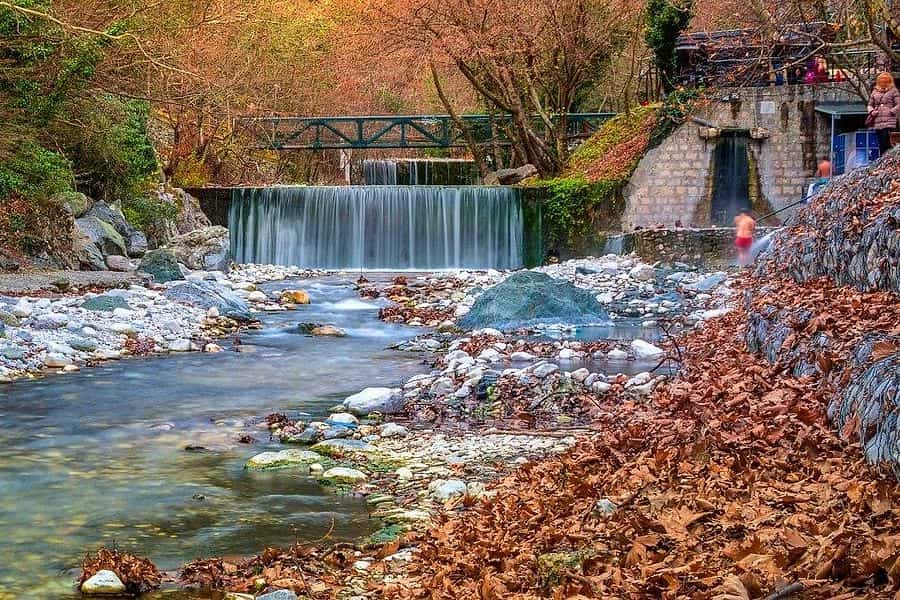
The Thermopotamos river flows through a ravine cut into a rocky mountain at Pozar. Inside the ravine, the river forms small waterfalls. It also spreads into shallow beds beside its banks. Such steps of falling water frame the site. The thermal falls are part of this wider river scene.
At the Pozar thermal baths, the hot springs form natural thermal waterfalls of their own. They pour down beside the Agios Nikolaos river, which crosses the spa town. Visitors bathe in these thermal-water waterfalls along the river, for leisure or for health. Both kinds of bather share the same falls.
Beyond the outdoor pool, landscaped paths lead through a canyon to the large waterfall. This fall is 22 metres high. Its altitude is 400 metres. The canyon path links a soak at the Pozar thermal baths with this tall cascade.
Bridges and paths at the site are shaped to follow the terrain. They let visitors walk and climb across the rocky ground at the baths. The layout keeps the land close to its natural form. Water, stone and walkways meet in one connected space around the Pozar thermal baths.
- Old name: The stream’s older Slavic name, Toplitsa, translates loosely as Thermopotamos, meaning the warm river.
- Downstream: After leaving Pozar, the warm river flows onward into the Almopia basin.
- Trail ends: Hiking and climbing routes around the baths come to an end where a canyon begins.
No reservation is needed to bathe at the waterfalls or the outdoor pool. Visitors can arrive, walk to the falls and step into the water. The falling water turns the Pozar thermal baths from a pool stop into a full river outing.
Which caves sit near the Pozar thermal baths?
The Pozar thermal baths sit beside a large cluster of caves. These caves line both banks of the Agios Nikolaos stream. Loutra Loutrakiou is another name for this bath area. A stone-paved path leads to the first cave, known as Arkoudospilia, the Bear Cave.
The Almopia Speleopark is the first and only speleological park in Greece. Speleological means having to do with caves. About 15 caves and rock hollows in the park have been recorded and studied since 1990. Those studies give the Pozar thermal baths a close link to cave science.
Researchers have studied the Bear Cave in detail. Geologists from Aristotle University worked there with the Ephorate of Palaeoanthropology-Speleology. That long name points to the study of early humans and caves. The team found bones of Ursus ingressus, a kind of cave bear. The bones show that cave bears once reached this spot.
Today the Bear Cave plays a new role. It serves as a place of worship. The reason is a natural pool of water, known as the agiasma. The word agiasma means holy water in Greek. Science and faith thus meet in one cave beside the Pozar thermal baths.
Since 2007, the Ephorate has dug in the Partisans’ Store cave. Its teams found a wide burnt layer and Late Neolithic pottery. Neolithic refers to the late Stone Age. A museum display holds Neolithic stone axes, a stone arrowhead, a bone sewing needle and Cave II potsherds. Potsherds are broken bits of pottery.
- Fossil age: The cave bear fossil layers in Loutra Arideas cave date from 32,000 to 38,000 years ago.
- Bird bones: Bird bones from Loutra Almopias Cave, 551 finds in all, represent at least 47 species.
- Cave-chasm: A little lower down lies an unnamed cave-chasm, open to the public until recently.
On the stream’s south bank lie three more caves: Avra, Keramika and Plotsa. Their names join the list of caves around the Pozar thermal baths. This stretch of stream keeps a long story in stone.
What nature surrounds the Pozar thermal baths?
The Pozar thermal baths are surrounded by the slopes of Mount Voras. The highest part of this range is Kaimaktsalan, the third-highest mountain in Greece. It reaches 2,524 metres. Thick forests, open meadows and mountain streams cover the land below its peaks.
The peaks of Mount Voras are a protected Natura 2000 habitat, listed under the code GR1240001. For visitors to the Pozar thermal baths, the mountain offers history as well as nature. A small church stands on the highest peak. It honours Serbian soldiers who fell in the First World War.
The plant life on the mountain is rich and mixed. Junipers grow here, along with open steppe meadows. Peat bogs form another part of the landscape. Forests also cover the slopes, with beech, oak, chestnut and pine trees. Together, these habitats create a green setting around the Pozar thermal baths.
The Black Forest lies at the foothills of Mount Voras, near the village of Orma. Dense fir, beech and chestnut trees stand close together across its slopes. Their thick crowns block much of the daylight. This deep shade gives the woodland its dark hue and its name.
Water shapes another kind of woodland in the same area. Riverside forests grow near Orma, along the banks of the Aspropotamos and Papadia streams. Alder and plane trees cover these strips of land. Both woodlands sit near the same village, yet each has its own trees and character.
- Raptors: The area is important for resident birds of prey, including griffon vultures, bearded vultures and imperial eagles.
- Mammals: Wolves, wild boar, chamois, otters and bears are among the mammals living on Mount Voras.
- Ski centre: The Kaimaktsalan ski centre starts at 2,050 metres and ends at 2,480 metres, at Greece’s highest lift.
Mountain water completes the picture. The River Almopeos springs from the Kaimaktsalan and Tzena mountains. Peaks, forests, streams and this river form the natural world around the Pozar thermal baths. Each part adds its own colour and life to a visit.
What history do the Pozar thermal baths carry?
The Pozar thermal baths carry a history that reaches back to the ancient world. Signs show the baths were working in the time of Alexander the Great. The same signs point to use in Roman times and again in Byzantine times.
The name of the Pozar thermal baths points to heat. One account splits Pozar into ‘po’ and ‘zar’, which together mean ‘under the fire’. Another account links it to the Slavic word ‘pozhar’, which means fire, blaze or heat. Both explanations are reported, and both tie the name to fire.
The area also saw war. In September 1916, Serbian troops met Bulgarian forces on Mount Kaimaktsalan. The fight became known as the Battle of Kaymakchalan. It ended with victory for the Serbian troops and defeat for the Bulgarian side. That battle forms part of the wider past around the Pozar thermal baths.
Almopia had a mixed population in earlier times. Until the 1924 population exchange with Turkey, Muslim Pomaks formed part of it. Pomaks are Muslims who speak a Slavic language. Megleno-Romanians also lived in Almopia up to that exchange. They are a people who speak a Romance language.
A major step came in the 1920s. In that decade, the springs at Pozar were officially declared therapeutic waters. The label marked the water as healing water in the eyes of the state. Another change came in 1985. That year, the community of Loutraki took over the running of the Pozar thermal baths.
- New facilities: The refreshment café and the large outdoor pool were built in the 1990s.
- First move: In 2000, reforms placed the baths under the municipality of Aridaia.
- Second move: In 2010, a further reform moved the baths under the municipality of Almopia.
In 2015, Loutra Pozar joined EHTTA, a European network of historic spa towns. The baths are still a member of that network today. Membership places the Pozar thermal baths in the company of other old spa towns across Europe.
Which season suits the Pozar thermal baths?
The Pozar thermal baths are a four-season destination, so any month works for a visit. In winter, guests can pair bathing with skiing on snowy slopes. In early summer, June fills the Pella region with the scent and taste of its famous cherries.
Climate data from the Aridaia station explain the rhythm of the year. Aridaia has a temperate climate, with hot summers and cold winters. Rain falls in all four seasons, so a dry day is never certain. This steady pattern helps visitors to the Pozar thermal baths plan clothes and day trips.
Winter in Aridaia brings crisp days and cold nights. January’s average daily high reaches only 8 °C. Nights that month fall to an average low of 0 °C. Snow is fairly rare in Aridaia, but frost is more frequent. Warm clothes and a hat make time outdoors far more comfortable.
Higher ground is colder. The Kaimaktsalan Ski Centre station stands at 2,090 m above sea level. Its January average daily high is -1.8 °C, just below freezing. The Florina station averages 7.5 days with snow in January. Skiers who add the slopes to a trip to the Pozar thermal baths need full winter gear.
Spring and autumn bring mild, comfortable weather in Aridaia. April reaches an average daily high of 19 °C. October is a touch warmer, with an average daily high of 20 °C. July climbs to an average daily high of 32 °C, so midday heat is strong.
- Swim kit: Pack a swimsuit, a towel and sandals for the pools in any season.
- November rain: Aridaia averages 55.4 mm of rain in November, so a waterproof jacket earns its place.
- Summer heat: Carry plenty of drinking water and sun cream for the hot afternoon hours.
Each season gives the Pozar thermal baths a different character. Cold months suit skiers who enjoy a hot soak after the slopes. Mild months suit walkers and families. Matching clothes to the season keeps every visit relaxed.
What questions come up about the Pozar thermal baths?
The Pozar thermal baths welcome bathers through the cold winter months and sit north of the Edessa waterfalls. Thessaloniki and its airport lie within easy road reach. Health cautions cover heart, circulation, diabetes and blood pressure problems, early pregnancy and alcohol.
Can visitors bathe in winter at the Pozar thermal baths?
The baths stay open all year, so visitors can soak while snow covers the winter landscape around them. A winter trip also pairs well with the Kaimaktsalan Ski Centre in Almopia municipality. The road up to the ski centre starts at Orma, the village beside Loutraki.
What does Edessa add to a trip to the Pozar thermal baths?
The baths lie 32 km north of Edessa, so the town’s waterfalls make an easy extra stop. Twelve waterfalls lie in the Edessa area, and four are clearly visible. Karanos is the largest of these falls, and its water drops from a height of 70 metres.
How far are the Pozar thermal baths from Thessaloniki?
The baths, also called Loutra Pozar, sit in western Almopia, only 100 km from Thessaloniki. For drivers, provincial road Pella 1 runs from Edessa through Apsalos to Aridaia. Pella has no airport of its own. Air travellers reach Aridaia through the Macedonia airport of Thessaloniki.
Which health cautions apply at the Pozar thermal baths?
Before hot soaking, people with heart, circulation, diabetes or blood pressure problems are advised to consult a doctor. Water above 102 °F can harm an unborn baby during the first three months of pregnancy. Drinking alcohol before or during a hot-water soak sharply raises the risk of drowning.