
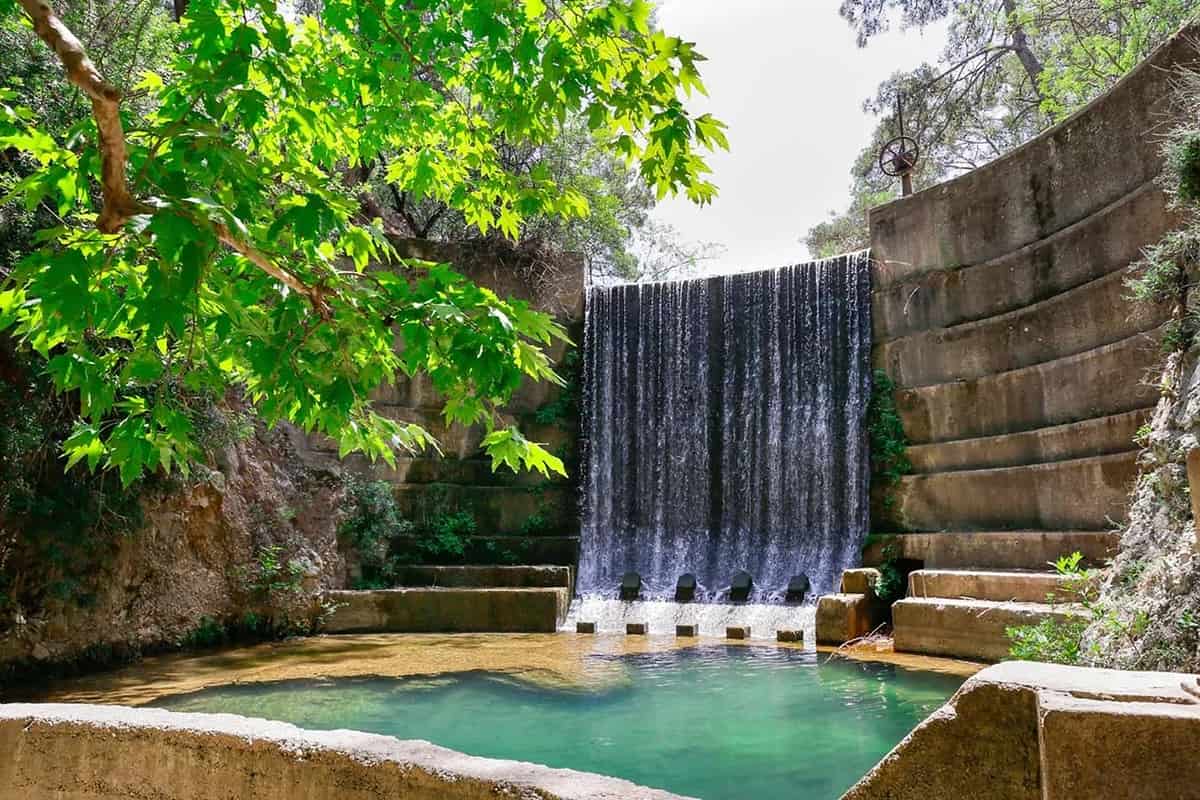
Seven Springs Rhodes is a spring-fed valley on the east side of the island. This page reads the place through nature and engineering topics: springs, dams, tunnels, peafowl and ducks. A last section answers four short questions, and every hard word gets a plain definition. More trip ideas wait on the Greece tours home page.
What does Seven Springs Rhodes mean?
Seven Springs Rhodes is an area close to Archangelos, a village on Rhodes. Seven springs on one slope gave it the name. A spring is a spot where water rises from underground. A slope is ground that leans downhill.
The water of the springs at Seven Springs Rhodes comes from the Loutanis river. A river is a long stream of fresh water that moves along a channel. The Loutanis lies in the north-east part of the island of Rhodes. The Loutanis is second in size after the Gadouras.
The Loutanis forms a valley in the wider area of Seven Springs Rhodes. A valley is low ground that lies between two hills or slopes. The lake of Seven Springs is between 1 and 8 metres deep. A lake is a wide pool of water with land around it.
Rhodes has protected areas that belong to the Natura 2000 network. A protected area is land kept safe for nature. Zone GR4210006 covers Seven Springs Rhodes and the slopes of Profitis Ilias. Special protection zone GR4210029 covers Seven Springs and the mouth of the Loutanis. A river’s mouth is where the river ends.
- Area: Seven Springs lies in the area around Kolympia, a settlement, meaning a small place where people live.
- Coast: Kolympia lies on the island’s eastern coastline, which is the side that faces the sunrise.
- Ravine: A steep narrow valley on the way to Seven Springs holds plane trees and pines.
The lake is artificial, made by people with a dam that the Italians built. A dam is a barrier across a stream that holds water back. Building the tunnel started in 1920 and finished eleven years afterwards. A tunnel is a passage dug through a hill.


On Seven Springs Rhodes, what does a spring add?
Seven Springs Rhodes begins with one plain idea about water. A spring is a natural point where groundwater emerges and flows onto the surface. Groundwater is simply water stored beneath the ground, and a spring is the place where it comes out.
Springs differ in size, and the numbers give readers of Seven Springs Rhodes a sense of scale. Yield is the amount of water a spring gives out. It runs from nearly zero to over 14,000 litres per second for the biggest springs. A litre is a metric unit for measuring liquid.
Springs fall into three classes, and each class has its own name: perennial, intermittent and periodic. Perennial means lasting all year, intermittent means starting and stopping, and periodic means repeating in a regular pattern. These terms are a handy base for anyone who reads about Seven Springs Rhodes and wants the basics.
First-magnitude springs discharge, which means they release, at least 100 cubic feet of water per second. A cubic foot is the space inside a box that is one foot long, wide and deep. That flow rate sets first-magnitude springs apart from the smaller springs. Florida has at least 27 known springs of first-magnitude size.
- Mineral content: Mineral water contains at least 250 parts per million of solids dissolved in it.
- Thermal springs: Thermal spring water is hotter than human body temperature, in the range of 45–50 °C.
- Orange water: Water heavy with iron or tannins takes on an orange colour.
Springs have supported drinking water, irrigation, mills, navigation and electricity generation. Irrigation means watering crops, and navigation means travel by boat or ship. These uses add depth to any reading of Seven Springs Rhodes, because springs do real, practical work.
On Seven Springs Rhodes, what does a dam bring?
Seven Springs Rhodes starts with a simple point: a dam is a barrier that holds back water. Dams provide for irrigation, which is watering crops, and for fish farming. They also provide for hydropower, which is power made from moving water.
The earliest known dam is Jawa Dam, built around 3000 BCE near Amman, Jordan. BCE is a label that historians put on years before year one. Around 2600 BCE, Egyptians built the Sadd el-Kafara embankment dam near Cairo. An embankment dam is a bank of heaped earth and rock.
Dams are classified into four basic types, and anyone reading about Seven Springs Rhodes can begin with two. Gravity dams rely on their weight to resist the force of impounded water. Impounded means held back. Arch dams use a curved concrete wall to transfer water weight to the valley walls. Valley walls are the steep sides of a valley.
About 20% of the world’s arable land is irrigated with water from dam-impounded reservoirs. Arable land is land that can grow crops. A reservoir is the lake that builds up behind a dam. Spillways provide a controlled release of excess reservoir water, preventing overflow. Seven Springs Rhodes readers can think of a spillway as an overflow channel.
- Roman dams: The Roman Empire began building stone masonry gravity dams in the 1st century CE.
- Gate types: Movable barriers called gates come as vertical lift, drum and radial types.
- Penstock: A penstock is a passage that feeds water into a generator, the machine that makes power.
A dam turns a stream into a store of water that people can use later. Reservoirs, spillways and gates are the words to know when Seven Springs Rhodes and dams come up together. Each part has a plain job in how a dam handles water.
On Seven Springs Rhodes, what does a tunnel add?
Seven Springs Rhodes raises the question of what a tunnel is, and the short answer is plain. A tunnel is a passage that runs underground or under the sea. That plain meaning is the base for every later fact on tunnels.
Readers of Seven Springs Rhodes meet the word tunnel, so a short look at its history helps. It is believed the first artificial tunnel was built in Babylon, around 2200 BC. Artificial here means made by people. The earliest tunnel known to have been dug from both ends is the Siloam Tunnel in Jerusalem.
Seven Springs Rhodes also invites a look at how tunnels are built. Cut-and-cover digs a trench for a shallow tunnel, then roofs it over with a support system. A trench is a long, narrow ditch. Tunnel boring machines are used to highly automate the entire tunnelling process. Automating means machines run the steps.
Tunnel building also relies on shafts. Access shafts go straight down to the level where the tunnel will be built. A shaft is a vertical hole dug from the surface. Once construction ends, access shafts can work as ventilation shafts and emergency exits. Ventilation is the flow of fresh air through a room or passage.
- Ground: A tunnel is dug through soil, earth or rock, or laid under water.
- Traffic: A tunnel can carry foot or road traffic, rail traffic, or a canal.
- Water: Hong Kong’s Lion Rock Tunnel carries a motorway and serves as an aqueduct, a water channel.
Water ties the name Seven Springs Rhodes to the story of early tunnelling. A spring is where groundwater reaches the open air. The first qanats, channels cut underground to move water, are known from before 2000 BC.
On Seven Springs Rhodes, what does the peafowl bring?
Seven Springs Rhodes goes with a bird story, the Indian peafowl. It is also called the common or blue peafowl. The male, the peacock, has a blue head with a fan-shaped crest, a tuft of feathers. He is best known for his long train.
For Seven Springs Rhodes, the peafowl is a topic in natural history, the study of living things. In India the bird is found from the Indus valley in the north-west to Assam in the north-east. A male can measure 200–230 cm (78–90 in) to the end of a fully grown train.
That train is made of elongated upper-tail covert feathers, the ones that cover the base of the tail. They carry colourful eyespots. The peahen, as the female is called, looks quite different. She is predominantly brown, with a white face and an iridescent green lower neck. Iridescent means the colour shifts in the light.
The peafowl is omnivorous, so its diet takes in both plants and animals. Its food list covers grass, seeds, flower buds, fruits, insects and small reptiles. A reptile is a scaly animal such as a snake or a lizard. Writing on Seven Springs Rhodes can add this diet to the picture of the bird as a species.
- Courtship: The peacock raises his tail feathers into an arched fan and quivers them to court a mate.
- Breeding: The breeding season links to the onset of the monsoon, the yearly rainy season.
- Colour: The Indian peafowl has colour mutations, including the leucistic white peafowl, a form with little pigment.
The peafowl also uses loud alarm sounds. They signal the presence of predators, animals that hunt others, such as the tiger in forests. These facts describe the bird, and Seven Springs Rhodes is only the reason to read them.
On Seven Springs Rhodes, what does the duck add?
Seven Springs Rhodes meets the duck here only through plain, general bird facts. Duck is the common name for a wide range of waterfowl. Waterfowl are birds that live on or near water, and ducks sit in the bird family Anatidae.
The name Seven Springs Rhodes marks one place, while these facts describe the bird as a whole. Swans and geese are other kinds of waterbird. Ducks are smaller than both, and their necks are shorter. Duck legs are strong and well developed. Those legs also tend to sit far back on the body.
Dabbling ducks feed on the water surface or on land, or they up-end without fully submerging. Up-ending means tipping the body forward, and submerging means going fully under water. Diving ducks are a second group, heavier than dabbling ducks. They also have more difficulty taking off, which means rising into the air.
Ducks tend to make a nest before breeding, and they lead ducklings to water after hatching. Ducklings are baby ducks, and hatching means coming out of the egg. Mother ducks are very caring and protective of their young. Family life is a bird fact, and Seven Springs Rhodes remains a separate topic.
- Bill: A comb-like structure called a pecten runs along the edge of the bill, the duck’s beak.
- Preening: The pecten also helps ducks preen feathers, which means tidying them, and hold slippery food.
- Quack: Female mallards, one kind of duck, make the classic quack, while males make a raspier sound.
Seven Springs Rhodes stays the place, and the duck stays a bird with a voice of its own. Ducks make a range of calls, including whistles, cooing, yodels and grunts. Cooing is a soft, low sound, and a yodel rises and falls.
About Seven Springs Rhodes, which questions come up and how are they answered?
Seven Springs Rhodes brings up four plain questions. The first asks which spirits of Greek myth watch over springs. The second asks which science studies water. The third asks which strip of land lines a stream. The last asks which small crossing links two banks.
Which nymphs of Greek myth watch over springs like Seven Springs Rhodes?
Naiads are female spirits of Greek myth. They are a kind of nymph, the name for a nature spirit. They preside over fountains, wells, springs and streams. Naiads are distinct from river gods, who embodied rivers. The Greek word for a naiad comes from a verb meaning to flow.
Which science studies the water behind Seven Springs Rhodes?
Hydrology is the science that answers it. It is the scientific study of the movement, distribution and management of water on Earth. A practitioner of hydrology is called a hydrologist. The field divides into surface water, groundwater and marine hydrology. Groundwater is the water held under the ground.
Which strip of land beside a stream sits behind Seven Springs Rhodes?
The answer is a riparian zone. It is the interface, or meeting zone, between land and a river or stream. The word riparian comes from the Latin word ripa, which means river bank. Riparian zones supply shade, and that shade limits how much a stream’s temperature changes.
Which small crossing links the banks beside Seven Springs Rhodes?
The small crossing in the question is a footbridge. It is a bridge designed solely for pedestrians, meaning people on foot. The simplest type of bridge is stepping stones, which are stones laid in a row to step on. The Sweet Track in England is around 6,000 years old.