
A Zeus cave tour is a trip to the Dikteon Cave on the Lasithi Plateau in eastern Crete, the cave that the ancient Greeks tied to the birth of Zeus. It is one of the Greece tours that join old myth, mountain villages and the Cretan highlands.
What does a Zeus cave tour mean?
A Zeus cave tour is a trip themed on a Greek story about Zeus and a cave. Psychro Cave is an ancient sacred cave of the Minoans, the early people of Crete. It lies on the Lasithi plateau, a high flat area in eastern Crete.
Ancient Greeks told a myth, meaning a traditional story passed on by word of mouth and in writing. The writer Apollodorus tells that Rhea gave birth to Zeus inside a cave at Mount Dikte. That story gives a Zeus cave tour its theme: the birth of a god in a cave.
Two further authors, Diodorus Siculus and Agathocles, placed the birth of Zeus at Dikte, as Apollodorus did. The name Dikte referred to a cave, a mountain, or the site of a sanctuary, a holy place. So the word Dikte alone does not point to one single cave in the old texts.
Arthur Evans and David George Hogarth, both excavators of the site, identified the cave of Dikte with Psychro. Excavators dig up old sites to study them. In 1988, Charles Crowther argued for identifying Dikte with the Palaikastro region instead. A Zeus cave tour that names Psychro therefore reflects one answer to an open question.
- Hesiod’s Theogony: this poem about the gods names a cave on Mount Aegaeon as where Zeus was raised.
- Apollonius of Rhodes: this author seemingly mixed up Dikte with a place called Ida, placing Zeus’s upbringing at both.
- Mieke Prent: writing in 2005, this writer describes the Psychro and Dikte identification as doubtful.
Modern scholarship broadly agrees that Dikte lay in eastern Crete. Scholarship is the careful study of the past by experts. So a Zeus cave tour of eastern Crete works within a region that experts accept. The exact cave is still argued over.
What does the Lasithi Plateau add to a Zeus cave tour?
Zeus cave tour visitors gain a wider setting from the Lasithi Plateau. Flat, raised land that spreads over a wide area is called a plateau. Its Greek name is Oropedio Lasithiou. Its soil, water and past add layers of local story to any trip.
The ground itself tells the first part of the story. Just under the plateau’s own ground surface sits impermeable rock, which water cannot pass through. The water table, the level below which soil is soaked, lies close to the ground surface. That is the ground around a Zeus cave tour.
Since Neolithic times, around 6000 BC, fertile soil has drawn settlers to the plateau. Neolithic means the New Stone Age, when people began to farm. A Minoan ossuary on the plateau yielded bone samples dated 4,400-3,700 years ago. Minoan names a Bronze Age people; an ossuary stores bones.
A Venetian manuscript, a handwritten text, labelled the troublesome plateau a thorn in Venice’s heart. In the early 15th century, Venetian rulers let refugees from the eastern Peloponnese settle on the plain. The Peloponnese is the large southern peninsula of Greece. That long record frames any Zeus cave tour in the area.
- January 1823: Hassan Pasha, holder of a high Ottoman title, led an Ottoman and Egyptian army that seized the plateau.
- Kroustalenia Monastery: This monks’ home was the base of the revolutionary committee and was demolished and later rebuilt.
- Axis occupation: Peaks around the plateau served as hideouts for local resistance fighters during this wartime occupation.
The 1997 Kapodistrias reform reorganised local government in Greece. Since then, the plateau has formed its own municipality, meaning one local council runs the whole area. Together, the soil, the rulers and the fighters give a Zeus cave tour its wider story.
In a Zeus cave tour, what does Psychro bring?
A Zeus cave tour adds Psychro, which scholars around 1900 matched with Dikte. Dikte is the name linked to the site where the god Zeus grew up. That tale is a myth, which is a story the ancient Greeks told about their gods.
Psychro is a village on the Lasithi Plateau, a wide area of flat, raised land. Ismail Selim Pasha was born there around 1809, and Pasha is a title of high rank. His father, Fragios Papadakis, was the priest of Psychro. This story gives a Zeus cave tour a human side beside the myth.
The Ottomans killed the priest of Psychro in 1823, in the Greek War of Independence. Ottoman refers to the empire that the Greeks fought in that war. Hassan Pasha’s Ottoman forces seized the plateau and captured the priest’s sons. The sons were sold as slaves, meaning people owned and traded as property.
Arthur Evans and David George Hogarth excavated the site. To excavate means to dig carefully into the ground in order to study the past. These two men identified the Diktaian Cave with Psychro. Because of that, a Zeus cave tour can name this cave when it speaks of the myth.
- Malia: In Minoan times, an ancient age on Crete, the town of Malia was the cave’s closest large centre.
- Votive offering, a gift to a god: Only one votive body part has ever been found in a sacred cave: a bronze leg from Psychro.
- Museums: Objects found at Psychro are displayed at the Heraklion Museum, the Ashmolean, the Louvre and the British Museum.
Mieke Prent wrote in 2005 that, on balance, the match between Psychro and Dikte looks wrong. A Zeus cave tour that names Dikte therefore speaks of a match, not a settled fact. A match like that is a judgment, and judgments can differ.
What does Mount Dikti add to a Zeus cave tour?
The Zeus cave tour is set against Dikti, a mountain range in the east of Crete. The range lies within the Lasithi regional unit. In Greece, a regional unit means an official land area used for local government.
The Dikti range has a second name, the Lasithian Mountains. In ancient times the range was known as Aigaion oros, where oros is the Greek word for mountain. All three names describe one range. Each name is a clue when a Zeus cave tour in this region is placed on a map.
The main Dikti massif, a block of high mountains, curves in a horseshoe shape around the Selakano valley. Omalos Viannou is one of the plateaus found in the range. A plateau is a stretch of high, fairly flat ground. Readers weighing a Zeus cave tour can picture this horseshoe on a map of Crete.
Named peaks stand in the Dikti range, and a peak marks the mountain’s highest point. Afentis Christos, also called Psari Madara, stands at 2,141 metres. Madara is a different peak of the range, at 1,783 metres. Metres are the unit for height, so the two heights can be compared directly.
- Skafidaras: Skafidaras is a peak of the Dikti range that stands 1,673 metres high.
- Katharo Tsivi: Katharo Tsivi is another named Dikti peak, standing 1,665 metres high.
- Sarakino: Sarakino is a further Dikti peak, standing 1,588 metres high in the range.
Kermes oak and Cretan maple grow in the forests of the Dikti range. Kermes oak is a type of oak, and Cretan maple is a type of maple. The forests are part of the wider mountain country in which a Zeus cave tour is set.
What does the Cretan Zeus add to a Zeus cave tour in Crete?
A Zeus cave tour adds a myth, a story the ancient Greeks told about their gods. In one telling, Rhea gave birth in a sacred Cretan cave, which is a large hollow in rock. Bees filled that cave and nursed the baby Zeus.
Cronus swallowed each newborn child after a prophecy, a prediction, said one of them was to overthrow him. Rhea travelled to Lyctus in Crete to give birth to Zeus. Rhea then gave Cronus a stone in swaddling clothes, which are strips of cloth for babies. He swallowed it, unaware it was not his son.
The Kouretes add noise to the story behind a Zeus cave tour. They were a band of ecstatic armed dancers, meaning dancers carried away by strong feeling. In the myth, they guarded the cave and beat their spears on their shields. The clashing noise left Cronus unable to hear the baby.
Cronus himself travelled to Crete to look for Zeus. Zeus became a snake and turned his nurses, who had cared for him, into bears. These twists turn the Cretan myth into a chase between father and son. This chase is part of the Cretan myth linked to a Zeus cave tour.
- Name: On Crete, Zeus was honoured as Zeus Velchanos, a name that means boy-Zeus.
- Art: On Crete, art showed Zeus as a long-haired youth rather than a mature adult.
- Finds: Sir Arthur Evans dug up small ivory statues of a Divine Boy near the Labyrinth at Knossos.
On Crete, a Zeus cave tour deals with one version of the myth. Pausanias wrote that the people claiming Zeus was born or raised among them were impossible to count. Each telling adds its own detail to the story of the young god.
What does Malia add to a Zeus cave tour?
The Zeus cave tour gains a second subject in Malia. Its Minoan ruins lie three kilometres east of the town centre. Minoan names the ancient culture that built the palace there. A palace here means a large complex of rooms and stores.
The Malia palace dates back to the Middle Bronze Age. That was a time when people made tools from bronze, a hard metal mixed from copper and tin. The Palace of Malia has 7,500 square metres of floor area. Floor area means the ground that the whole building covers.
Joseph Hadzidakis first uncovered the Malia palace in 1915. Excavation at Malia began in 1922 under the French School at Athens. Excavation means careful digging for what ancient people left. A Zeus cave tour deals with myth, a story the ancient Greeks told about their gods. Malia gives the other side: real remains.
The central courtyard of the palace measures 48 metres by 23 metres. A courtyard is an open space within a building complex. The Malia municipal unit, a local government area, covers a total area of 60.720 square kilometres. These figures give a Zeus cave tour a measured place to set beside its myth.
- Kernos stone: It looks like a millstone, a round grinding stone, with a cup attached.
- Pithos jars: These large storage jars stand up to two metres tall in the north storage rooms.
- Kouloures: Eight of these silos, or grain stores, sit in the southwest corner of the palace.
Malia has been a holiday destination for European tourists since the 1990s. A Zeus cave tour can therefore sit beside a holiday town and ruins far older than any holiday. That pairing of old and new is what Malia adds.
What does Hersonissos bring to a Zeus cave tour?
Zeus cave tour centres on the god Zeus and a cave, a large hollow in rock. Hersonissos adds local history, starting with its Greek name, Chersonisos, which means peninsula. Land that forms a strip jutting out into the sea is called a peninsula.
The ancient town of Chersonasus became a Christian bishopric, a district led by a bishop. This happened in the Roman province of Creta et Cyrenaica. A bishop named Anderius from the town joined the Council of Ephesus, a church meeting, in 431. Such records give a Zeus cave tour a human past.
Latin Church bishops took over the diocese of Chersonesus once the Venetians had conquered Crete in 1212. Venetian means from the city of Venice, and the Latin Church is the Western branch of Christianity. The line of Latin bishops ended in 1669, when the Ottomans, rulers of a large empire, conquered Crete.
A local government reform in 2011 formed the municipality of Hersonissos by merging four former municipalities. A municipality is an area under local government. The four were Episkopi, Gouves, Hersonissos and Malia. Knowing the four names helps readers compare a Zeus cave tour with other outings in the wider area.
- Municipality: The municipality of Hersonissos covers an area of 272.17 square kilometres.
- Municipal unit: The municipal unit of Hersonissos, a smaller part of the municipality, alone covers 70.98 square kilometres.
- Roman port: Traces of the Roman port remain under water at the resort in places.
Dinosauria Park is a tourist site in the village of Gournes. Beside the old records above, it shows that the area also serves modern visitors today. Hersonissos therefore gives a Zeus cave tour a long past, a clear name and a present setting.
What does a Zeus cave tour get from Tzermiado?
A Zeus cave tour gains its local setting from Tzermiado, where one municipality has its seat. A municipality is an area under local government; the town where it governs is its seat. Since the 1997 Kapodistrias reform, this one has covered the whole plateau.
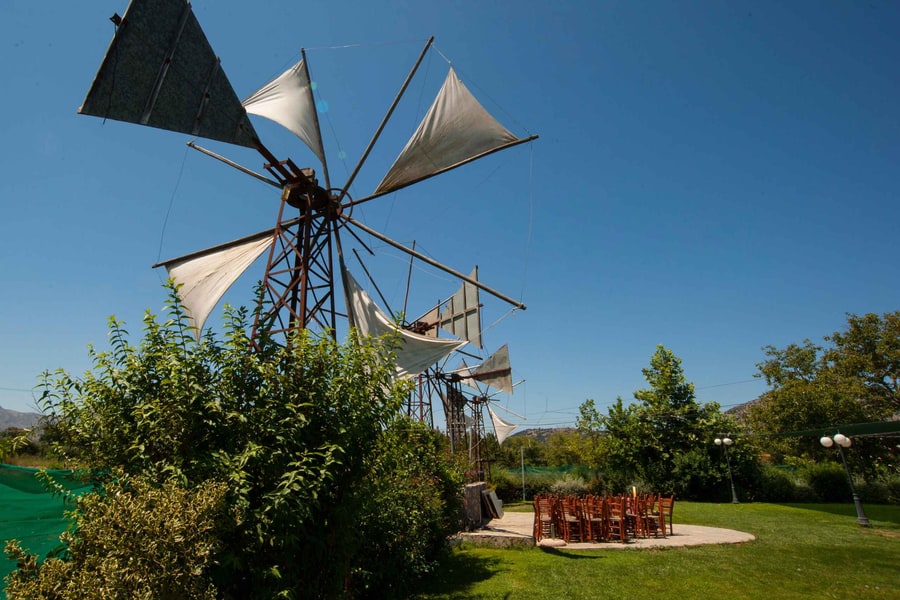
The plateau is an area of high, flat land. Measured east to west, it spans 11 km, and north to south it spans 6 km. White-sailed windmills, towers whose sails the wind turns, have watered the plateau’s land since the 1920s. This farmland forms the backdrop that Tzermiado adds to a Zeus cave tour.
The fertile soil has drawn settlers since Neolithic times, around 6000 BC. Neolithic means late Stone Age, when farming began. From 1293, during the Venetian occupation of Crete, the plateau stood uninhabited for over two centuries. A thirteenth-century Venetian manuscript, a handwritten text, described the troublesome plateau as a thorn in Venice’s heart.
In the early 15th century, Venetian rulers let refugees from the eastern Peloponnese settle on the plain. The Peloponnese is a region in southern Greece. During the great Cretan revolt, Ottoman and Egyptian forces marched towards the plateau. That was in the fifth month of 1867. This history gives a Zeus cave tour depth.
- Monastery: The Kroustalenia Monastery, where the revolutionary committee sat, was demolished and later rebuilt.
- Mountains: Local resistance fighters hid in the peaks around the plateau between 1941 and 1944.
- Burial: Stone mausoleums, or decorative stone boxes, house the dead above ground on the plateau.
Tzermiado gives a Zeus cave tour a place as well as a story. A cave is a natural hollow in rock. A myth is a story the ancient Greeks told about Zeus. The plateau adds farmland, settlement and local memory to that story.
What does Kritsa add to a Zeus cave tour in Crete?
A Zeus cave tour gains local depth from Kritsa, a Cretan village 10 km from Agios Nikolaos. Kritsa gives a Zeus cave tour a real village, with its own people, past and landmarks. Kritsa is not just a name on a map.
The villagers of Kritsa live in four neighbourhoods: Palemilos, Koukistres, Christos and Pergiolikia. A neighbourhood is a named district inside a village. The Middle Ages is a lengthy era set between ancient and modern times. Back then, people thought Kritsa was the largest village in the whole of Crete.
Evidence shows that people lived around Kritsa as early as the second millennium BCE. A millennium is a period of one thousand years. BCE marks years that run backward from the point where the common calendar begins. Kritsa was destroyed again and again in recent centuries because it joined Crete’s revolutions. A revolution is an uprising.
The oldest settlement near Kritsa, on Kastellos hill, comes from the 13th and 12th centuries BCE. Panagia Kera is a Byzantine church with frescoes dating to the 13th and 14th centuries CE. Byzantine describes the Christian empire of the Greek-speaking east. Frescoes are wall paintings made on fresh plaster. CE counts the years forward.
- Olive oil: Kritsa’s olive growers opened their own olive oil factory in the village in 1937.
- Night shape: Lit up in the evening, Kritsa takes the shape of a scorpion.
- Katharo plateau: A climb from Kritsa leads to this high flat land, which has a panoramic view of Mirabello Bay.
About 2200 people live in Kritsa, so the village adds present-day life to a Zeus cave tour. Its long past gives the tour’s story a setting rooted in real people. That local setting is what Kritsa adds to a Zeus cave tour.
What does Karfi bring to a Zeus cave tour in Crete?
A Zeus cave tour in eastern Crete gains a human story from Karfi. This archaeological site, where remains of the past are studied, sits high up in the Dikti Mountains. Karfi adds the world of ancient people to a tour about a god.
Karfi sits about 1100 meters above sea level. The site overlooks the northern entrance of the Lasithi Plateau. This plateau is a stretch of high, flat land among mountains. Its dramatic setting is likened to that of Machu Picchu, the Inca site in Peru. For readers planning a Zeus cave tour, Karfi is a name worth knowing.
Karfi’s fame rests on a large Late Minoan IIIC town, dated around 1200 to 1000 BCE. Minoan describes the ancient culture of Crete, and IIIC is an archaeologists’ label for that period. The town has a shrine with an altar, single-story houses and paved streets. A shrine is a place built for worship.
The peak of Karfi was originally a peak sanctuary, a holy place on a high shoulder. Clay figurines from the temple show goddesses in cylindrical, tube-shaped skirts. Their hands are raised in the epiphany gesture, which shows a god appearing. These goddess figures add another side to the worship behind a Zeus cave tour.
- Dig: Pendlebury and the British Archaeology School dug up the ruins in 1937 and 1939.
- Museum: Today, the Archaeological Museum of Iraklion displays the finds from Karfi.
- Outlook: Settlers on the slopes looked out on the Pediada valley and the Sea of Crete.
Remains at Karfi include house complexes, which are groups of homes built close together. They record where families lived in the mountain town. For a Zeus cave tour, that daily side of ancient Crete gives the gods a real setting.
What questions come up about a Zeus cave tour?
Zeus cave tour planning raises four plain questions. Plain facts and figures cover the airport, then the season, then the regional unit, then the municipality. Answers rest on the Kasteli airport plan, Sitia weather records, Lasithi and the Oropedio Lasithiou municipality.
Which airport serves a Zeus cave tour?
A planned replacement airport at Kasteli lies 39 kilometres south-east of Heraklion. Heraklion airport is a shared facility, with civil use, meaning ordinary public use, and with military use. At first, the airport site had three tents, wind smoke and storm lamps.
Which season suits a Zeus cave tour?
At the Sitia weather station, the average April high is 19.9 °C. A high means the warmest reading of a day. At the Sitia weather station, the average July high is 28.4 °C. In October, the Sitia weather station records an average of 50.2 millimetres of rain.
Which regional unit holds a Zeus cave tour?
Lasithi is the easternmost regional unit on the island of Crete. Administrative areas of this kind are called regional units. Vai in Lasithi is well known for its forest of date palms. Gournia is a Minoan ruin in the Lasithi regional unit. Minoan means from an ancient culture of Crete.
Which municipality holds a Zeus cave tour?
The Oropedio Lasithiou municipality has its seat at Tzermiado. Municipalities are local government areas, and the seat of each is its administrative centre. Agios Georgios is the second biggest village of the municipality. The Oropedio Lasithiou municipality has a population of 2,258 people.