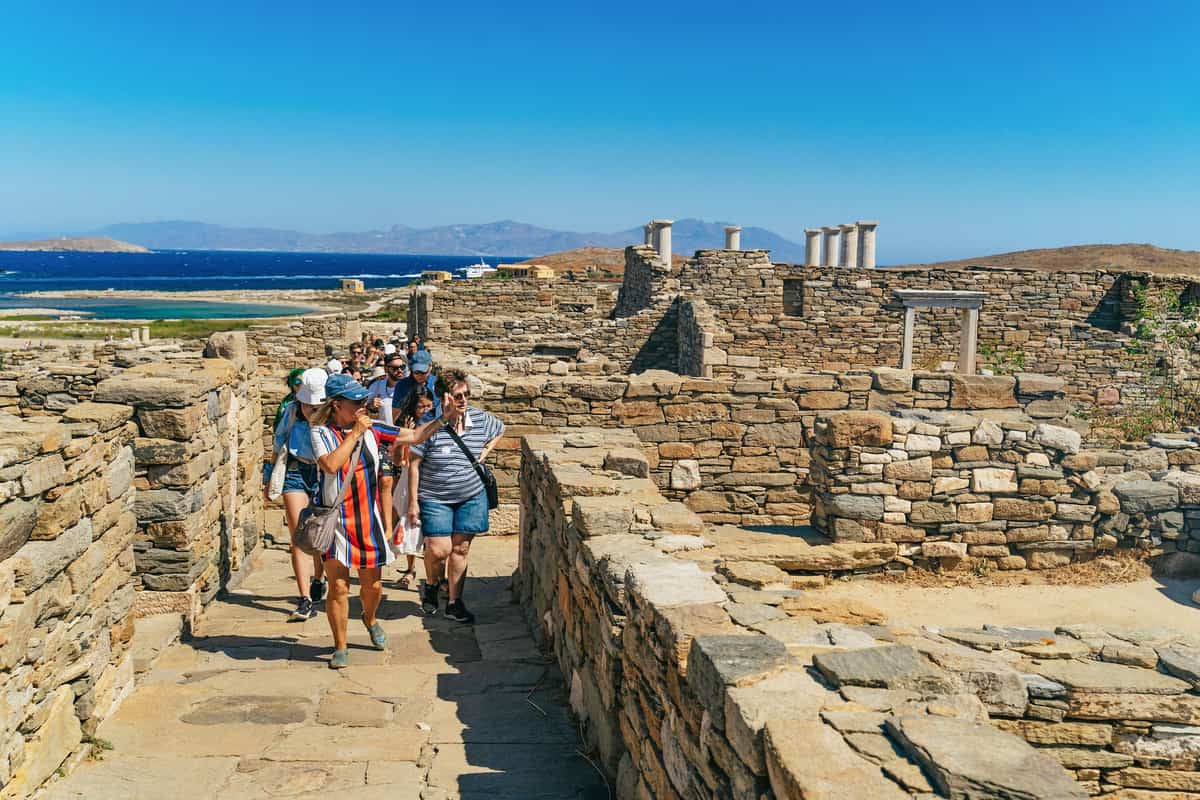
A Delos tour from Mykonos is a boat trip to the sacred island of Delos, followed by a walk through its ancient ruins. It is one of the island-hopping Greece tours that leave from Mykonos.
What is a Delos tour from Mykonos?
A Delos tour from Mykonos is a boat ride to the island of Delos. Across the water, Delos lies just 2 km from Mykonos. Visitors on the trip learn about the island’s history, its legends and the sites that remain there.

UNESCO added Delos to its World Heritage List in 1990. The list names places that matter to people around the world. In UNESCO’s words, the site gives a picture of a great Mediterranean port that was cosmopolitan. Cosmopolitan means a place where people from different lands meet. A Delos tour from Mykonos brings visitors to this listed site.
Legend says the twin gods Apollo and Artemis were born on Delos. A legend is an old story passed down through the years from person to person. Mount Cynthus on Delos is crowned with a sanctuary of Zeus. A sanctuary is a holy place, and this one stands at the top of the mount.
Stone huts on Delos show that people have lived there since the third millennium BC. A millennium means one thousand years. Around the eighth century AD the island was left empty, abandoned by its people. A Delos tour from Mykonos is one way to learn about that long past.
- Dedication: The people of Naxos gave the Terrace of the Lions to Apollo not long before 600 BC.
- Marble lions: Only seven of the lions that first stood on the terrace remain.
- Free port: In 166 BC, Rome made Delos a free port, a harbour open for trade.
Boats for tours leave Mykonos at regular times for the nearby island of Delos. Anyone who plans a Delos tour from Mykonos can check the boat times first. With the crossing arranged, the visit can turn to the island’s history and its sites.
Which myth makes Delos sacred on a Delos tour from Mykonos?
A Delos tour from Mykonos visits the island that myth names as the birthplace of Apollo. Jealous Hera ordered the lands to shun Leto and deny her shelter while she carried the twins. The myth begins with that anger and leads Leto to Delos.
The old myths about the island itself set the scene for a Delos tour from Mykonos. Delos had no link to the mainland or to the ocean floor. That let Leto give birth there. Myth says Delos was once the goddess Asteria, who fled Zeus into the sea as a floating island.
Leto swore an oath on the river Styx: her son was to honor Delos above the other lands. The goddesses sent Iris to fetch Eileithyia. They offered her a necklace of amber, a golden tree resin, nine yards long. Leto clutched a palm tree as she finally gave birth to Apollo on Delos.
The story behind a Delos tour from Mykonos also includes a scene with swans. They circled the island seven times as Apollo was born. Myth reads the seven circles as a sign of his future seven-stringed lyre. A lyre is a small stringed instrument, a bit like a tiny harp.
- Birth site: Apollo was born on Mount Cynthus, on the island of Delos.
- Older holiness: Delos was a holy place of worship for a thousand years before the birth myth.
- Sacred rule: A decree, an official order, barred burials and births on Delos because of its sacred importance.
In gratitude, Delos was fixed in place with four pillars and became sacred to Apollo. That is the answer the myth gives to the question of the island’s holiness. Visitors on a Delos tour from Mykonos walk on ground that the story calls holy.
What does the Terrace of the Lions show on a Delos tour from Mykonos?
A Delos tour from Mykonos shows the Terrace of the Lions, a line of marble lions. The people of Naxos dedicated this terrace to the god Apollo shortly before 600 BC. They stood along the Sacred Way, a holy road in the sanctuary, or sacred ground.
At first the terrace held between nine and twelve marble lions, all squatting and snarling. The row forms a monumental avenue, a grand walkway lined with statues. Egyptian avenues of sphinxes, rows of statues of mythical beasts, make a fair comparison. A Delos tour from Mykonos that includes the terrace lets visitors picture that avenue.
Only seven of the original lions survive today. The museum keeps the large original lions, the ancient carvings themselves. Reproductions of them stand outside on the Delos site. A reproduction is a modern copy of the original. During a Delos tour from Mykonos, the lions standing outside on the site are copies.
One lion was taken away and now sits over the main gate of the Venetian Arsenal. An arsenal is a naval yard, a place where ships were built, stored and repaired. That lioness has a body of marble from Naxos, made in the closing years of the 7th century BC.
- Head: The head of the Venice lioness is a Baroque addition, made in a later art style.
- Arrival: Alvise Pasqualigo brought the lioness from Delos, and it was already in Venice before December 1684.
- Placement: In 1716 the lioness was set up before the Arsenal to mark the defence of Corfu.
Cycladic cities, the cities of the Cyclades islands, celebrated their prosperity through great sanctuaries. The terrace of lions that Naxos offered to Delos is part of that story. Visitors on a Delos tour from Mykonos can read that prosperity in the carved stone.
What does the Sacred Lake show on a Delos tour from Mykonos?
A Delos tour from Mykonos shows the Sacred Lake. The position of this lake decided where later features on the island were placed. In plain words, later features are the parts of the island that were added after the lake.
The Sacred Lake of Delos sits inside a circular bowl. Sacred means holy to a god, and a lake is a body of still water. A bowl here is a round hollow in the ground with raised edges. A Delos tour from Mykonos that stops there lets visitors see this round shape.
Today the island’s caretakers leave the Sacred Lake dry on purpose. Caretakers are the people who look after the island and the ancient ruins on it. Dry here means the bowl holds no standing water at all. A Delos tour from Mykonos therefore shows a bowl with no water in it.
The reason behind this choice is a health risk. Malaria is a serious illness that spreads to people through mosquito bites. A mosquito is a small flying insect that bites. The dry bowl helps hold back mosquitoes that carry malaria. To suppress something means to hold it back or keep it small.
- Sanctuary of Apollo: A sanctuary is a holy place, and the one for the god Apollo lies beside the Sacred Lake.
- Palm tree: A palm is a leafy tree. It was sacred to Apollo, who was born beneath one on Delos.
- House of the Lake: This house had an irregular, meaning uneven, shape and stood near a sacred lake.
Tours differ in their stops, so each Delos tour from Mykonos covers its own set of sites. Visitors who want to see the Sacred Lake can check a tour’s stops before booking. A tour leader can also confirm the exact route for the day.
What does the Sanctuary of Apollo hold on a Delos tour from Mykonos?
A Delos tour from Mykonos can include the Temple of the Delians, the largest of three Apollo temples. All three stand inside the sanctuary, a sacred area set apart for a god. The building is also called the Great Temple or the Delian Temple of Apollo.
The Delian League, an alliance of Greek city-states, paid for the temple, and building began in 476 BC. Building then resumed after 314 BC, during the period when Delos was independent. These two dates frame the story that visitors on a Delos tour from Mykonos can follow here.
The temple follows the Doric style, a plain and sturdy way of shaping columns. A column is an upright stone post that holds up a roof. Along each long side the temple has 13 columns, and each short side has 6. A Delos tour from Mykonos lets visitors picture the full outline of the building.
The temple held the cult statue of Apollo, the sacred image that stood for the god. It also held centuries of precious offerings, which are gifts given to the god. Angelion and Tektaos made a temple statue of Apollo holding three Charites in his hand. The Charites are goddesses of grace.
- Colossus of the Naxians: This giant statue stood in the courtyard next to the temple.
- Naxian Oikos: This long hall from the early sixth century BC has Ionic columns, topped with scrolls.
- Unfinished work: The finishing touches and decorations of the temple were never completed.
The ancient Mithridatic Wars mainly destroyed the temple. Only the foundations, the stylobate and broken columns remain. The stylobate is the stone platform on which the columns stood. A Delos tour from Mykonos that stops here sees these remains of the temple.
What do the mosaics of the House of Dionysus show on a Delos tour from Mykonos?
A Delos tour from Mykonos can include a stop at the House of Dionysus on the island. This luxurious private house is named for its mosaic of Dionysus riding a panther. A mosaic is a picture made of tiny pieces of material fixed side by side.
The winged Dionysus mosaic of the House of Dionysus dates to the 2nd century BC. The wings suggest a daimon rather than a full god. A daimon is a divine spirit of lower rank. During a Delos tour from Mykonos, the wings give visitors a clue to the figure’s rank.
Mosaic makers cut small pieces called tesserae from glass, faience, terracotta and natural stones. Faience is a glazed ceramic, and terracotta is baked clay. The pieces measure roughly one millimetre square, a thousandth of a metre. That tiny size allows sharp detail and an elaborate colour scheme in the finished picture.
The House of Dionysus is an exception. A peristyle is a courtyard ringed by columns. The other peristyle courtyards on Delos show only floral and geometric motifs. Those are plant patterns and plain shapes. Visitors on a Delos tour from Mykonos who reach this house see the exception for themselves.
- Scholar’s view: Dunbabin ranks the Dionysus mosaic with the best examples of opus vermiculatum, the tiny-piece style.
- Guest rooms: Rooms set aside for receiving guests carried richer mosaics than plain walkways.
- Upper floors: Upstairs rooms hold opus vermiculatum and opus tessellatum (larger cubes) mosaics more than ground floors do.
Mosaics reward slow, careful looking. Visitors who take their time at each floor notice colour, shape and placement first. A Delos tour from Mykonos that stops at this house gives visitors that chance. Each floor then repays the effort of looking closely.
What does the House of the Masks show on a Delos tour from Mykonos?
A Delos tour from Mykonos can include the House of the Masks. The home is named for a mosaic of theatre masks on ivy scrolls. A mosaic is a picture made from tiny pieces of stone that are laid in a floor.
During a Delos tour from Mykonos, the House of the Masks shows a courtyard of marble chips. A courtyard is an open yard inside a house. Four rooms branch off it and hold the house’s more intricately decorated mosaics. One central mosaic shows the god Dionysos riding a leopard against a black background.
A second central mosaic in the same house has a dancing figure and a flute player. Only the Dionysos figure in the House of the Masks uses the vermiculatum method. Vermiculatum is a way of making mosaics from tiny stones. So the flute player and the dancing figure do not use that method.
A Delos tour from Mykonos can also reach the House of the Dolphins, another house on the island. Its courtyard mosaic shows a circle set inside a square, a layout that is unusual for Delos. Each corner of the square shows pairs of dolphins that are ridden by tiny winged figures.
- Winged riders: The winged riders carry a thyrsus and a caduceus, both staffs, and a trident, a three-pronged spear.
- Artist’s name: An artist named Asclepiades of Arados signed the House of the Dolphins mosaic.
- Tanit floor: The Phoenician owner of the dolphin house ordered a floor mosaic showing the goddess Tanit in his entrance hall.
Hellenistic mosaic making, the craft of the late ancient Greek age, ended after roughly 69 BC. Warfare with the Kingdom of Pontus brought that craft to an end. That date gives a Delos tour from Mykonos a clear end to the mosaic story.
What does the Theatre Quarter show on a Delos tour from Mykonos?
A Delos tour from Mykonos can include the Theatre Quarter, a crowded district on the island of Delos. Its streets form a narrow and irregular grid. That layout is unlike the other quarters of Delos, which follow a different pattern.
During a Delos tour from Mykonos, the houses of the Theatre Quarter stand out by their shape. Floor plans are irregular, such as trapezoids, four-sided shapes with two parallel sides. The open courtyard has no porticoes, meaning covered walkways with columns. It also lacks a columned peristyle, a courtyard ringed by pillars.
Certain houses in the Theatre Quarter have neither wall murals nor mosaics inside. A mosaic is a floor picture built from small stones set side by side. On Delos, craftsmen built luxurious houses with frescoes and mosaic floors for the rich merchants, bankers and ship-owners. A fresco is a wall painting made on wet plaster.
Water is part of the story on a Delos tour from Mykonos. Delos managed its limited water with an extensive system of cisterns, aqueducts, wells and sanitary drains. A cistern is a tank for storing water. An aqueduct is a built channel that moves water from one place to another.
- Marble theatre: The marble theatre is a rebuilding of an older theatre, made shortly after 300 BC.
- Stoivadeion pillar: A pillar of the Stoivadeion, raised around 300 BC, celebrates a winning theatrical performance.
- House of the Trident: The panels of this house show a red anchor with a black dolphin wrapped around it.
The characteristic house of Delos had a narrow rectangular plan with a central courtyard. A Delos tour from Mykonos can let visitors read these plans in the stone walls that remain. They can also picture the households that once lived around each open yard.
What did the Sanctuary of the Foreign Gods hold on a Delos tour from Mykonos?
A Delos tour from Mykonos can include the Sanctuary of the Foreign Gods. It held temples of Sarapis, Isis and Anubis, and temples to the Syrian gods Hadad and Atargatis. A sanctuary is a sacred place kept apart for the worship of gods.
A Doric temple on a high hill honoured the trinity of Isis, Serapis and Anubis. A trinity is a group of three gods worshipped together. Doric names a plain style of Greek columns and buildings. Visitors on a Delos tour from Mykonos can look for this temple on its hill.
Foreign traders from all around the Mediterranean opened businesses on Delos. The terrace of foreign gods shows this. A separate quarter of Delos was reserved for foreigners and the sanctuaries of foreign deities. Deities are gods and goddesses. Visitors on a Delos tour from Mykonos can learn about this foreign quarter.
Non-Greeks gained more freedom to travel and trade across the Mediterranean in the Hellenistic period. That name marks the later age of ancient Greece. By the late fourth century BCE, merchants spread the cults of Isis and Serapis to Greek port cities. A cult is a group that shares the worship of one god.
- Italy: Trade made Delos a launch point for the Egyptian cults of Isis and Serapis to reach Italy.
- Atargatis: Syrian merchants largely spread the cult of Atargatis, and carved inscriptions on Delos show her importance.
- Water: Egyptian sanctuaries in Roman-era Delos had a central basin giving water for Isis ceremonies.
In 100 CE, Praulus of Samaria made a dedication at the Serapeion on Delos. A dedication is a gift to a god, and a Serapeion is a sanctuary of Serapis. That offering shows that a Delos tour from Mykonos is about more than Greek gods.
What does Mount Kynthos add to a Delos tour from Mykonos?
A Delos tour from Mykonos adds Mount Cynthus, a bare granite rock that rises 113 metres high. Its summit holds the foundations and remains of a large building in the Ionic style. Ionic names one of the orders, or styles, of ancient Greek columns and buildings.
Two flights of steps once climbed to the summit. One rose on the north slope and the other on the west slope. An ancient gate also stands on the mountain’s west side. A Delos tour from Mykonos that climbs this slope can point out the gate to visitors.
At the western foot of Mount Cynthus stood the ancient theatre, which faced the island of Rheneia. Ruins of ancient houses line the small valley that leads up to the summit of the mountain. Above those houses, at the foot of the peak, stands a wall of white marble, a pale stone.
An altar, a stone used for offerings, stands near the foot of the peak. Its inscription, which is writing cut into stone, is a dedication, a gift offered to the goddess Isis. It names her priest, Ctesippus, as the giver. Stops like this give a Delos tour from Mykonos a look at ancient worship.
- Gate roof: Two roughly shaped stones leaning together form the roof of the western gate.
- Views: The mountain offers superb views of the innermost islands, from Mykonos and Naxos to Paros, Syros and Rheneia.
- Centre: One online encyclopedia calls Mount Cynthus the nominal centre, meaning centre in name, of the Cyclades island group.
Travellers comparing a Delos tour from Mykonos can look for Mount Cynthus among the listed stops. Not every tour visits every site, so the stops differ from tour to tour. Checking the stops before booking shows whether the mountain is included in the tour.
What does the Archaeological Museum of Delos hold on a Delos tour from Mykonos?
A Delos tour from Mykonos can include the Archaeological Museum of Delos. Six rooms inside the museum hold the statues and reliefs found on the island of Delos. A relief is a carving that stands out from a flat stone surface. A statue stands free.
The Archaeological Society of Athens built the museum on Delos in 1904 to house the finds. The building began with five rooms. Expansions in 1931 and 1972 later grew it to nine rooms. A visitor on a Delos tour from Mykonos therefore enters a museum with a history of its own.
The museum holds an ivory plaque that dates to between 1400 and 1200 BC. The plaque pictures a Mycenaean soldier, meaning a warrior from an early period of Greek history. His helmet is made from the teeth of wild boars. BC counts years backward, so a larger number means an older date.
The fifth-century marble statue of Boreas shows the kidnapping of Oreitheia, a princess from the city of Athens. Visitors on a Delos tour from Mykonos can also see the marble figures of Dioskourides and of Kleopatra, his wife. Both of them lived on Delos, and their statues stand in the museum today.
- Kouros torso: This torso comes from a kouros, a standing statue of a young man, and dates to the sixth century BC.
- Inscribed base: A triangular kouros base from the seventh century BC reads: Euthycartides the Naxian made me and dedicated me.
- Corinthian alabastron: This small container for perfumed oil shows the figure Potnia Theron among two swans.
A fresco is a wall painting. One from a house wall in the Skardana Quarter shows Heracles and two boxers. Tour stops differ, so a visitor checks that the museum is on the chosen Delos tour from Mykonos.
How did Delos grow as a trading port on a Delos tour from Mykonos?
A Delos tour from Mykonos visits the island Rome made a free port in 166 BC, says Strabo. A free port is a harbour with no customs charges, which are taxes paid on goods brought in. That decision shaped the island’s trading rise.
Part of the Roman motive was to damage the trade of Rhodes. Rhodes was then a target of Roman hostility, meaning open enmity. The decision was about rivalry between states as well as about business. Delos also passed under Athenian control again, so Athens ruled the island once more.
Roman traders came to Delos to purchase tens of thousands of slaves. Slaves were people owned and sold as property. Delos became a hub of the slave trade. Its slave market was the largest in the area. This hard chapter is part of the island’s past for anyone planning a Delos tour from Mykonos.
Delos saw a commercial explosion, especially after Rome destroyed its rival Corinth in 146 BC. Here, commercial means linked to buying and selling, and explosion means very fast growth. A rival is a competitor in trade or in power. That fast-growing trade is part of the story behind a Delos tour from Mykonos.
- Awning holes: The Agora of the Competaliasts was a market square. Holes in its paving once held posts for awnings.
- Clubhouse: The Poseidoniasts’ clubhouse belonged to a Koinon, or association, of Berytian merchants, ship captains and warehousemen.
- Imports: Delos was unable to produce its own food, fibre or timber, so these were imported.
The 2001 Greek census reported 14 inhabitants on Delos. A census is a formal head count of the residents of a place. That small number contrasts sharply with the island’s trading past. This past is the background for a Delos tour from Mykonos.
How did Athens shape a Delos tour from Mykonos?
A Delos tour from Mykonos reaches the island that gave the Delian League its modern name. The league was an alliance, meaning a group that works together, founded in 478 BC under Athenian leadership. Its aim was to keep fighting the Persian Empire.
A Delos tour from Mykonos can include the story of the oath that bound the league’s members. They swore to share friends and enemies. To show the bond was permanent, they dropped iron ingots, which are bars of metal, into the sea. The act was a promise of a lasting alliance.
Members had a choice between two kinds of support. One option was to offer armed forces. The other was to pay a tax to the joint treasury, which was the shared fund. Athens stopped taking ships, men and weapons as dues, which are payments owed to the group. It accepted only money.
The writer Plutarch gives one view of the treasury’s move to Athens. He says the rivals of Pericles saw it as taking funds for building projects. The argument was about the league’s shared money and its use. That complaint is part of the history that a Delos tour from Mykonos can explain to visitors.
- Purification: In the Peloponnesian War’s sixth year, the Delphic Oracle, a sacred adviser, ordered Delos purged of dead bodies.
- Tombs: Two Hyperborean Maidens’ tombs stayed on Delos because a hero cult, a form of worship, surrounded them.
- Festival: The Delia festival was not revived, or brought back, until 426 BC.
Athens added horse-races to the Delia, which had never before been held there. So Athenian influence reached the festival as well as the league itself. A Delos tour from Mykonos can show both sides: the league’s money and the island’s festival.
Why did Delos lose its people on a Delos tour from Mykonos?
A Delos tour from Mykonos shows an island that lost its people over time. The loss followed two assaults. Delos came under attack from the forces of Mithridates VI of Pontus in 88 BC and again in 69 BC.
Afterwards, the island’s trade shrank sharply. Trade is the buying and selling of goods. Building work, meaning the putting up of new buildings, shrank sharply too. So did the population, which is the number of people living on the island. That drop is part of what a Delos tour from Mykonos explains.
Another place took over from Delos. Puteoli replaced Delos as the chief focus of Italian trade with the east. That means Puteoli became the main centre of that business. A Delos tour from Mykonos therefore reaches an island that no longer held that role. So the trade went elsewhere.
The writer Pausanias described the island in the second century AD. He wrote that Delos had no residents beyond the custodians of its sanctuaries. Custodians are caretakers, and sanctuaries are holy places set apart for worship. In his account, only the keepers of holy places still lived on the island.
- Worship: Delos also fell into a sharp decline as a cult centre, a place of religious worship.
- Evidence: Objects dug up from the Roman era do not show that people lived on Delos without a break.
- Abandonment: The island lay abandoned from about the eighth century AD, which means people left it behind.
A massive excavation on Delos was begun in 1872 by the French School at Athens. An excavation is a dig that uncovers what lies buried beneath the ground. Today, the remains uncovered there are what a Delos tour from Mykonos can explain to the visitors.
What questions come up about a Delos tour from Mykonos?
A Delos tour from Mykonos rests on four plain things. The airport brings visitors in, and the island of Rheneia lies to the west of Delos. Warm days come in June and September, and boats and buses run from the port of Mykonos.
Which airport serves a Delos tour from Mykonos?
The IATA code of Mykonos-Manto Mavrogenous Airport is JMK, and its ICAO code is LGMK. Both are airport codes. Ornos, Psarrou and Platis Gialos lie 3.5 km from it. A transit bus links the airport with Chora, a Greek word for main town, and other destinations. It runs in summer only.
Which island lies beside a Delos tour from Mykonos?
Rheneia sits close to the west of Delos, and farther to the southwest of Mykonos. It has an area of 14 square kilometres. In 426 BC, the Athenians of ancient Athens purified Delos. That means they cleansed the island by removing its tombs and banning burials there.
Which season suits a Delos tour from Mykonos?
At the Mykonos station, the average June high is 26.3 °C. At the same Mykonos station, the average September high is 25.7 °C. At the Mykonos station, August rain adds up to only 1.3 mm, which is very little. An average high is the warmest point of a normal day.
Which port serves a Delos tour from Mykonos?
Tour boats leave at regular times for Delos, an island close by. Small boats run to and from the island’s beaches. The northern bus depot, which is a bus station, sits above the old port. It serves Ano Mera, Elia and Kalafatis, three places on the island.