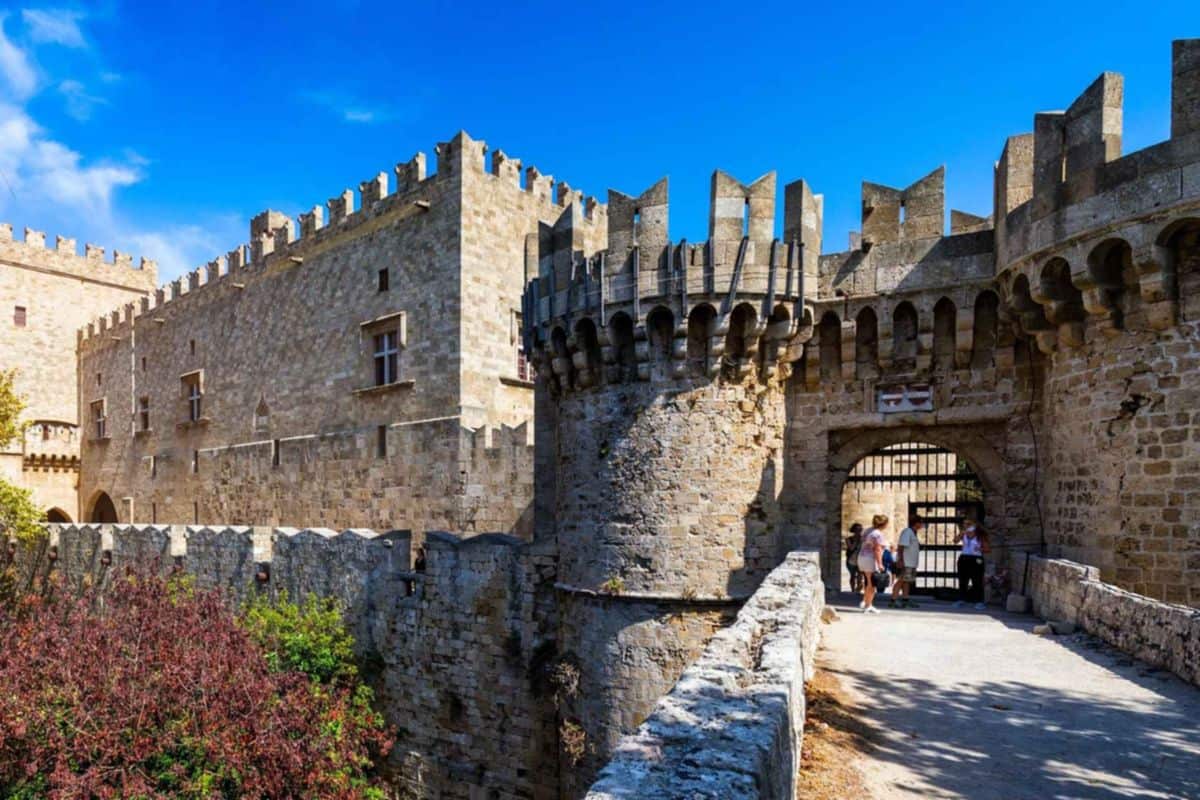
A Rhodes old town tour is a walking visit to the Medieval City of Rhodes, the walled old town of Rhodes city. It is one of the historical Greece tours that run on the island.
What is a Rhodes old town tour?
A Rhodes old town tour is a walk through the Medieval City of Rhodes. This old quarter forms part of the modern capital city of Rhodes. The medieval town and the modern capital therefore sit together in one city today.

The Knights of St John held Rhodes from 1309 to 1523. The Knights Hospitallers, a medieval order of knights, made Rhodes their headquarters after they left Cyprus. These dates mark the age of the Knights in the medieval city of Rhodes. They also give a Rhodes old town tour its time frame.
The medieval city has two parts. The northern part is the high town, while the lower town stretches to the south-southwest. The Knights built the high town, and a fortified wall originally separated it from the lower town. A fortified wall is a strong wall built to defend a town from attack.
The Ministry of Culture gave the whole medieval town the status of a protected monument in 1960. A protected monument is a site under official protection. The citadel of Rhodes, a fortress-town built by the Hospitallers, is among Europe’s best-kept medieval towns. A Rhodes old town tour therefore shows a medieval town under protection today.
- Street of the Knights: This street is the principal east-west axis, the main line of the medieval city.
- Seven tongues: The order split into seven sections called tongues, and every tongue kept an inn of its own.
- Islamic monuments: Islamic buildings such as mosques, baths and houses joined the city up to 1912.
The lower town is nearly as dense with monuments as the high town. Monuments stand close together in both parts of the medieval city. A Rhodes old town tour can therefore include the lower town as well as the high town.
What does the Street of the Knights show on a Rhodes old town tour?
A Rhodes old town tour passes along the Street of the Knights, a road across the old town. This street is the principal east-west axis, or main line. Inns of Italy, France, Spain and Provence lined both sides of it, each named for a place.
Visitors on a Rhodes old town tour can see the Inn of Auvergne, which stands to the north. It is close to the site of the first hospice, a house for the sick. The Archaeological Museum of Rhodes fills the monumental building which served as the knights’ hospital. Monumental means very large.
The church of Panagia tou Kastrou sits at the street’s eastern end. It is the oldest and largest surviving Byzantine church in the medieval town. Byzantine describes the church style of the old Greek-speaking Christian empire. Medieval means from the Middle Ages. Surviving means the church still stands today.
A Rhodes old town tour on this street can also take in Holy Trinity, a Greek Orthodox church. Its entrance eaves, the roof edges above the door, show the Holy See’s arms, framed by England’s arms. The Holy See is the Catholic Church’s central authority, and arms are shield emblems.
- Tongues: The knights’ Order was organized into seven tongues, which are language groups.
- Auberge: Each tongue, called a langue in French, had an auberge, or inn, as its headquarters.
- Rebuilding: The rebuilding of the palace and the nearby Street of the Knights was planned by the architect Vittorio Mesturino.
A Rhodes old town tour along this street joins inns, a hospital and churches into one story. Not every tour enters every building, so visitors can ask the tour leader about the route. The leader can name each building and say what it was for.
What does the Palace of the Grand Master show on a Rhodes old town tour?
A Rhodes old town tour can reach the Palace of the Grand Master. Its other name is the Kastello, from the Italian word Castello, meaning castle. The palace is an example of Gothic architecture in Greece, a building style of the Middle Ages.
During a Rhodes old town tour, the palace tells of the Knights Hospitaller, a medieval order of knights. They took Rhodes in the year 1309. Then they made the fortress their administrative centre, the place where they ran their affairs. It also became the palace of their Grand Master, the head of the order.
A lightning bolt hit a gunpowder magazine beneath the Church of Saint John in 1856. A magazine is a storeroom for gunpowder. The strike caused a massive explosion. The blast wrecked the church and a large part of the Grand Master’s Palace. A Rhodes old town tour that stops at the palace can describe this disaster.
The ground floor rooms of the palace survived the explosion. Ground floor means the lowest rooms of the building. Later, the Italian authorities demolished, or pulled down, the Ottoman-era structures of the former palace. Ottoman-era means built in the time of the Ottoman Empire. Both events changed the site.
- Rebuilding: The architect Vittorio Mesturino was asked to design the reconstruction, meaning the rebuilding, of the palace.
- Royal use: The castle served as a holiday home for King Victor Emmanuel III of Italy and later for Benito Mussolini.
- Plaque: Mussolini’s name can still be seen on a large plaque, a flat sign, near the palace entrance.
The palace was converted into a museum. A Rhodes old town tour can therefore include a stop inside the walls of the palace. Each tour operator sets its own route, so visitors check that the palace is included before booking.
Which walls and moat surround a Rhodes old town tour?
A Rhodes old town tour explores a medieval city within a wall 4 km long. Two rings of walls protected the city, with a third ring in places. Builders improved the defences with a thicker main wall and a dry ditch, or moat, twice as wide.
The Knights Hospitaller, a medieval order of knights, built the fortifications, or city defences, from 1309. They enhanced the existing Byzantine walls, which came from the eastern Roman era. Walls already enclosed Rhodes in the late 4th century BC. Those walls withstood the siege of Demetrius Poliorketes in 305 BC.
The Theodosian walls of Constantinople were the reference model, or pattern to follow, for the Rhodes fortifications. The walls on a Rhodes old town tour are built of rubble masonry, a great mass of stone. This mass withstood gunshots. Builders gave the outer faces a smooth surface to stop attackers climbing.
Walls on a Rhodes old town tour faced a siege in 1480. Around 2,500 soldiers called Janissaries took the tower of Italy at dawn and entered the city. Two gunpowder mines, which are explosive charges, exploded under the bastion of England, a wall tower. The blast dropped 11 m of wall into the moat.
- Langue: A langue was a group of knights who shared one language.
- Bastion of Italy: This wall tower still bears the name of a langue.
- Terreplein of Spain: A terreplein is a broad earth platform behind a wall, and it bears a langue’s name too.
The walls stayed frozen at 1522, which means they were left as they stood that year. Because of this, they still show the shift from medieval to modern fortification. A Rhodes old town tour therefore shows that shift in stone.
Which gates open onto a Rhodes old town tour?
A Rhodes old town tour can pass the d’Amboise Gate and the Gate of Saint John. It can also reach the Gate of Saint Athanasios, the Liberty Gate and the Marine Gate. Not every tour stops at each of these gates.
The d’Amboise Gate has a triple defensive belt, meaning three layers of defence. It also has a covered entrance and two round towers. Remains of the old studded wood doors are still visible at the gate. A Rhodes old town tour that stops here can look at the towers and door remains up close.
The Gate of Saint John is also known as Koshkinou or Porta Kokkini, meaning red door. Tradition says fallen men in 1522 dyed, or coloured, the stones in front of the gate red. A Rhodes old town tour that reaches this gate can explain both the name and the tradition.
The Gate of Saint Athanasios was built between 1441 and 1442. In 1922, the Italians reopened it, marking 400 years since the Ottoman conquest. That conquest was the takeover of Rhodes by the Ottoman Empire. The Italians opened the Liberty Gate in 1924 and presented themselves as liberators from Ottoman rule.
- Saint George bastion: The five-sided bastion, a jutting part of the wall, covered the way to the d’Amboise Gate with cannons.
- Italian arrival: Italian troops entered Rhodes town through the Gate of Saint John in 1912.
- Liberty Gate design: The modern gate was built to respect the building style of the gates from the Middle Ages.
The Marine Gate side runs close to the waterfront, the shore along the sea. Little space lies between waterfront and walls, so no army was able to attack that side. A Rhodes old town tour that reaches this gate can show that small space.
What does the Archaeological Museum of Rhodes hold on a Rhodes old town tour?
A Rhodes old town tour can reach the Archaeological Museum of Rhodes, inside the Medieval City of Rhodes. The museum fills a monumental building, meaning a very grand one. It was once a hospital run by the Knights of Saint John, a medieval order.
The hospital was completed in the time of Grand Master d’Aubusson (1476-1503). A Grand Master was the head of the knightly order. The building therefore dates from the age of the knights, not from later times. During a Rhodes old town tour, the building is part of the story, not only the objects inside.
The museum displays the Statue of the Crouching Aphrodite, dated to the first century BC. It follows a famous prototype, an earlier model, made by the sculptor Doidalsas in the third century BC. The statue therefore looks back to a design older than itself. The name of the statue describes the pose of the goddess.
The Aphrodite of Rhodes came to light by chance in 1923. The find happened in the Governor’s villa garden. This figure is 49 cm tall, about half life-size. A Rhodes old town tour that includes the museum lets visitors see the work up close. Its size is modest beside the monumental building around it.
- Head of Helios: The head in the museum shows Helios, the god of the island of Rhodes.
- From an infant’s tomb: A red-figured pelike, a painted vase, shows a man with a lyre and a woman with clappers.
- Pebble mosaic floor: Small pebbles show Bellerophon on the winged horse Pegasus while he kills the Chimera.
The Aphrodite of Rhodes shows the goddess holding up her hair with her fingers to dry it. This everyday moment gives a Rhodes old town tour a human touch beside the knights and the myths. Statues, vases and floors share one museum building.
What does the Jewish Quarter show on a Rhodes old town tour?
A Rhodes old town tour can reach La Juderia, the Jewish Quarter. It is found in the east of the Old City of Rhodes, near a cruise-ship pier. The Jewish Quarter holds a synagogue, a museum, a courtyard and a square of remembrance.
A synagogue is a Jewish house of prayer. Kahal Shalom Synagogue was completed in 1577, and it is the oldest synagogue in Greece. Six synagogues once stood in the city, and only Kahal Shalom still stands today. A Rhodes old town tour in the Jewish Quarter can see the one that remains.
The Square of the Martyred Jews honours the Jews of Rhodes who were murdered in the Holocaust. On 23 July 1944, the Germans gathered 1,673 Jews in Martyrs’ Square in the Jewish quarter. A stop here on a Rhodes old town tour also recalls the loss of those people.
The synagogue floor is a mosaic of the black and white local stones used in Rhodes pavements. A Torah ark is a cabinet for holy scrolls. Two Torah arks flank the door leading into the interior courtyard. A Rhodes old town tour that reaches the synagogue can look for both details.
- Street: The quarter centres on Dossiadou Street, where the synagogue and the Jewish Museum of Rhodes stand.
- Fountain: The Kohanim, the priests, washed their hands at a courtyard fountain before the priestly blessings.
- Museum: The museum fills six rooms that were formerly the women’s prayer rooms.
The quarter was home to Jews who spoke a language called Ladino. The synagogue, the museum and the square all belong to the shared story of those people. A visit to La Juderia adds their story to the sights of the Old City.
Which mosques and baths does a Rhodes old town tour pass?
A Rhodes old town tour can pass the Suleymaniye, Ibrahim Pasha and Mustafa Pasha mosques. It can also reach the Yeni Hamam, a public bath. The old town library of Rhodes joins them as a further site on the same list of stops.
The Suleymaniye Mosque was the first mosque built in Rhodes town after the Ottoman capture in 1522. A mosque is a Muslim house of prayer. Builders rebuilt it in 1808 to the same design as the original. Its central room has a large high dome, with a lower-domed room on either side.
The Ibrahim Pasha Mosque is the oldest of the seven mosques inside the old walled city of Rhodes. Sultan Suleiman, whose title means ruler, built it in 1540/1541 in what is now Platonos Square. A Rhodes old town tour that stops there shows a large square room with a twelve-sided dome.
The Mustafa Pasha Mosque stands on a small square right next to the old town hamam. A hamam is a public bath house. Rhodes also has the Yeni Hamam, a double bath dating from the 16th century. A Rhodes old town tour can show the mosque and the hamam side by side.
- Suleymaniye portico: The inner portico, a covered porch, has seven domes and rests on eight columns.
- Library founder: Hafiz Ahmed Agha founded the old town library of Rhodes in 1793.
- Library treasure: The library keeps valuables that include a Koran, the holy book of Islam, from 1540.
Choosing a Rhodes old town tour starts with its stop list, because not every tour visits every site. Travellers read that list to see which mosques, baths and library are included. Then they pick the route that fits their own plans.
What do the squares and the Clock Tower show on a Rhodes old town tour?
A Rhodes old town tour explores the medieval town of Rhodes. The town contains a clock tower and Socrates Square. A square is an open public space in a town where people can gather. A clock tower is a tall tower that shows the time.
A medieval fountain stands at Hippokratous Square in Rhodes. Medieval means belonging to the Middle Ages, the long period between ancient and modern times. A fountain is a built structure that holds or sprays water for people to use. A Rhodes old town tour can stop at this fountain to look at it closely.
The Mehmet Agha Mosque stands on Sokratous Street inside the old walled town of Rhodes. A walled town is a town with walls built around it. A mosque is a building where Muslims gather to pray. This street and the mosque beside it can be part of a Rhodes old town tour.
The Mehmet Agha Mosque was built in 1819, during the Ottoman era. An era is a long stretch of history with its own rulers and customs. Ottoman means linked to the Ottoman Empire, a state that no longer exists. A tour leader can use that date to place the building in time.
- Mosque of Suleiman: Today this mosque can be seen at the end of Sokratous Street.
- Remodelling: The Mehmet Agha Mosque was extensively remodelled in 1875, which came after the earthquake of 1856.
- Earthquake: An earthquake is a sudden shaking of the ground caused by movement deep inside the earth.
The Greek name of Sokratous Street is Odos Sokratous, and odos is the Greek word for street. Both names point to the same road on the map. A Rhodes old town tour is easier to follow when streets and buildings have plain names.
Which Knights shaped a Rhodes old town tour?
A Rhodes old town tour follows the Knights Hospitaller, a medieval order of knights who lived on Rhodes. Master Guillaume de Villaret chose Rhodes, then a Byzantine island, as the order’s own territory. The walled old town carries the story of that order.
The knights belonged to one of eight langues. A langue, from the French word for tongue, was a language group inside the order. The eight were Provence, Auvergne, France, Italy, Aragon, Castile, England and the Holy Roman Empire. On Rhodes itself, the knights lived in auberges, which are inns, separated by langue.
About 2,500 Janissaries, soldiers of the Ottoman army, took the tower of Italy. They entered the city on 27 July 1480. Knights counter-attacking that year reached the Ottoman commander’s tent and seized Islam’s holy standard, a sacred flag. These events are part of the history that shapes a Rhodes old town tour.
After 1480, builders gave the fortress a thicker main wall and a dry ditch twice as wide. A dry ditch is a trench with no water in it. Philippe Villiers de L’Isle-Adam was elected grand master, the leader of the order, in 1521. That fortress is the setting for a Rhodes old town tour.
- Succession: The Grand Commander took the Grand Master’s place if the Grand Master was absent or died.
- Defence: The 1522 defence of the walls was divided into sections, each given to a different langue.
- 4 September 1522: Two gunpowder mines exploded under the bastion of England, a projecting stronghold, felling 11 metres of wall.
Under the surrender terms, the knights were allowed to take their weapons, valuables and religious icons with them. Icons are holy images. A Rhodes old town tour can add this detail to the story of the knights and their langues.
What did Italian rule change on a Rhodes old town tour?
A Rhodes old town tour follows the changes that Italian rule brought to the island. Architect Florestano Di Fausto can be considered the father of Italian Rhodes. His plans changed the Medieval Town, which is the walled old city of Rhodes.
A treaty is a signed deal between states. The Treaty of Ouchy used vague wording, meaning unclear words. That wording allowed a provisional Italian administration of the islands, which means a temporary government. A Rhodes old town tour can begin with this legal background before it turns to the streets.
A city plan is a scheme for how a town is laid out and changed. Di Fausto’s plan dates from 1923. It demolished only the Ottoman-era houses built on and around the city walls. Ottoman-era means dating to the years of Ottoman rule. The plan did not clear the whole of the old town.
Tourism is another change that came to the islands with Italian rule. The Italians began to introduce mass-scale tourism to Rhodes and Kos. Mass-scale tourism means travel to a place by very large numbers of people. Today, a Rhodes old town tour is one way to explore the island and its past.
- Green zone: The Jewish and Ottoman cemeteries became green space around the Medieval Town under Di Fausto.
- Palace: Italian authorities demolished the palace’s Ottoman-era structures, and Benito Mussolini’s name still shows on a plaque near the entrance.
- Governor: Mario Lago, a liberal diplomat, favoured peaceful coexistence between the ethnic groups and the Italians.
Italian rule affected people as well as buildings on Rhodes. 6,000 Italian colonists, meaning settlers from Italy, were forced to abandon Rhodes and returned to Italy. A Rhodes old town tour can set that departure beside the earlier building work in the walled town.
What questions come up about a Rhodes old town tour?
A Rhodes old town tour sits in Rhodes city, home to a medieval fortress-town. The city’s story includes the Colossus and an order of knights that ran hospitals. A hill above the city holds an acropolis, an ancient city’s high ground.
Which hill above a Rhodes old town tour holds an acropolis?
Monte Smith, overlooking the west coast of the island, carries the Acropolis of Rhodes. Ships sailing to ancient Rhodes used the Temple of Pythian Apollo as a landmark. The stadium on the Acropolis hill is 210 metres long and runs north to south.
Which giant statue stood near a Rhodes old town tour?
The Rhodians built the Colossus to celebrate defending the city against Demetrius I of Macedon’s year-long siege. An army surrounding a city is a siege. Lysippos, Chares’s teacher, built a bronze Zeus 22 metres tall at Tarentum. The Rhodians did not rebuild the Colossus, because of the Oracle of Delphi.
Which city holds a Rhodes old town tour?
Rhodes city has a population of about 56,000 people. The citadel of Rhodes, a fortified town, was built by the Hospitallers, a medieval order of knights. Among Europe’s medieval towns, it is one of the best kept. Rhodes came under Roman control in 164 BC.
Which order ran hospitals in a Rhodes old town tour?
Amalfi merchants founded a hospital in Jerusalem, in which monks looked after pilgrims who were Christian and sick, poor or hurt. The order was based in Jerusalem and Acre until 1291. On Malta, the knights ran a vassal state, a land under a higher ruler. That ruler was Sicily’s Spanish viceroy, a king’s deputy.