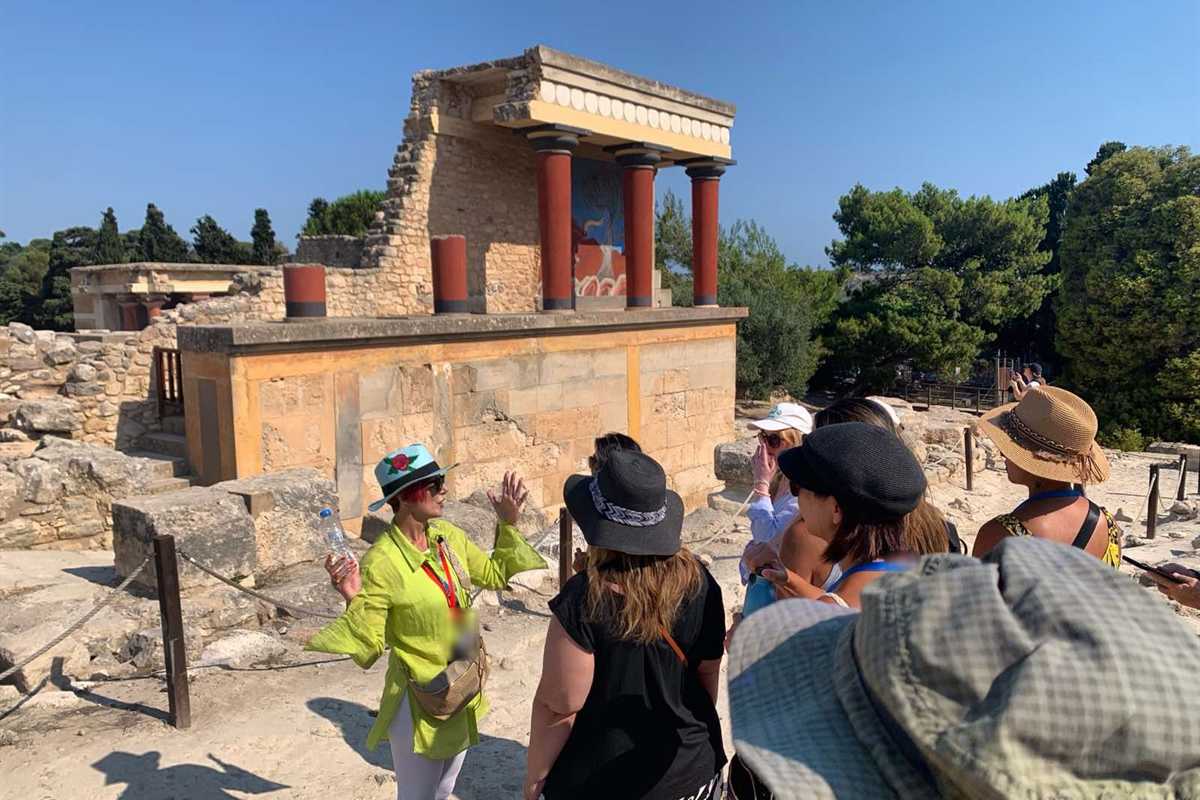
A Knossos palace tour walks through the largest Minoan palace on Crete, just outside Heraklion, with a tour leader who explains its rooms, frescoes and myths. It pairs well with the Greece tours that start on Crete.
What is a Knossos palace tour?
A Knossos palace tour is a visit to the ruins of the Minoan palace on Crete. A tour leader takes the group around the site and explains what visitors see. Knossos is the largest Bronze Age archaeological site on the island.

The Minoans were the Bronze Age people of Crete. The Bronze Age was the era when people made tools from bronze. Knossos has a wide reputation as Europe’s oldest city. An archaeological site is a place where evidence of past activity survives. A Knossos palace tour lets visitors see that evidence up close.
The monumental Palace of Minos dominates the ruins at Knossos. It was a multi-storey complex, with floors built one above another. The whole building covered an area of about 20,000 square metres. On a Knossos palace tour, the tour leader explains how the rooms and levels fit together.
Like other Minoan palaces, the Knossos complex is read as an administrative and economic centre. It is also seen as a religious and ceremonial centre. Scholars still debate whether the palace also served as a royal residence. That debate gives every Knossos palace tour a real puzzle to think about.
The Neopalatial era was the time of the later, rebuilt Minoan palaces. In that era, Knossos reached double the size of Phaistos and Malia. It was also three times the size of Galatas and Zakros. These comparisons help visitors on a Knossos palace tour picture how big the place was.
In ancient times, the palace did not stand alone. It was part of the town that surrounded it. A research effort called the Knossos Urban Landscape Project studied roughly 11 square kilometres of land around the site. Inside that landscape, the town itself spread over roughly 1.5 square kilometres, ringed by cemeteries.
- Town and roads: The remains beyond the palace walls include the Minoan town and roads.
- Villas: Villas rank among the remains found outside the main palace complex.
- Sacred places: Sanctuaries and ritual buildings are also part of what survives outside the palace.
Population figures for Knossos are estimates, not exact counts. In 2500 BC, Knossos had between 1,300 and 2,000 people. For 2000 BC, the estimate climbs to 18,000. For 1600 BC, estimates run from 20,000 to 100,000 people. For 1360 BC, the estimate is 30,000.
Where does a Knossos palace tour take place?
A Knossos palace tour takes place on Kephala hill, a rise of land in the Kairatos river valley. The ruins lie inside the modern municipality of Heraklion, the local area that also covers the city. Visitors explore the remains on the hill itself.
A river valley is low ground shaped by flowing water over a long time. The Bronze Age palace sat on the gently sloping banks of the Kairatos river. Gentle slopes are easier to build on than steep, rocky ground. A Knossos palace tour lets visitors stand on these slopes and picture the river below.
The raised spot on Kephala hill let the palace catch cool sea breezes in summer. Moving air brings relief on a hot day, and a breeze helps to cool the rooms inside. A Knossos palace tour shows how open this raised ground is to the wind.
The setting served trade. This spot gave the ancient town a way to reach the north coast and its harbour. A harbour is a sheltered stretch of water where ships load and unload goods. Routes inland linked the town to the land behind it. With both, goods moved by sea and over land.
The modern city still carries a trace of the past in its name. Heraklion takes its name from Heracleium, the old port that Knossos used as its harbour. On a Knossos palace tour, the tour leader can explain this old tie between the hill and the coast.
The Kairatos runs east of Knossos and reaches the Aegean Sea at Katsampas. That river mouth lies 1.5 km to the east of the Heraklion city centre. A river mouth is the place where fresh water joins the sea. Following the river on a map shows how the valley links the hill to the shore.
- City size: Heraklion ranks fourth among Greek cities by size and is the biggest city on the Greek islands.
- Population: The municipality of Heraklion had 179,302 residents when people were counted in 2021.
- Island setting: Crete holds more residents than any other Greek island, with over 600,000 people living there.
The land around the ruins matters too. UNESCO states that the farmland settings around the Minoan palace sites remain largely undisturbed. Undisturbed means the fields have seen little change. A Knossos palace tour places the palace inside this wider rural scene.
Who were the Minoans behind a Knossos palace tour?
A Knossos palace tour introduces visitors to the Minoans, the people who built this site. Their civilisation was a Bronze Age culture, and its centre was the island of Crete. The ruins at Knossos give visitors a close, direct look at their world.
The Minoan story did not begin with a palace. Around 3100 BC, their civilisation rose from the local Neolithic culture. Neolithic is the name for the late Stone Age of early farmers. Complex towns came later, around 2000 BC. Visitors on a Knossos palace tour see where that slow growth led.
The word Minoan is a modern label, not an ancient one. It comes from the mythical King Minos. Classical Greeks believed that this king ruled Knossos. The Egyptians used another word for the same people, written as kftjw. Egyptologists, the experts who study ancient Egypt, pronounce that word Keftiu today.
Minoan ships began sailing beyond the Aegean to Egypt and Syria. This was possibly thanks to masted ships, with sails on tall poles. Minoan-made goods point to trade with Cyprus, Syria, Anatolia, Egypt and Mesopotamia. The links reached west to Iberia. A Knossos palace tour reveals a people at home on the sea.
The Minoans also settled beyond Crete. Kastri on the island of Kythera held a Minoan settlement. Minoan influence there began in the mid-third millennium BC. A millennium is a span of a thousand years. Closer to Crete, Karpathos, Saria and Kasos held Middle Bronze Age Minoan colonies or trader settlements.
Pottery adds another clue to a Knossos palace tour. A style called Kamares ware shows white, red and orange abstract motifs painted over a black background. Its sherds, the broken pieces of pottery, have travelled far. Kamares sherds have turned up at El-Lisht in Egypt, near a pyramid at that site.
- The Thera eruption: This eruption left sites in north-east Crete abandoned, while Knossos kept prospering.
- Mycenaean rule: After about 1450 BC, the Mycenaeans, Bronze Age Greeks of the mainland, dominated the Minoans.
- A mixed culture: Minoan and Mycenaean ways formed a mixed culture on Crete until about 1100 BC.
Over time, Crete’s language of administration shifted to Mycenaean Greek. Administration here means the official business of running the island. This change reflects the rise of a Greek-speaking elite. A Knossos palace tour makes this chapter of Minoan Crete easy to follow.
How old is the site on a Knossos palace tour?
A Knossos palace tour covers a site where people first settled around 7000 BC. They made their home on Kephala hill, in one of Crete’s earliest Neolithic settlements. Neolithic means the late Stone Age, the age of the first farmers.
In the Middle Neolithic, from 5000 to 4000 BC, the village covered 1 to 2.5 hectares. A hectare is a unit used to measure land area. Between 500 and 1,000 people lived there at that time. The early story on a Knossos palace tour is about this farming village, not a palace.
The first palace went up around 1900 BC. It stood on a hill that people had lived on for thousands of years. A Knossos palace tour picks up the palace story at this point. Around 1700 BC, the first palace was destroyed. An earthquake, or a series of tremors, is thought to be the cause.
After this loss, the palace was rebuilt on a larger and more elaborate scale. The Second Palace period followed, from about 1700 to 1450 BC. These centuries were the peak of Minoan Knossos. A Knossos palace tour therefore deals with two palace phases, not just one building.
Around 1450 BC, the palaces at Malia, Phaistos and Zakros fell. That left Knossos as the only surviving palace on Crete. After about 1450 BC, Knossos became an important Mycenaean administrative centre. Mycenaean refers to the Bronze Age Greeks of the mainland. An administrative centre is a place where public affairs are managed.
A major fire destroyed the palace. The accepted date for this event is about 1350 BC. In its final years, possibly 1330 to 1200 BC, the palace was partly patched up. Patched up means repaired in places, not fully rebuilt. It served as a utilitarian building, which means plain and practical.
- Revival: By 1000 BC, Knossos had re-emerged as one of Crete’s leading centres.
- Roman colony: A Roman colony stood near the palace, but only a small part of it has been excavated.
- New town: In the ninth century AD, local people moved to the new town of Chandax, today’s Heraklion.
Over the millennia, the first settlement on Kephala hill expanded. As it grew, it built up deep archaeological layers. These layers lie beneath the ground that a Knossos palace tour crosses today. Together, they show how long people lived at this spot.
Who dug up the palace on a Knossos palace tour?
A Knossos palace tour tells the story of two diggers. Minos Kalokairinos carried out the first excavations at Knossos. Arthur Evans came later and uncovered the palace that visitors walk through today. Visitors hear both names throughout the site.
Kalokairinos was a Cretan businessman. He was also an amateur archaeologist, digging out of interest, not as a profession. In December 1878, he dug at Kephala Hill. His digging exposed storage magazines in the west wing. Magazines are storerooms, the rooms used to keep supplies. He also exposed part of the west facade.
The dig did not last long. In February 1879, the Cretan parliament halted the work. Its members feared losing the finds to the Ottomans. In 1886, Heinrich Schliemann visited the site. He planned to buy the land for further digging. A Knossos palace tour notes his visit as part of the early story.
Arthur Evans bought a quarter of the Knossos site. The deal gave him the first right to buy the rest later. On 23 March 1900, Evans and his team staged a donkey parade. It ran from Heraklion to Kephala Hill. The parade is a colourful scene to picture on a Knossos palace tour.
Evans did not work alone. Scottish archaeologist Duncan Mackenzie assisted him in excavating the Minoan palace. To excavate means to dig with care to uncover old remains. Evans put 250 diggers to work at Knossos. Within months, the team had uncovered a large part of the building. Evans named it the Palace of Minos.
The major digs at Knossos ran from 1900 to 1905. The digging left the wealthy Evans insolvent, which means out of money. When war broke out in 1914, he halted the work. He went home to write his book, The Palace of Minos. A Knossos palace tour draws on that long effort.
- Gift in 1926: Evans handed the palace, its grounds and the Villa Ariadne over to the British School at Athens.
- New curator: In 1947, Piet de Jong became curator, meaning the person in charge of the site.
- Greek control: In 1951, the Greek Archaeological Service took over as curator of the Knossos site.
Both the Greek Archaeological Service and the British School at Athens have worked at Knossos. Their work covers the palace, the town and the cemeteries, or burial grounds. A Knossos palace tour reflects the labour of every team in this story.
Why does a Knossos palace tour show rebuilt walls?
A Knossos palace tour shows rebuilt walls because wood from a pre-1913 rebuild had rotted. Parts of the palace stood near collapse. Evans then decided to “reconstitute” the palace, meaning rebuild it from what remains. He used reinforced concrete, concrete strengthened with steel.
Architect Christian Doll worked on the palace staircases. He took out the wooden beams that held them up. In their place, he fitted steel beams and coated them in concrete. That coating was made to look like wood. On a Knossos palace tour, the beams pass for timber at a glance. Steel sits inside.
The second storeys of the palace had fallen. Evans turned to Fyfe’s expertise to put them back. With that help, he rebuilt the upper floors along with their supporting beams and columns. The palace regained a second level in these places. A visitor sees rooms rising above rooms, not only ground-level ruins.
A Knossos palace tour explains how Minoan columns looked. They were made of wood, not stone, and were mostly painted red. Their shape is worth a close look. The Minoan inverted column was wider at the top than at its base. In other words, it narrowed as it reached down to the floor.
Evans relied on a team of skilled helpers to carry out his plan. He hired the English artist and architect Piet de Jong to oversee the reconstruction. Émile Gilliéron and his son, also named Émile, served Evans too. Father and son spent three decades at Knossos working for him.
A Knossos palace tour also passes the Throne Room’s anteroom, the room that leads into it. Evans added two reinforced-concrete storeys above this anteroom. In the lower of the new storeys, he displayed fresco copies made by Gilliéron. A fresco is a painting made directly on a wall.
- Pieced-together art: The father and son Gilliéron built frescoes from fragments found in separate areas of Knossos.
- Added detail: Evans rebuilt ceilings, stairways and upper storeys that the archaeological record does not show.
- Lasting choice: Concrete made his work irreversible, or impossible to undo, so new evidence cannot correct it.
Evans’s rebuilt rooms now form part of the site’s history. They still need ongoing monitoring and maintenance. UNESCO says methods for telling authentic remains apart from later reconstructions at Knossos will be developed further. A Knossos palace tour shows both sides of that story.
What is the Throne Room on a Knossos palace tour?
A Knossos palace tour leads to the Throne Room, built for ceremonial use in the 15th century BC. The room sits at the centre of the palace complex. Visitors find it just west of the central court, inside the main palace block.
British archaeologist Arthur Evans unearthed the Throne Room in 1900. The find came during the first phase of his dig at Knossos. An archaeologist studies the remains of past people by digging up buildings and objects. A Knossos palace tour reaches a room that has drawn attention since that first season.
An alabaster seat stands against the north wall of the room. Alabaster is a soft white stone. Evans called this seat a throne. Griffins appear on each side of it. A griffin is a mythical beast with a lion’s body and an eagle’s head. Gypsum benches line three sides of the room.
A Knossos palace tour shows the Throne Room as part of a larger suite. An outer anteroom leads into it. An inner chamber lies further in and was possibly a chapel. The main room also holds a partly screened sunken area. Evans called it a lustral basin, a lowered spot for ritual washing.
Evans did not settle on that name at once. At first, he mistook the basin for an impluvium. An impluvium is a basin that catches rainwater as it falls from above. His next idea was a kitchen fish tank. Each change shows the purpose of the space was not clear at first.
Émile Gilliéron spotted the outline of a griffin in the first fresco fragments from the room. A fresco is a painting on a wall. Facing pairs of stylised griffins were common in later Mycenaean wall painting. Yet they were new to Crete. A Knossos palace tour brings this contrast into view.
- Dating: Archaeologists date the room and its furniture to the Mycenaean takeover, after about 1450 BC.
- Priest-king theory: Evans claimed the seat belonged to a priest-king, with the griffins marking him as more than mortal.
- Shrine theory: Helga Reusch and Friedrich Matz suggested a goddess’s shrine, where an enthroned priestess played her part.
Whichever theory is right, the seat keeps its place in history. It is considered the oldest stone throne in the Aegean region. It is also seen as the oldest throne in Europe. A Knossos palace tour gives visitors the chance to see it.
Which frescoes does a Knossos palace tour show?
A Knossos palace tour explains well-known frescoes such as the Procession Fresco, the Cup-Bearer and the Sacred Grove fresco. A fresco is paint laid on wet plaster. At the palace, visitors see copies, while the originals of certain scenes rest in the Heraklion museum.
The Bull-Leaping Fresco is the fullest restored stucco panel from the palace’s upper east wall. Stucco is a fine plaster. On a Knossos palace tour, visitors learn where this panel once belonged. The scene shows two women at the front and back of the bull. A male youth balances on the bull.
The Prince of the Lilies is not a flat picture. Artists built it up in plaster as a low relief, then painted it. Low relief means shapes raised slightly from a flat surface. Heraklion’s museum holds the original. A copy with flowers stands at the palace for a Knossos palace tour to view.
La Parisienne, also called the Minoan Lady, is a surviving fragment from the Camp Stool Fresco. A fragment is a broken piece that survives from a larger picture. She dates to about 1450-1350 BC. The original is now in the Heraklion Archaeological Museum, not on the palace walls.
In the Queen’s Megaron, dolphin frescoes show that the Minoans knew these sea animals and celebrated them. A Knossos palace tour tells the story of these painted dolphins. The well-known dolphin scene from Knossos was possibly painted on a floor. If so, it lay underfoot rather than on a wall.
Minoan painters turned plain materials into paint. They took black from shale, a layered rock. White came from slaked lime, which is lime mixed with water. Red came from hematite, an iron ore. Yellow came from ochre, a yellow earth. Knowing these sources helps visitors read the colours on the palace walls.
- Skin colours: Minoan painters gave men reddish-brown skin and gave women white skin.
- North Entrance: A stucco fresco at the North Entrance of the palace carries a cattle motif.
- La Parisienne’s name: The French scholar Edmond Pottier chose it, thinking she looked like a woman of Paris.
The oldest true frescoes date to the Bronze Age. They come from Minoan Crete and other Aegean islands. That puts the scenes on a Knossos palace tour within the early history of this art form. Each copy at the site echoes Minoan work.
How does the Minotaur myth shape a Knossos palace tour?
A Knossos palace tour turns a walk among stone walls into a trip through an old Greek myth. Tour leaders at the palace tell the story of the Minotaur. They also explain, in plain terms, why the palace became linked with the Labyrinth.
In the myth, the trouble begins with a request from Minos. He asked Poseidon, the god of the sea, to send him a snow-white bull. The animal was to be a sign of the god’s favour. To punish Minos, Poseidon and Aphrodite made Queen Pasiphaë fall in love with the bull.
The story says Daedalus then built Pasiphaë a hollow wooden cow. He covered it in real cow hide. The monster at the heart of a Knossos palace tour has a telling name. Minotaur joins Minos with tauros, which is Greek for bull. Put together, the name means “Bull of Minos.”
Then the Delphic oracle played its part. This was Apollo’s priestess at Delphi, who gave advice. Following her words, Minos had Daedalus build a huge Labyrinth to hold the Minotaur. The myth places this maze near Minos’s palace at Knossos. That link is why a Knossos palace tour keeps returning to the story.
The word Labyrinth has its own story too. In 1892 Maximilian Mayer proposed that labyrinthos comes from labrys, a Lydian word for a double-bladed axe. Archaeologists once cited over 1,300 maze-like rooms at the palace. They saw the palace as the source of the Labyrinth story, but that idea is now largely rejected.
A Knossos palace tour also recalls a cruel tribute. In different versions, Athens had to send seven youths and seven maidens to the Minotaur. One version says this happened every year. Others say every seven or nine years. As the third sacrifice drew near, the Athenian prince Theseus volunteered to slay the Minotaur.
- Ariadne’s gifts: Ariadne gave Theseus a sword and a ball of thread to retrace his way out.
- Daedalus’s wings: Daedalus built escape wings from moulted feathers, blanket threads, sandal straps and beeswax.
- The fall of Icarus: Icarus ignored the warning, flew too close to the Sun, and the beeswax in his wings melted.
For all its power, the tale stays a myth. Minos’s palace at Knossos has been found, but the Labyrinth itself never was. A Knossos palace tour therefore walks real halls, while the monster’s maze remains part of the story.
How is the palace laid out on a Knossos palace tour?
A Knossos palace tour follows a plan built around one central courtyard. Four wings surround this open space. Together they hold the royal quarters, the workshops, the shrines and the storerooms. Learning this simple plan early helps visitors make sense of the ruins around them.
The Central Court is an open rectangle at the heart of the palace. Its length is double its width. Its long side runs north to south. The court measures roughly 24 by 52 metres. The courts at Phaistos and Malia are almost the same size.
The Central Court organised the whole complex around it. It is thought to have hosted ceremonies, gatherings and movement through the palace. On a Knossos palace tour, visitors stand at the centre of this old plan. That makes the court a sensible starting point for reading the rest of the layout.
The West Court lies directly outside the main entrance of the palace. It was a spacious public area. In the first-palace era, west courts had raised triangular causeways. Causeways are raised walkways for people on foot. These west courts also held kouloures, which are round pits lined with stone.
The palace held extensive storage magazines, chiefly in its west wing. In this setting, the word magazine means a storeroom, not something to read. Another word heard on a Knossos palace tour is pithos, plural pithoi. A pithos is a ceramic jar about as tall as a man, with a large lidded mouth.
Knossos held over 1,000 interlocking rooms. Artisans had their own workrooms among them. Food-processing rooms there held wine presses. In Minoan palaces, corridors sometimes took roundabout routes. This happened even between rooms that shared a wall. On a Knossos palace tour, this maze of rooms and passages needs close attention.
- Stone: Minoan builders at Knossos worked with limestone and gypsum, a soft, pale stone.
- Other materials: Timber, rubble masonry and plaster completed the builders’ list of materials at Knossos.
- Upper floors: In 1910, two extra gypsum blocks fitting gaps in a wall showed a fourth storey once stood.
The North and South Entrances linked the palace to processional routes. A procession is a formal, ordered walk. They also connected it to the town that surrounded it. Leaving through one of these gates ends a Knossos palace tour where the palace met the town.
What are the Grand Staircase and Queen’s Megaron on a Knossos palace tour?
A Knossos palace tour shows the Grand Staircase and the Queen’s Megaron. A megaron is a large hall. The East Wing holds rooms built into the slope of the hill. Two of them bear the names Queen’s Hall and Hall of the Double Axes.
A Knossos palace tour draws attention to the way daylight moved through the building. Light wells, open courts, porticoes and shafts let sun and air into the inner rooms. A portico is a porch with columns. A light well is a space inside a large building that lets light and air reach dark areas.
The Grand Staircase posed a hard problem for the team that dug at Knossos. Excavators were unable to simply uncover it, since its walls were at risk of collapse. Evans brought in two silver miners from Athens. Their tunnel down the staircase allowed the walls and ceilings to be propped up.
On a Knossos palace tour, the Grand Staircase stands in its present form. That form came from the architect Christian Doll. Doll took out the wooden columns of the staircase. In their place, he set stone columns coated in plaster. After that swap, he put the stairs back together again.
The Grand Staircase has also worked as a stage. The dancer Isadora Duncan once performed there, floating up and down its stairs. Evans found social uses for the palace as well. He held tea parties in the Throne Room and in the Hall of the Double Axes. Both rooms were rebuilt later.
A Knossos palace tour also explains the bathroom of the Queen’s Megaron and its bathtub. Filling that tub took real effort. First, someone had to heat the water. Next, the water had to be carried to the bathtub. Last of all, someone poured it in to fill the tub.
- Rebuilt rooms: Piet de Jong’s rebuilding work focused above all on the Queen’s Megaron and the Throne Room.
- Lustral basin: Beside the Queen’s Megaron lies what is thought to be a filled-in, sunken area for ritual washing.
- Warm-weather comfort: Light wells are understood to have added comfort to the palace in warm weather.
Taken together, the stops on a Knossos palace tour place original building work beside later repair. In the East Wing, much of the living quarters took its final shape in the Final Palace Period. These spaces therefore tell two stories at once.
How did water and drainage work on a Knossos palace tour?
A Knossos palace tour reveals an organised water system built into the palace itself. One part of the system brought clean water into the palace. Another part carried waste water out and away from it. Both parts worked together as one planned network.
Fresh water at Knossos did not start inside the palace walls. In Minoan times, aqueducts carried water to Kephala Hill from springs at Archanes. An aqueduct is a man-made channel for moving water over a distance. On a Knossos palace tour, this link between springs and hill shows where the water supply came from.
The palaces of Crete were the first to use an inverted siphon system. An inverted siphon is a pipe that dips down and rises again. Water pressure pushes the flow along, so the water climbs back up after each dip. The Minoans built these lines from clay pipes with a glass covering.
Rain gave the Minoans another way to store water. Their flat roofs and open courtyards collected rainfall for storage in cisterns. A cistern is an underground tank that holds water until people need it. During a Knossos palace tour, the open courtyards help visitors picture how rain was gathered and kept.
Heavy rain created a different task for the palace builders. Storm sewage canals at Knossos took the overflow whenever heavy rain fell. The storm drains include stone-lined channels big enough for a person to crawl through. On a Knossos palace tour, these channels show the scale of the drainage work.
Sanitation formed another part of the plan. By the second millennium BC, the Minoans built flushable pedestal toilets. Examples of these toilets were excavated at Knossos itself. Minoan sanitation facilities drained into stone sewers, and rain flushed those sewers out regularly. A Knossos palace tour connects these finds to daily life in the palace.
- Clay pipes: The Minoans of Crete laid underground clay pipes for both sanitation and water supply.
- Water filters: Ceramic filters were fitted inline into the clay pipes that fed water to homes.
- Sloped surfaces: Channels, drains and sloped surfaces carried rainwater and wastewater away from parts of the palace.
The palace rose as a multi-storey structure with drains and water channels built inside. It also held light wells, open shafts that let light into inner rooms. Visitors leave with a clear picture of how water planning fitted into the whole building.
What do the clay tablets on a Knossos palace tour reveal?
A Knossos palace tour explains how a fire saved the palace’s clay records. Arthur Evans tied the Knossos archive, a store of written records, to a blaze around 1400 BC. That heat baked the clay tablets hard and preserved them.
Linear B was not the only script on Crete. Cretan hieroglyphs were the favoured script at Knossos, in the north of the island. Linear A, by contrast, spread outward from Phaistos in the south. A Knossos palace tour uses this split to show how writing differed between north and south Crete.
The Minoans of Crete wrote in Linear A from 1800 BC to 1450 BC. Experts have deciphered, meaning read and understood, just one Bronze Age Aegean script: Linear B. Linear A and Cretan hieroglyphic both stay unreadable. This gap makes the Linear B records especially valuable to historians.
A scribe was a trained writer, and each one left a personal style on the clay. Experts compare the handwriting to tell these writers apart. The marks point to 66 scribes at Knossos and 45 at Pylos. The oldest Linear B tablets are thought to come from the Room of the Chariot Tablets at Knossos.
The tablets read like a palace supply list. Wool, sheep and grain were common items on them. Religious groups appear among those who received these goods. A Knossos palace tour also mentions a Linear B inscription from Knossos naming the goddess Athena. Her name appears there as A-ta-na.
A Knossos palace tour then turns to Michael Ventris and his work on the signs. He studied sign groups found only on Cretan tablets. He guessed these groups were names of places on the island. On 1 July 1952, he spoke on radio. He said Linear B was Greek, 500 years older than Homer.
- Size of the find: Knossos has produced about 5,500 Linear B fragments, which make up about 4,158 tablets.
- Alice Kober: She filled 40 notebooks and 180,000 scrap-paper index cards with her Linear B notes.
- John Chadwick: After the broadcast, he offered help as “a mere philologist”, a scholar of old languages and texts.
One Knossos inscription names the “mistress of the Labyrinth”. The phrase recalls the old myth of the Minoan labyrinth. A Knossos palace tour links this written title to the legend. Visitors leave seeing the palace as both a real place and a story.
Which sacred symbols mark a Knossos palace tour?
A Knossos palace tour points out Minoan sacred symbols. They include the bull and its horns of consecration, the labrys, the pillar and the tree. Horns of consecration are a stone shape like a pair of bull’s horns. A labrys is a double-bladed axe.
In Neopalatial Crete, horns of stone or clay stood on top of roofs, tombs or shrines. They are thought to have marked holy buildings. Visitors on a Knossos palace tour see such horns on the East Propylaea, which is a gateway. The horns there, made of porous limestone, are restorations.
Two names stand out in the labrys story at Knossos. Kalokairinos saw the double axe carved into massive stone walls. The double axe was a sign of royal authority. On reaching Knossos, Arthur Evans jumped straight into a trench to examine the double-axe signs. A Knossos palace tour recalls both scenes.
The west wing of Knossos held ritual areas, including pillar crypts and repositories. A pillar crypt was a small, dark room. One or more square pillars stood in its centre. These crypt pillars bore the double-axe sign. Channels or basins nearby are thought to have served libations, or drinks poured out as offerings.
A cist is a stone-lined pit or box. Evans named the Knossos cists Temple Repositories because they held objects no longer needed. They are thought to have been stored there after a fire. Bull-leaping was strongly centred on Knossos. Scholars agree that it carried religious meaning, thought to be tied to choosing leaders.
The palace of Knossos is aligned with Mount Juktas on a north-south axis. An expert-led Knossos palace tour explains this line between palace and mountain. Archaeologists have identified a Minoan mountain goddess. She was worshipped at peak sanctuaries. A peak sanctuary is a holy place on a mountain top.
- Clay figurines: Finds at the Juktas peak sanctuary include figures shaped from clay.
- Stone horns and altars: Excavations on the same summit also turned up stone horns and stone altars.
- Bronze double axes: Double axes made of bronze were also among the finds at the Juktas sanctuary.
A chasm, or deep split in the rock, lies within the Juktas peak sanctuary. One scholarly view holds that this chasm was once thought to be the burial site of Zeus. That old belief gives a Knossos palace tour one more sacred story to tell.
What lies beyond the walls on a Knossos palace tour?
A Knossos palace tour centres on the great ruins, but a whole town once spread around them. The Royal Road linked the palace area with parts of that town. Mansions, a villa, a rest house and a tomb still lie outside the main walls.
West of the main palace stands the Little Palace. Its plan holds reception rooms and a peristyle hall, which is a hall ringed by columns. The building also contains a lustral basin-shrine. It tells visitors on a Knossos palace tour that grand rooms reached past the palace walls.
North-east of the palace lies the Royal Villa. Its builders used pier-and-door partitions, which are rows of pillars with doors between them. The villa also has a pillar crypt, a small dark room with a central pillar. A two-flight staircase rises inside as well. Together, these details show careful building close to the palace.
Two more buildings stand north-west of the palace. The House of the Frescoes is a small town mansion with richly decorated walls. The Unexplored Mansion was a private building. Experts think it was used for industrial work. On a Knossos palace tour, they show a town of fine homes and places of work.
South of the palace stands the Caravanserai. Scholars read it as a reception hall and also as a hospice. A hospice here means a rest house for travellers. The Temple Tomb is found to the south as well. It sits almost 600 m away from the palace.
A paved street once ran from the Temple Tomb to the House of the High Priest. One of the last kings of Knossos seems to have been buried in that tomb. This burial gives a Knossos palace tour a human link to the rulers of the palace.
- House name: Evans first named his house Palazzo Evans, then renamed it Villa Ariadne after the Knossos work.
- Battle of Crete: The villa briefly housed the Greek government-in-exile, a government forced to work away from home.
- German headquarters: The villa then served for three years as headquarters of Germany’s military governorship of Crete.
The wartime story of the villa closed with peace. In 1945, the Germans signed their surrender at the Villa Ariadne. A Knossos palace tour therefore touches two worlds. One is the ancient town around the palace. The other is the wartime past of Evans’s house.
Which Knossos finds does the Heraklion museum add to a Knossos palace tour?
A Knossos palace tour shows the ruins in their real setting. The Heraklion Archaeological Museum holds the original finds from Knossos. The museum makes a good partner for a visit to the palace. The site gives the place, and the museum gives the objects that once filled it.
The museum’s Minoan collection includes the masterpieces of Minoan art. These works add real objects to the stories that visitors hear on a Knossos palace tour. The museum’s own story began in 1883. At that time it was just a plain collection of antiquities. Antiquities are objects from the ancient past.
Architect Patroklos Karantinos built the museum in Heraklion’s town centre between 1937 and 1940. The building resists earthquakes and stands as a key example of modernist design. It won a Bauhaus commendation. The Bauhaus was a famous school of modern design. The building itself deserves a look, as well as the objects inside.
The bull’s head rhyton comes from the Little Palace at Knossos and dates to 1600-1450 BC. A rhyton is a ritual vase for pouring liquid offerings to a god. These offerings are called libations, meaning drinks poured out as gifts. The rhyton helps a Knossos palace tour feel like more than a walk among stones.
The snake goddess figurines tell another part of the story. After a destruction around 1600 BC, these objects became sacred relics. They were kept in the Temple Repositories. The figurines are made of painted faience, a glazed ceramic material. They give a Knossos palace tour a glimpse of what the Minoans held sacred.
The Harvester Vase shows a group of men on the move. They carry farm tools as they walk and sing. They keep time to the beat of a sistrum, a rattle-like instrument. The scene feels full of sound and motion. It gives a Knossos palace tour a human side.
- Bull’s head rhyton: Liquid entered through a hole behind the bull’s neck and flowed out through its mouth.
- Phaistos Disc: Tiny seals stamped 241 signs into both sides while the clay was still wet.
- Gold bee pendant: This jewel came from the Chrysolakkos cemetery at Malia and dates to around 1800 BC.
In Greece and Europe, the Heraklion Archaeological Museum counts among the largest and leading museums. A stop there turns a Knossos palace tour into a fuller picture of the Minoan world. Together, the ruins and the finds tell one connected story.
Which Minoan palaces share UNESCO status with a Knossos palace tour?
A Knossos palace tour visits one of six Crete sites in UNESCO’s Minoan Palatial Centres listing. The other five are Phaistos, Malia, Zakros, Zominthos and Kydonia. UNESCO’s World Heritage list names places of worldwide value, and these six stand on it as one group.
UNESCO places the six palatial sites between 1900 BC and 1100 BC. BC dates count backwards, so the larger number marks the earlier time. That means 1900 BC came first and 1100 BC came last. A Knossos palace tour explores ruins that UNESCO places inside this window, like the five other sites.
UNESCO says Minoan civilisation flourished in the Eastern Mediterranean for two millennia, from 2800 to 1100 BC. Millennia means thousands of years. Flourished means the culture grew strong and kept going over that long stretch. The ruins on Crete come from a people who thrived across that sea region.
UNESCO says Crete’s strategic position made it a cultural and economic bridge between Europe, Africa and Asia. Here, a bridge means a link, not a structure of stone. Cultural points to ideas and ways of life, and economic points to trade. A Knossos palace tour begins on the island UNESCO places at this crossing.
UNESCO says the palace plans and building methods show state-like organisation emerging in the Eastern Mediterranean. A state is a society run by a central power with shared rules. State-like means the palaces reveal early signs of that kind of order. The layout itself serves as evidence of that early order.
Phaistos is a Bronze Age site at modern Faistos, a municipality in south central Crete. A municipality is a local area with its own council. Phaistos ranked among Minoan Crete’s three largest cities, together with Knossos and Malia. So the city at the heart of a Knossos palace tour stood in that leading group.
- Malia location: Malia sits roughly 35 km to the east of Knossos, or 40 km east of modern Heraklion.
- Malia palace: It surrounds three courts, Central, North and Northwest, and its size was about 80 by 100 metres.
- Zakros palace: It covered about 8,000 square metres, with about 150 rooms and two paved courtyards.
UNESCO calls the sites an exceptional testimony to the Minoans, one of Europe’s first advanced civilisations. Testimony here means proof left behind by a people long gone. A Knossos palace tour offers a close look at that proof in one of its six homes.
What questions come up about a Knossos palace tour?
A Knossos palace tour is cooler in the fifth month and October than in July. The airport at Heraklion serves the trip. Venetian walls and the Koules fortress stand in the city. Archanes adds Minoan burial finds and local wine.
When is a Knossos palace tour cooler?
July is the hottest of the three months. At the Nikos Kazantzakis Airport station, Heraklion’s average July high reaches 30.3 °C. The fifth month is cooler, averaging a 24.3 °C high at the Nikos Kazantzakis Airport station. October’s average high is 24.0 °C at the Nikos Kazantzakis Airport station.
Which airport serves a Knossos palace tour?
Heraklion International Airport “Nikos Kazantzakis” serves the trip. It ranks as the second busiest airport in Greece, behind Athens. The airport lies near the municipality of Nea Alikarnassos, east of Heraklion city centre. Its name honours Nikos Kazantzakis, a Greek writer and philosopher born in Heraklion.
Which Venetian sights in Heraklion pair with a Knossos palace tour?
Heraklion’s Venetian walls rank among Europe’s best preserved Venetian fortifications. Nikos Kazantzakis is buried on the Martinengo Bastion, the highest point of the walls. A bastion is a fortress corner that sticks out. In 1630, the Koules fortress carried 18 ground-floor cannons and 25 on its roof path.
What is Archanes near a Knossos palace tour?
Archaeological evidence shows ancient Archanes stood on the same ground as the modern town. The Phourni cemetery at Archanes covers 6,600 square metres and holds 26 burial buildings. A quarter of the wine made in Archanes is exported to Germany, France and the Netherlands.